Turn First-Party Data Into Pipeline Growth
Explore proven ways to capture, organize, and activate customer data for smarter B2B marketing decisions.
 Lead-Gen now on Auto-Pilot with
Build My Campaign
Lead-Gen now on Auto-Pilot with
Build My Campaign

Discover 7 first-party data governance mistakes that can hurt revenue and learn how to improve data quality, compliance, and business growth.


Turn First-Party Data Into Pipeline Growth
Explore proven ways to capture, organize, and activate customer data for smarter B2B marketing decisions.
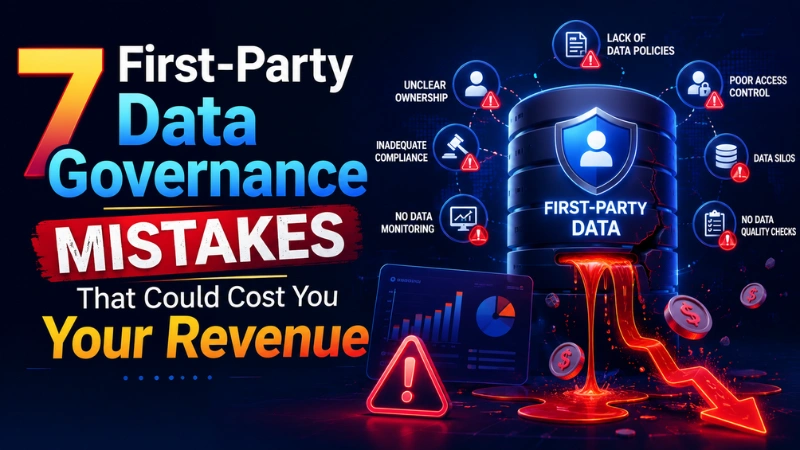
If you could see your CRM through the eyes of an auditor, you would probably find a few things you would rather not explain. Organizations rarely intend to create a non-compliant data program, but that is exactly what happens when you treat governance like a one-time project instead of an operating system. Most teams face genuine resource constraints and competing priorities that make perfect governance challenging from day one. The companies in this piece, H&M, Experian, and teams just like yours, did not intend to create problems. They just chose speed over structure one too many times.
These companies are not cautionary tales about reckless organizations. They are teams running standard B2B revenue stacks. Their mistakes are common. Their price tags were not.
First-party data governance failures typically involve poor consent management, excessive data access, weak retention policies, and inadequate source documentation.
Here are seven first-party data governance failures with receipts, what went wrong, and how they found a better way to stop patching holes and start building a structure that catches the next drift automatically.
Legitimate interest is a real, usable lawful basis under GDPR. It is not a blanket exemption. It means you need a documented reason for using the data and a clear explanation for why that use is fair. You also need to be transparent about where you got their info and make it easy for them to object.
The lesson for any B2B first-party data strategy is not to never use legitimate interest. It is that you must document it properly or be prepared for a long, expensive conversation later.
Access to sensitive data should be restricted to people who need it for a specific, documented purpose. It is not about letting everyone on the team have a look, and it is certainly not about managers having access by default. If someone does not need the data to do their job, they probably should not have access to it.
Turn First-Party Data Into Pipeline Growth
Explore proven ways to capture, organize, and activate customer data for smarter B2B marketing decisions.
Contact data performs best with continuous validation, though many organizations start with quarterly reviews before scaling to real-time processes. Duplicate detection, email verification, and field enrichment should run as an ongoing process tied to your first-party data collection engine, not a one-time scramble before a big campaign.
Consent capture belongs at the point of collection, embedded into the form, the chatbot, or the event registration, not bolted on after the fact once legal flags a gap in your process.
Every dataset needs a clear shelf life. When that time is up, the data should be deleted or anonymized, not left in a forgotten backup folder.
Collecting a phone number for sales outreach and using that same number for an ad retargeting audience are two different processing purposes. Your records must reflect these distinct uses.
You need to be able to point to every single contact in your database and explain exactly where they came from. This is especially true for purchased lists, third-party data, or those random co-registration sign-ups. If you cannot produce the receipt for that data, you are essentially betting that nobody will ever ask questions.
| Mistake | Core Issue | Typical Business Impact |
| Legitimate Interest | Using it as a blanket loophole. | Expensive, years-long legal battles. |
| Data Access | Over-sharing sensitive info. | Massive regulatory fines. |
| CRM Hygiene | Treating cleanup as an annual event. | Declining data trust and low conversion. |
| Consent Timing | Bolting it on after collection. | Inability to prove compliance during audits. |
| Retention | Keeping data indefinitely. | Major liability during breach investigations. |
| Purpose Mapping | Single yes/no flags for all uses. | Accidental spamming or regulatory non-compliance. |
| Source Tracking | Trusting vendors without receipts. | Unverifiable and risky lead lists. |
Every mistake on this list traces back to the same root cause: treating data governance as a one-time setup instead of an operating system. The companies that fixed it fast shared one thing in common. They stopped patching individual problems and built a structure that catches the next one automatically.
The most common first-party data governance mistake is treating compliance as a one-time project instead of an ongoing operational process. If you want a clear-eyed look at where your own data governance has gaps before they turn into a major remediation project, talk to the Valasys data solutions team. We have audited enough first-party data programs to know exactly which of these seven mistakes is likely sitting in your stack right now.

Treating consent as a one-time checkbox instead of a continuously tracked data field. This breaks the moment a user opts out of one channel because that signal fails to propagate to the rest of the revenue stack.
Fixing the issue helps, but it does not erase what already happened. Regulators want to see you fix it, but they also want to deter others, so they often keep the fine in place to make a point.
No. It requires a documented balancing test for first-party data governance compliance where you weigh your business goals against the person’s privacy rights. Without that document, you are flying blind.
Tie your retention to the specific purpose. If someone has not engaged with you in two years, the justification for holding their data is usually gone. Use automated purging tools.
It means having a consent record for each specific action, like email marketing or phone outreach, instead of one big yes for everything.
It can have a significant impact on revenue performance. One remediation project we know of found a 14% lift in conversion just by cleaning up the database. The time your reps spend cleaning data is time they are not selling.
Q7. Should we trust a third-party data vendor’s consent claims?
Never take it on faith. If they cannot show you the documentation proving exactly when and how they got the consent, do not touch that data.
Q8. What is the “need-to-know” access standard?
Only people who need specific data for a documented, daily part of their job should have access. If a manager does not need to see health or financial details to do their job, they should not see them.
Q9. Is it possible to recover after a major compliance failure?
Yes. By appointing a dedicated lead and becoming hyper-transparent with their remediation process, companies can regain regulatory trust.
Turn First-Party Data Into Pipeline Growth
Explore proven ways to capture, organize, and activate customer data for smarter B2B marketing decisions.