Turn First-Party Data Into Pipeline Growth
Explore proven ways to capture, organize, and activate customer data for smarter B2B marketing decisions.
 Lead-Gen now on Auto-Pilot with
Build My Campaign
Lead-Gen now on Auto-Pilot with
Build My Campaign

Learn how to choose the right customer data platform (CDP) for B2B marketing, from data integration to audience insights and ROI.

Turn First-Party Data Into Pipeline Growth
Explore proven ways to capture, organize, and activate customer data for smarter B2B marketing decisions.
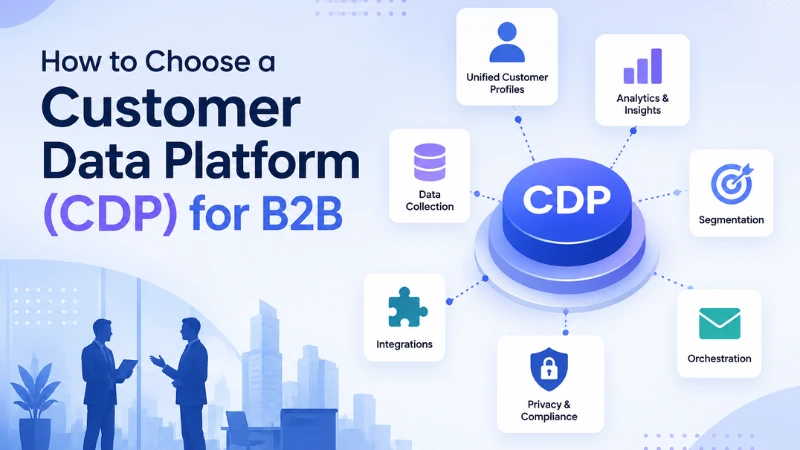
Every revenue team has lived this exact nightmare: Your sales rep is gearing up for a high-stakes enterprise pitch. Meanwhile, marketing is blasting that same account with a generic nurture sequence, and customer success is hitting them up to schedule a Quarterly Business Review (QBR). All three teams are operating in total isolation, pulling mismatched data from three disconnected systems.
Then the prospect picks up the phone and says, “Look, I have gotten four emails and two conflicting calls from you this week about different things. Who is actually running my account?”
Cue the awkward, incredibly expensive silence.
That is what happens when your data lives in unvetted silos. It is precisely the problem a Customer Data Platform (CDP) is built to solve.
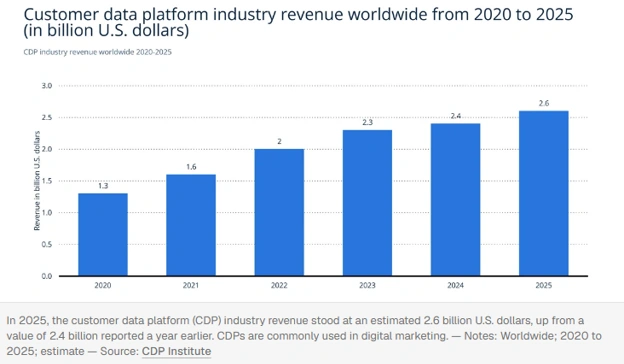
The market has exploded. Global CDP industry revenues crossed $2.6 billion, driven largely by enterprise AI adoption and architecture shifts. But if you read the standard industry blogs, you will notice a glaring flaw. Most CDP content focuses on B2C use cases trying to personalize email campaigns about sneakers.
The buying motion in mid-market and enterprise accounts is a completely different beast. Your platform selection needs to reflect that.
If you are amongst the operators making the actual call: RevOps leaders, CMOs, and CROs who need a platform that maps to complex buying committees, account-based workflows, and long sales cycles, this blog is for you.
Turn First-Party Data Into Pipeline Growth
Explore proven ways to capture, organize, and activate customer data for smarter B2B marketing decisions.
At its most basic level, a CDP ingests data from every conceivable touchpoint; CRM, marketing automation, web analytics, product usage, support tickets, and intent signals; and stitches it into unified profiles.
But in an account-based environment, you are not just resolving individual consumer contacts. You are resolving entire accounts. When you combine a website visit, a chat log, and an email click, you find out exactly which target company is checking you out.
Enterprise deals typically involve multiple stakeholders across departments with extended sales cycles. If your platform only maps to individual consumer journeys via browser cookies, it will completely fall apart the moment you ask it to aggregate signals and surface buying committee overlap.
Furthermore, a data platform serves as the ultimate engine for your b2b first party data strategy guide. With privacy laws tightening globally and third-party tracking dying a slow death, the directive is clear: own your data infrastructure or lose your market edge.
Most vendor blogs recycle the same basic definitions. To actually win this space, you need to talk about the tactical realities of running a modern revenue engine.
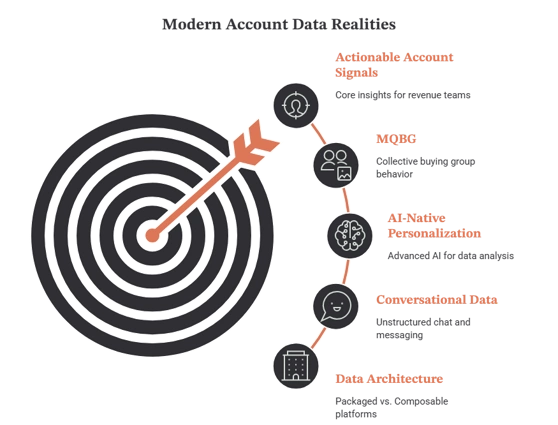
The traditional Marketing Qualified Lead (MQL) is increasingly inadequate for complex B2B sales cycles. Tracking a single whitepaper download from a mid-level manager does not win enterprise deals. Instead, modern revenue teams are moving toward the Marketing Qualified Buying Group (MQBG).
A sophisticated data platform tracks when multiple stakeholders from the same account collectively cross a behavioral threshold. If a Director of IT downloads a security document, the VP of Procurement views the pricing page, and an end-user runs a product demo all within 72 hours, the platform flags the buying group as hot. That is an actionable account signal; a single isolated lead score is just noise. This is exactly the type of persona intent problem the VAIS Find Prospect Feature is built to solve.
Every software vendor slaps an AI sticker on their homepage, but true AI-native features do more than just write email subject lines. They feature predictive identity resolution (using machine learning to accurately link anonymous activity to messy enterprise accounts when deterministic identifiers match poorly) and autonomous segmentation.
Instead of an operations manager manually building hundreds of static lists, AI-driven ICP scoring platforms continuously analyze behavioral data to auto-generate dynamic account cohorts based on real-time churn risk or expansion intent.
Look at your current data stack. Where are your WhatsApp conversations, chatbot interactions, and AI agent transcripts going? For most companies, they are completely lost in isolated tools.
Modern buyer journeys happen in chat windows and messaging channels. A true next-generation platform ingests this conversational data, uses Natural Language Processing (NLP) to extract intent keywords, and appends those insights directly to the unified account profile.
The biggest architectural split in data operations today is choosing between a packaged platform and a composable platform.
A data platform is an accelerator, not a magic wand. It does not clean your data. In fact, enterprise research reveals that B2B databases face a natural decay rate of over 30% each year due to rapid job shifts and corporate restructuring. The downstream impact is severe: Salesforce data shows that only 35% of sales professionals fully trust the accuracy of their internal CRM data.
If your CRM features duplicate accounts, missing firmographic details, and five different spellings for the same enterprise client, your platform will simply unify that chaos into a single, perfectly structured mess. You must run a thorough data audit before ingestion, or you are simply buying an incredibly expensive garbage disposal.
When evaluating vendors, look past the glossy UI and pressure-test these four core capabilities during a proof of concept.
Contact-level resolution is table stakes. What matters is whether the platform can stitch multiple distinct contacts to a single parent account record, deduplicate across your CRM and marketing automation platforms (MAP), and link anonymous web sessions to known accounts. Demand a live demo using your messiest real-world data, not a pristine vendor sandbox.
A platform that syncs data via batches every 24 hours is a liability. You need real-time or near-real-time activation. When a target enterprise account triggers a high-intent signal, your sales development reps and account managers need to know within minutes, not the following Tuesday.

The average enterprise tech stack runs dozens of tools. Every integration that requires custom engineering is a future maintenance headache. Prioritize platforms with pre-built, bidirectional connectors to your warehouse, CRM, and ad networks. If you have already deployed a first party data collection engine, you want a platform that ingests from those sources without friction.
Compliance isn’t just a legal check-the-box exercise; it’s a revenue protection strategy. A platform without robust data lineage documentation and consent flags creates massive compliance risks that can halt active campaigns and trigger regulatory fines.
Use a first-party data governance framework to keep consent, lineage, access, and data-quality controls operational.
Evaluating options requires balancing deployment style against your existing stack. The table below outlines how top players stack up for account-centric operations.
| Platform | Best For | Account-Level Resolution | Architecture Type | Starting Price (Approx.) |
| Segment (Twilio) | Mid-market, product-led growth (PLG) teams | Yes, via Personas / Unify | Packaged (Hybrid options available) | ~$120/month (Growth tier) |
| Salesforce Data Cloud | Enterprise, Salesforce-native ecosystems | Strong (Native account architecture) | Packaged / Deeply integrated | $108,000/year (Base price) |
| Adobe Real-Time CDP | Enterprise with complex multi-channel marketing | Yes (B2B Edition) | Packaged | Custom Enterprise |
| ActionIQ | Complex enterprise with hybrid infrastructure | Strong | Composable and Packaged options | Custom Enterprise |
| Treasure Data | Global enterprise with massive data volumes | Strong | Packaged | Custom Enterprise |
| Lytics | Content-driven marketing, mid-market | Moderate | Packaged | ~$3,000/month |
Pricing sourced from vendor documentation and aggregated G2 category data. True enterprise contracts scale based on data volume, profiles, and ingestion compute.
The cost that never appears in the table: professional services. Implementation for a complex B2B stack typically runs $50,000 to $200,000 on top of platform licensing, depending on the vendor and your stack complexity. Ask for that number upfront. Most vendors bury it.
IBM leveraged Salesforce Data Cloud to consolidate disparate account records, communication channels, and internal infrastructure across its global operations. Moving away from manual data reconciliation between internal databases and legacy systems allowed account teams to view complex enterprise relationships through a single pane of glass, eliminating conflicting sales outreach and streamlining the B2B seller experience.
Asana deployed Twilio Segment to transition away from fragmented point-to-point data integrations and build a unified, warehouse-connected customer data framework. Eliminating a reliance on manual data wrangling and analytics support queues slashed audience creation loops from two days to same-day execution, saving their go-to-market teams over 250 working days in a single year. By resolving identities across anonymous web visits and known in-product behavior, Asana activated precise, real-time engagement triggers that ultimately drove a 57% increase in web leads from paid media campaigns.
Henkel successfully unified customer interactions across 30 distinct brands, 300 web domains, and 40 global markets through its custom digital business platform, RAQN, powered by Adobe Real-Time CDP. By replacing weeks of manual database querying with automated, real-time audience segment creation, regional marketing teams accelerated campaign launch timelines from months to days, turning fragmented data into instant personalization at scale.
Before you can fully activate an enterprise platform, you need to understand the strategic differences when comparing first party vs third party data b2b marketers utilize daily.
Third-party data is rapidly losing its utility. High-performing teams are turning instead to direct interaction data and zero party data b2b marketing techniques; such as interactive calculators, onboarding flows, and preference centers, to collect explicit consent and intent directly from the buyer. Your platform must be configured to prioritize these high-trust inputs over legacy third-party lists.
Before committing to a multi-year software contract, run your vendors through this diagnostic checklist:
The sunsetting of traditional tracking methods means you need a system that thrives on owned identifiers. Transitioning to cookieless marketing in B2B requires an infrastructure that links anonymous corporate IP addresses and content interactions to known accounts without relying on cross-site tracking. A modern data platform serves as the operational bridge for this transition, turning raw web traffic into addressable first-party audiences.
Choosing a B2B Customer Data Platform isn’t a technical purchase; it’s an operational commitment to how your company goes to market. The software will only perform as well as the data strategy driving it, the quality of the inputs you feed it, and the cross-functional alignment of the teams using it.
If your data engine is currently fractured, buying software won’t automatically fix it. Success starts with a comprehensive audit of your existing assets, identifying where your data is breaking down, and engineering a clean foundation before you scale.
Ready to build a unified data foundation that drives real revenue results? Valasys’s Data Solutions practice partners with modern enterprise teams to audit, clean, and structure data assets. Contact us to ensure your infrastructure is fully optimized before you invest in a CDP, making sure your platform delivers genuine, actionable account intelligence from day one.
A B2C platform focuses on tracking individual consumer behaviors, resolved primarily through cookies, personal emails, and device IDs for high-volume, rapid-fire transactions. A B2B platform must resolve complex account-level identities, mapping multiple individual stakeholders, corporate structures, and long sales cycles back to a unified business account record.
A packaged solution is an all-in-one software solution that ingests, processes, stores, and activates data inside its own proprietary platform. A composable platform separates these layers, using reverse ETL tools to activate data directly from your existing cloud data warehouse (like Snowflake or BigQuery) without creating duplicate storage silos.
No, it does not replace a CRM. A CRM functions as a transactional system of record for sales teams to track manual interactions, deals, and pipelines. A CDP sits on top of your technology stack, automatically ingesting data from the CRM alongside web analytics, product usage, and support tickets to clean, unify, and distribute data back to all channels.
An MQBG is a modern marketing metric that tracks the collective behavioral signals of multiple stakeholders within a single target account. Unlike a traditional individual MQL, an MQBG triggers an alert when cross-departmental decision-makers collectively engage with high-intent content, indicating organizational buying intent.
AI-native systems utilize machine learning models and probabilistic algorithms alongside deterministic rules to resolve identities. They analyze messy, fragmented data points—such as anonymous IP addresses, corporate email variations, and web behavior—to accurately match anonymous interactions to the correct parent enterprise account, even when explicit identifiers are missing.
The elimination of third-party cookies drastically reduces the accuracy of traditional ad targeting, retargeting, and third-party intent data streams. Teams are adopting data platforms to centralize and activate their own first-party data assets, allowing them to track, identify, and engage accounts using data they own and control directly.
No, it will not automatically clean pre-existing dirty data. If your CRM contains duplicate records, outdated contacts, and inconsistent firmographic fields, the platform will simply unify those errors into its profiles. Organizations must execute a comprehensive data audit and cleansing process prior to deployment to avoid scaling bad data.
While software vendors frequently quote implementation timelines of 30 to 60 days, real-world deployments generally require three to six months. This extended timeline accounts for mapping complex account hierarchies, configuring custom data pipelines, cleansing legacy databases, and establishing cross-functional team workflows.
Turn First-Party Data Into Pipeline Growth
Explore proven ways to capture, organize, and activate customer data for smarter B2B marketing decisions.