
From Intent Data to Intelligent Action: How Agentic AI Is Transforming Sales Pipelines
Discover how agentic AI transforms B2B sales by turning intent data into action, accelerating pipelines, personalizing outreach, and driving higher ROI.

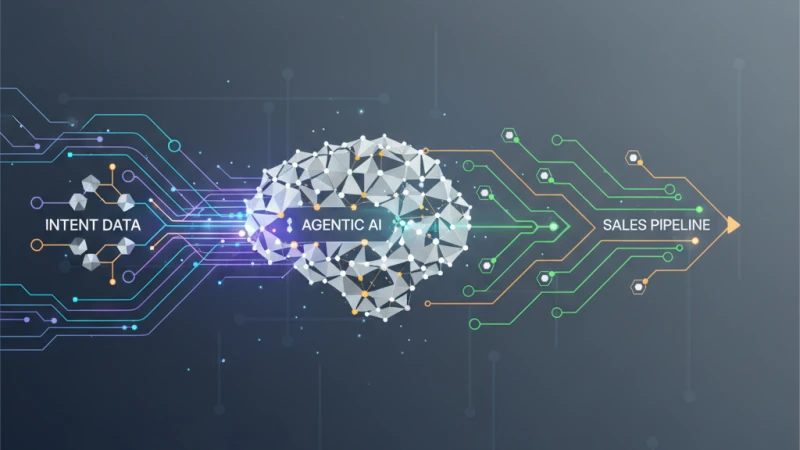
The way B2B companies convert prospects into customers is undergoing a fundamental shift. Intent data has long promised to reveal which accounts are actively researching solutions, but turning those signals into closed deals has remained a persistent challenge for sales and marketing teams.
Enter agentic AI, an emerging category of autonomous systems that can independently plan, execute, and optimize sales tasks with minimal human oversight. Unlike traditional automation tools that follow rigid rules, these intelligent agents adapt to changing market conditions and customer behaviors in real time.
The Growing Gap Between Intent and Action
B2B buyers now conduct an average of 12 online searches before visiting a specific brand’s website. By the time they contact your sales team, they are already 60 to 90 percent through their decision-making process. This hidden research phase represents both an opportunity and a challenge for revenue teams.
Research indicates that 99% of businesses report increased sales or ROI after implementing intent data strategies. Yet many organizations struggle to act on these signals quickly enough to influence buying decisions. The average B2B sales cycle stretches beyond four to six months, creating countless moments where deals can stall or slip to competitors.
Manual lead qualification processes often extend sales cycles dramatically. What one SDR considers a high-priority lead might be dismissed by another, leading to inconsistent pipeline health and missed opportunities. This is precisely where intelligent automation delivers its greatest value.
What Makes Agentic AI Different
Traditional sales automation tools handle single, repetitive tasks like generating email templates or scheduling follow-ups. Each function operates separately and typically follows pre-set rules that require human input at nearly every stage.
Agentic AI systems take a fundamentally different approach. These platforms can sense what is happening across your sales ecosystem, reason about what actions to take, make autonomous decisions, and execute complex workflows to reach defined goals. The technology continuously learns from outcomes and refines its strategies based on real-world results.
According to recent industry analysis, companies implementing agentic AI in sales can expect 20 to 30 percent increases in pipeline generation and up to 80 percent reduction in lead response times. Some organizations report up to 300 percent increases in qualified leads after deploying these autonomous systems.
Turning Intent Signals Into Revenue
The real power of agentic AI emerges when it connects directly to your intent data infrastructure. These systems continuously scan digital signals including funding rounds, hiring surges, technology adoption patterns, and content consumption behaviors to identify potential customers before competitors even notice them.
When a target account shows a sudden uptick in research activity around topics relevant to your solution, agentic AI can immediately trigger personalized outreach sequences. The system crafts unique messages tailored not just to an industry, but to the specific role, company context, and recent activity of each contact.
A CEO receives a strategic value pitch while a sales manager gets a tactical solution case study. This level of personalization at scale was previously impossible without massive team expansion. Now, companies are achieving hyper-relevant engagement across thousands of accounts simultaneously.
What 2026 Holds for B2B Sales

The pace of transformation is accelerating rapidly. Forrester predicts that by 2026, at least 20% of B2B sellers will be compelled to respond to AI-powered buyer agents with dynamically delivered counteroffers via their own seller-controlled agents. This marks the emergence of true agent-to-agent commerce in B2B transactions.
According to G2 research, more than 35% of enterprise companies will allocate budgets of $5 million or more for AI agents in 2026. About 10% will invest $10 million or more as their agentic workflows mature and deliver measurable efficiency gains.
Juniper Research projects that customer interactions automated by AI agents will explode from 3.3 billion in 2025 to more than 34 billion by 2027. This surge reflects accelerating enterprise adoption as platforms enable automation across customer support, marketing, and sales functions.
Industry analysts suggest 2026 will create a clear dividing line between organizations that are merely AI-enhanced and those that become truly AI-native. While some teams will manage individual AI tools, others will deploy autonomous systems generating pipeline around the clock.
Reshaping the B2B Sales Funnel
The traditional marketing qualified lead has long served as the handoff point between marketing and sales teams. However, this model creates friction and delays that modern buyers simply will not tolerate.
In what some industry experts call the AI Marketing Funnel, intelligent agents handle qualification and follow-up steps instantly. Rather than marketing passing 1,000 MQLs to sales and hoping they get worked, an AI agent can engage every lead as it arrives, nurture relationships, and hand off only when the prospect is genuinely sales-ready.
Looking further ahead, Gartner predicts that by 2028, 90% of B2B buying will be AI agent intermediated, pushing over $15 trillion of B2B spend through AI agent exchanges. Companies that fail to prepare for this shift risk losing relevance in an increasingly automated marketplace.
The Human-AI Partnership
It is important to understand that agentic AI does not replace human sellers. Instead, it removes the least desirable tasks from their workload and frees them to focus on relationship building and complex deal strategy.
Account executives and sales managers can spend more time in front of customers rather than updating CRM records, scheduling meetings, or researching prospects. Automation and AI have already yielded 10 to 15 percent efficiency gains in recent years. With agentic systems in the mix, those improvements are accelerating significantly.
In 2026, sales enablement must address a new audience: the buyer’s digital gatekeeper. Success will depend on clear, structured, and data-rich messaging that AI can interpret and forward. Representatives who communicate tangible ROI and measurable benefits will thrive in this environment.
Getting Started With Intelligent Sales Automation
Organizations looking to implement agentic AI should begin with clear alignment between sales and marketing teams. Both groups need visibility into the same intent dashboards and should work from shared prioritization criteria.
Data quality matters enormously. Ensure your customer and prospect information is clean, compliant with privacy regulations, and regularly updated. Intent signals lose value quickly, so working with providers that refresh data frequently will improve your results substantially.
Consider running a 90-day pilot that replaces one SDR queue with AI agents. Track meetings booked, cost per lead, and pipeline velocity to establish clear ROI benchmarks. Many organizations see measurable lift within the first three months of deployment.
The Competitive Imperative
The AI orchestration market is projected to reach $30 billion by 2027, potentially three years ahead of earlier estimates. This acceleration reflects how quickly enterprises are adopting multi-agent systems to boost accuracy and outcome quality across their revenue operations.
Early adopters are building capabilities that will be difficult for competitors to replicate. They are identifying prospects earlier, engaging them more effectively, and closing deals faster than organizations still relying on traditional methods.
The question facing B2B revenue leaders is no longer whether to adopt these technologies. It is whether they will be among the companies that benefit from early adoption or those playing catch-up in an increasingly automated marketplace.
Conclusion
The transformation from intent data collection to intelligent action represents one of the most significant shifts in B2B sales strategy in decades. Agentic AI bridges the gap between knowing who might buy and actually converting those prospects into customers.
For organizations ready to move beyond static automation and embrace truly autonomous sales intelligence, the opportunity has never been greater. The technology exists today to deliver personalized engagement at scale, accelerate pipeline velocity, and empower human sellers to focus on what they do best: building relationships and closing deals.