
How Do High Quality Electrical Components Improve Product Reliability?
Learn how high-quality electrical components improve product reliability, performance, safety, and long-term operational efficiency.


Just consider the last time you were disappointed with a device. Perhaps it was an auto that failed to start on a cold morning, industrial machinery that died during the middle of the day, or maybe a consumer gadget that just died after a couple of months.
The problem is most likely not the large, obvious components, but a small component hidden away somewhere: a connector that has corroded, a capacitor that broke down when heated, a wire that was overloaded. It’s the unsung hero of just about every product that we rely on: the electrical component. The difference between good components and lower quality ones is not just about performance under peak conditions, it’s about performance under less-than-ideal conditions.
The Hidden Cost of Cutting Corners
When looking to produce items at scale, every cent counts and it’s easy to look at how much each component is and get the urge to save money on that. However, there is a problem with this: component quality will catch up.
Common Failure Points
- Thermal Stress: Can cause low-grade capacitors to degrade more quickly.
- Oxidization: Connectors whose plating is not good become oxidized and cause resistance over time.
- Environmental Damage: Poorly-insulated wiring can crack, fray, or even fail altogether due to vibration, moisture, or temperature fluctuations.
Each of these failure points is not simply a problem for one unit; it can compromise your product line, your warranty and even your brand reputation. Tight tolerances are used in high quality components. That is, they are more consistent over a broader range of circumstances, more enduring under stress and less prone to failure. The initial price difference is typically small. Downstream savings returns, repairs, and customer trust can be huge.
Why Component Quality Matters More in Complex Systems
Today’s products are not straightforward. Miles of wiring can be found in a mid-range EV. High currents, complex switching, and continuous operation are all requirements of industrial control panels. In the medical device arena, failure is not only inconvenient, it’s dangerous. Systems like this have the quality of each individual component contributing to the integrity of the system. A weak link can make all the difference.
The Example of Wiring Harnesses
For applications where power loads are important whether it be automotive, aerospace or heavy industrial equipment, high voltage harnesses are subjected to a lot of electrical load and conditions that will quickly reveal any weakness. Temperature cycling, mechanical vibration, exposure to chemicals or moisture are not edge cases; they are commonplace. Quality wire, connectors, and sturdiness in the insulation construction of harnesses can take this beating. It’s the only thing that can be more affordable.
The Multiplicative Nature of Reliability
That is why the design engineers do not only specify the component by function, they specify by the quality tier. They understand that for a complex system, reliability is multiplicative.
- A system level reliability of 100 components that each have a 99% reliability is ~37%.
- If that per-component rate goes up to 99.9%, the system level rate becomes 90%.
The math is cold and it’s why a quality-minded engineer almost becomes a maniac when selecting components.
The Importance of Sourcing and Manufacturing Standards
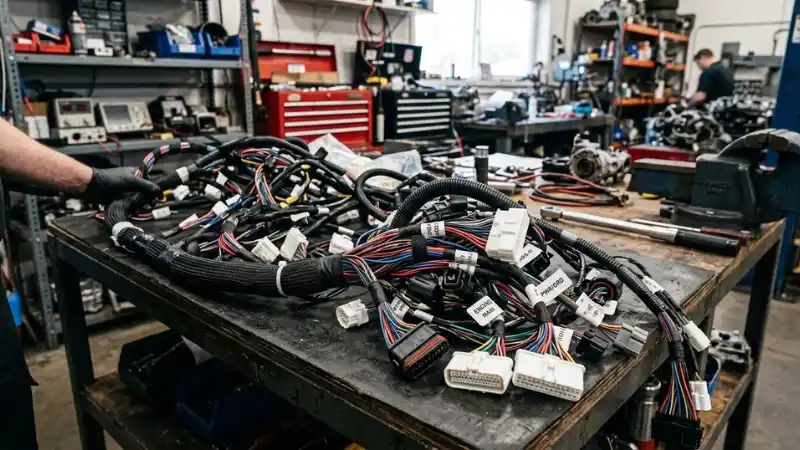
Quality of components doesn’t begin at the drawing board, it starts with who is making them, and how. For instance, a good Wiring harness manufacturer doesn’t simply put together wire and connectors. They check raw materials against specifications, ensure uniform manufacturing procedures, and test the finished assemblies in the environment where they will be used, and keep track of all the work that has been accomplished, so if something goes wrong, it can be traced and remedied quickly.
Such controlled production is of utmost importance. Two harnesses may seem the same on the surface, but over time they may give two different results depending on the quality of the materials used and how they are made. Issues often include:
- Solder joints that aren’t properly inspected.
- Non-specifically crimped terminals.
- Insulation material which falls slightly short of the rated temperature range.
None of these problems are perceptible to the unaided eye, but these all lead to decreased product life. Searching for a product from a manufacturer who has quality in mind, who invests in the proper tooling, trained technicians, and worthwhile testing, you’re not simply purchasing a part. You’re buying assurance.
Reliability in the Real World – What Does It Truly Look Like?
Let’s get practical. Suppose that two manufacturers are creating the same style of motor controller. One buys parts mainly on the basis of cost. The other calls for parts that have more precise tolerances, connectors that have superior contact plating, and a supplier with excellent quality control.
Both products may be equally effective during the first year. By year three, however, the first manufacturer began receiving warranty claims of failing capacitors in high-temperature environments, connectors with intermittent connections, and early degradation in wiring insulations. Customer satisfaction drops. Support costs climb.
The second manufacturer? They have low returns, good feedback, and repeat customers. Not for luck due to intentional choices they made in their products.
Reliability is a Design Philosophy, Not Just a Spec
It’s important to take a moment and realize that product reliability is not something you design for at the end, but it’s something you design for from the start. Part of that philosophy is high quality electrical components.
This means:
- The components should be rated for more than, not just, their intended operating conditions.
- The supplier should be able to show consistent quality, not just a low price.
- Realizing that the expense of failure in terms of warranty, reputation, and lost customers is almost always greater than the expense of doing it right.
Wrapping Up
Trust is the foundation of a great product. But, in the world of electronics and electrical systems, trust is established by the components, one by one. When the wiring is there to hold up and connectors remain solid, and components function as they should each and every year it is not a coincidence. It’s a product of deliberate decisions, made well before it ever reaches a customer.
It isn’t only a technical decision when you invest in the quality components. It is a business decision, a customer experience decision and most of all a statement of what your product is about. Once you have that foundation down, reliability is usually a result.