
How Full-Desk Recruiters Can Balance Billing and Business Development
Learn how full-desk recruiters balance billing and business development with a daily BD block, a lead priority order and a 60-minute outreach plan.

Full-desk recruiters balance billing and business development by protecting a fixed block of time for BD every day, prioritizing the highest-signal leads, and automating the research so their limited BD time goes into conversations. The common failure is treating business development as something to do when the desk is quiet, which means it only happens when the pipeline is already empty.
What is a full-desk recruiter?
A full-desk recruiter owns the whole placement: winning the client, taking the job order, sourcing candidates, managing interviews and closing the offer. It is the most common setup in small and mid-sized staffing firms, and the hardest to sustain, because both halves of the job compete for the same hours.
Why does business development always lose?
Delivery has deadlines. A client is waiting for a shortlist, a candidate needs prepping, an offer needs closing. Business development has no deadline until the day you run out of open roles. So it gets pushed to “later”, and later becomes a quiet month with nothing to fill.
This is the feast-and-famine cycle almost every full-desk recruiter knows.
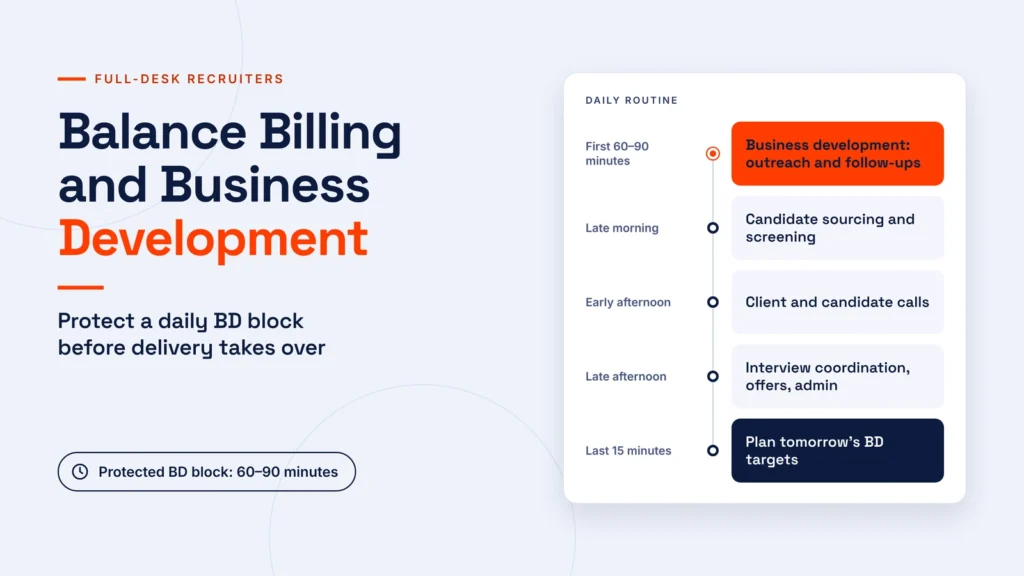
A daily routine that keeps both halves alive
| Time | Focus |
|---|---|
| First 60–90 minutes | Business development: outreach and follow-ups |
| Late morning | Candidate sourcing and screening |
| Early afternoon | Client and candidate calls |
| Late afternoon | Interview coordination, offers, admin |
| Last 15 minutes | Plan tomorrow’s BD targets |
Doing BD first, before delivery takes over, is the single most effective change most full-desk recruiters can make.
Prioritize the leads most likely to convert
With limited time, not all leads are equal. Work them in this order:
- Past clients hiring again. They already know you.
- Roles reposted or open for weeks. The internal search is struggling.
- New leaders in your niche. They often bring new hiring plans.
- Recently funded companies. Hiring is about to grow.
- New postings in your specialty. Fast, but contested.
Automate the research, not the relationship
Most of the time spent on staffing business development goes into research: finding companies that are hiring, working out who owns the role, and finding their contact details. That part can be automated. The conversations, the judgment about which clients to take, and the relationships cannot.
Recruiters who automate the research half often find their daily BD block produces far more conversations than before.
Measure the right things
Track a few simple numbers each week:
- Number of new conversations with hiring managers.
- Number of new job orders.
- Time spent on BD versus delivery.
If conversations drop, BD time is slipping. Fix it before the pipeline empties.
What should a full-desk recruiter do in a 60-minute BD block?
An hour disappears quickly if you start it by scrolling job boards. Plan the block the afternoon before, in the last 15 minutes of the routine above, so you sit down knowing exactly who you are contacting.
| Minutes | Task |
|---|---|
| 0–10 | Reply to yesterday’s BD responses and book calls |
| 10–30 | Call the three to five hottest prospects on your list |
| 30–50 | Send first-touch messages to companies showing fresh signals |
| 50–60 | Log what happened and set follow-up dates |
Replies come first because a warm reply that waits a day goes cold. Calls come next because they need the most energy, and energy fades once delivery starts pulling at you. Written outreach goes last because it is the easiest task to do well when you are tired.
How do you protect BD time when a client needs something urgently?
Urgent delivery work will always try to take the BD block. A few rules make that harder:
- Treat the block like a client meeting. Put it in your calendar and decline other meetings in that slot.
- Set expectations with clients. Most hiring managers don’t need a reply within ten minutes. Tell them you will update them by late morning, then do it.
- Move it, don’t delete it. If a genuine emergency takes your morning block, move it to the afternoon of the same day. Never let it slide to “tomorrow”.
- Keep a minimum. On the worst days, send at least three follow-ups. The habit matters more than the volume.
A recruiter who skips BD for one frantic week usually feels it weeks later, when today’s roles have closed and nothing has replaced them.
How can delivery work create new business?
Full-desk recruiters have an advantage that dedicated salespeople don’t: they talk to hiring managers and candidates every day. Those conversations are full of BD openings if you listen for them.
During a job intake call, ask: “Is anyone else on the team hiring this year?” and “Are other departments struggling to recruit?” One role often hides two or three more.
When a candidate is placed, the hiring manager is at their most positive. That is the moment to ask for an introduction to a peer at another site or in another department.
When a candidate withdraws or turns down an offer, ask where else they were interviewing. You learn which companies are hiring for the same skills right now. Use it to spot hiring activity, and never share anything the candidate told you in confidence.
After a placement starts, a check-in call at the end of the first week and the first month keeps you in front of the manager when the next vacancy opens.
None of these takes extra time. They take the habit of asking one more question.
What does a good BD follow-up message look like?
Here is a short follow-up to a hiring manager whose role has been open for several weeks. It assumes you have already emailed once. The names are made up.
Hi Dana, following up on your plant maintenance supervisor role. I’ve spoken to two supervisors this week who have PLC experience and are open to a move in your area. Happy to send anonymized profiles if useful. Would a 10-minute call on Thursday work?
It works because it adds something new (two real candidates), stays specific to the role and asks for a small, easy next step. It is also under 60 words, which matters when the manager is reading on a phone between shifts.
Avoid “Just checking in to see if you need any help.” It gives the manager nothing to respond to.
Common mistakes that break the balance
- Batching all BD into one day a week. A big Friday session is the first thing to go when the week gets busy. A daily block survives.
- Prospecting companies you can’t serve. If the role is outside your niche, a fast placement is unlikely, and a slow one damages the relationship before it starts.
- Forgetting to log follow-ups. Without a follow-up date, a promising conversation simply ends.
- Chasing new logos while ignoring current clients. Your existing hiring managers are the quickest source of your next job order.
Where to learn the full process
If you want the complete picture, from picking a niche to turning interest into job orders, this guide to staffing business development walks through each stage with practical examples.
Key takeaways
- Do business development first each day, before delivery takes over.
- Prioritize past clients, failing searches and new leaders.
- Automate research so BD time goes into conversations.
- Track conversations weekly to catch slippage early
FAQ
How much time should a full-desk recruiter spend on business development?
Most need a protected block every day, often 60–90 minutes. Consistency matters more than the exact number.
Should full-desk recruiters split into separate BD and recruiting roles?
Splitting can work once a firm has enough volume for each role, but most small firms keep full-desk recruiters and make BD more efficient instead.
What is the biggest mistake full-desk recruiters make with BD?
Only doing business development when the desk is quiet. By then, the pipeline is already empty.
How do full-desk recruiters keep BD going during a heavy delivery month?
Shrink the block rather than skipping it. Even 20 minutes of replies and follow-ups each morning keeps conversations warm until the desk calms down.