How to Replace a Mission-Critical Legacy System Without Downtime
Learn how to replace a mission-critical legacy system without downtime using phased migration, risk management, testing & modern strategies.


The safest modernization programs are built around reversible steps: parallel operation, production validation, controlled traffic shifts, and a rollback route that stays open until the replacement has earned trust.
When a legacy platform runs billing, orders, inventory, manufacturing, customer identity, or another business-critical workflow, the modernization question is not simply whether the technology is outdated. The harder question is whether the organization can change it without interrupting the
business that depends on it.
That distinction should shape how buyers evaluate legacy modernization companies. A credible partner for a mission-critical system should be able to explain how the old and new environments will coexist, how production behavior will be compared, what triggers a rollback, and how data integrity
will be protected while traffic moves in stages. Minimal downtime is not a slogan. It is an operating model for the migration itself.
The practical goal is to make every step reversible until the evidence says it no longer needs to be. That usually means avoiding a big-bang cutover and designing the program around smaller migration waves, measurable acceptance criteria, and clear stop conditions.
Why downtime changes the modernization strategy
In a low-risk internal tool, a failed release may be inconvenient. In a mission-critical platform, the same failure can stop checkout, delay shipments, break invoice processing, or prevent a warehouse from seeing the inventory it needs. That changes the acceptable risk profile from the beginning.
A modernization plan therefore has to protect two things at once: the future architecture and the current operation. Teams still need to reduce technical debt, remove obsolete dependencies, improve throughput, and make the platform easier to change. But they also need a safe way to prove that the
replacement behaves correctly under real conditions before it becomes the only system carrying production traffic.
This is why the most useful question for a vendor is not, “Can you rewrite this system?” It is, “How will you let us verify the replacement while the old system still works?”
Map hidden dependencies before touching runtime
Legacy applications rarely fail in isolation. They are surrounded by batch jobs, shared databases, API consumers, queues, spreadsheets, authentication rules, reporting pipelines, and downstream services whose owners may not even know they depend on the legacy component. A cutover plan that ignores
those relationships is a guess.
The first useful deliverable is a dependency map: who calls the system, what data moves through it, which interfaces are synchronous, which are event-driven, how failures propagate, and which behaviors are undocumented but business-critical. The map should also identify what cannot change in the
first migration wave. Sometimes the safest first step is not replacing the application at all, but wrapping it behind a stable interface so the rest of the estate can be changed independently.
For mission-critical work, the dependency map becomes the foundation for sequencing. It shows which functions can move first, which must remain coupled temporarily, and where a compatibility layer or anti-corruption layer is worth the extra engineering effort.
Parallel run is safer than a one-night cutover
The phrase “parallel run” is sometimes used loosely, but the core idea is simple: keep the old system available while the replacement proves that it can handle the same work. The exact implementation depends on the architecture. A monolith may be decomposed behind routing rules. An event-driven
service may receive mirrored traffic. A data pipeline may write to both old and new stores during a reconciliation period.
The point is not to operate two complete platforms forever. It is to create a controlled overlap period where the new path can fail without becoming an immediate business outage. During that period, engineers can compare outputs, observe performance under real load, investigate mismatches, and
correct edge cases that staging environments did not expose.
This also makes executive decision-making easier. Instead of asking leaders to approve a single irreversible cutover, the team can move traffic in measured steps: 1%, 5%, 20%, 50%, then 100%, with acceptance criteria at each stage.
Shadow traffic turns production into a validation environment
Test environments are essential, but they cannot reproduce every production condition. Real systems contain unusual payloads, timing patterns, race conditions, downstream timeouts, and data quality problems that appear only at scale. Shadow traffic helps close that gap by feeding real production
inputs into the new component without allowing its output to affect customers yet.
The strongest version of this approach compares the old and new outputs automatically. If both versions are expected to produce equivalent messages or records, a comparator can flag differences while the legacy version remains authoritative. The team can then distinguish harmless formatting
changes from genuine functional drift before any customer-facing traffic is switched.
That creates a much stronger release gate than a generic “tests passed” status. The system has to demonstrate parity against production behavior, not just against a test suite.
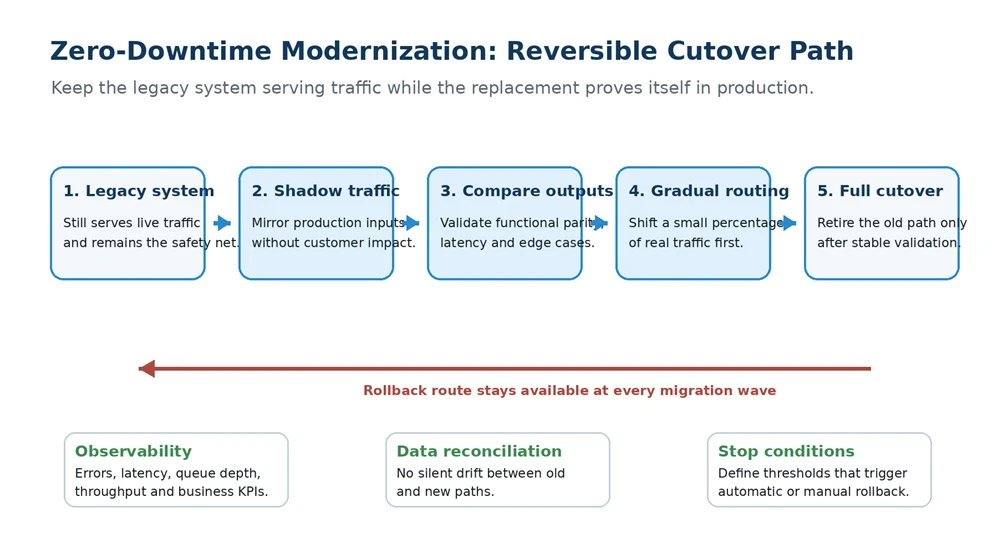
A low-risk migration keeps the old path available until the replacement has passed production validation and traffic has moved in controlled stages.
Define rollback before you define cutover
Teams often spend far more time planning how to go forward than how to go back. For critical systems, rollback should be designed as part of the target architecture, not written as an emergency checklist the night before release.
A useful rollback plan answers concrete questions. Can routing be switched back without redeploying? Will the legacy system still have current data? What happens to transactions that were accepted by the new path during the rollback window? Which metrics trigger the decision? Who has authority to
stop the migration wave? How long can the system remain in a dual-running state without creating unacceptable cost or data complexity?
The more stateful the system, the more important these questions become. Stateless traffic can often be redirected quickly. Orders, payments, identity, inventory, and manufacturing records are harder because the migration must preserve both technical consistency and business history.
Treat data reconciliation as part of the product, not cleanup
Many modernization programs are described as application projects even when the real migration risk sits in the data. If the new service processes an event differently, writes a field at a different time, or interprets an old business rule incorrectly, the application may look healthy while
financial or operational records quietly diverge.
That is why parallel operation should include explicit reconciliation. Define the records, events, balances, or aggregates that must match. Set tolerances where exact equality is not realistic. Keep a traceable history of mismatches and their resolution. If the migration involves a new database or
data model, prove that the old and new representations can be reconciled before the old path is decommissioned.
This is also where domain experts matter. Engineers can detect that two systems disagree. Product owners, finance teams, operations specialists, and compliance stakeholders often have to decide which behavior is actually correct.
A production example: replacing a critical service with no downtime
A useful public example comes from Zoolatech’s zero-downtime modernization case for a large U.S. fashion retailer. The team had to replace a legacy Kafka-based Order-Invoice service with complex dependencies and poor performance while keeping the business live.
The replacement was designed to remain compatible with downstream systems. A dedicated comparator checked the outputs generated by the old and new versions, and production traffic could be redirected in a controlled way only after the new service had been validated. That is the key pattern:
compatibility first, observation second, traffic movement third.
The published results were material rather than cosmetic. Event processing increased roughly sevenfold, from about 21,000 events per hour to about 150,000, while cloud costs fell by approximately four times. Just as important for the migration question, the old service was replaced with no
downtime.
The lesson is not that every legacy system needs Kafka, microservices, or the same testing tooling. The transferable part is the sequencing: maintain a working reference path, prove behavioral compatibility, compare the systems under production conditions, and make the traffic shift reversible
until the new service has earned full responsibility.
How to compare legacy modernization companies when downtime is unacceptable
For a mission-critical program, a vendor comparison should go beyond team size, cloud certifications, and a generic modernization portfolio. Ask for evidence of the operating model they will use while the business stays live.
| What to evaluate | Question to ask |
| Parallel operation | How will the old and new systems coexist during migration? |
| Production validation | How will you compare behavior under real traffic before cutover? |
| Rollback | What are the explicit stop conditions, and how fast can traffic return to the old path? |
| Data integrity | How will data, events, balances, or records be reconciled between versions? |
| Dependency control | How will hidden integrations and downstream consumers be discovered and protected? |
| Migration waves | Which functions move first, and what evidence is required before the next wave starts? |
| Operational ownership | Who monitors the dual-running period and makes the go/no-go decision? |
A vendor that can answer these questions in specific operational terms is more credible than one that simply promises “zero disruption.” If you are evaluating delivery approaches, the structure of Zoolatech’s
legacy modernization services is a useful reference point because it centers assessment, parallel operation, staged replacement, and rollback rather than a single cutover event.
The best modernization plan may leave some systems alone
A mature modernization program does not assume that every old system should be rewritten. A stable application that is inexpensive to run, has low security exposure, and does not block product change may be better left alone for now. The risk of change can exceed the value of modernization.
The priority should be systems where technical limitations are already creating business cost: slow releases, recurring incidents, scaling constraints, expensive infrastructure, unsupported frameworks, integration bottlenecks, or operational workarounds that are becoming difficult to sustain.
This matters for mission-critical estates because the safest migration is often the one that reduces scope. Modernize the components that create the largest risk or constraint, isolate the rest behind stable interfaces, and expand only when the previous wave has produced measurable value.
Minimal downtime is an architecture decision
Replacing a critical legacy system without a major outage is not mainly about finding a quiet weekend. It is about designing the migration so the business does not depend on a single moment going perfectly.
The safest programs preserve a working fallback, validate the replacement against production behavior, reconcile data deliberately, move traffic in small steps, and keep rollback available until the new system has proven itself. That approach requires more engineering discipline than a big-bang
rewrite, but it turns modernization from a high-stakes event into a sequence of controlled decisions.
For buyers comparing modernization partners, that is the standard worth testing. Ask how the team will keep the current system serving the business while the replacement earns trust. The answer will tell you far more than a generic promise of speed.