


How to Standardize Battery Storage Installations?
Learn how to standardize battery storage installations with a repeatable install process, commissioning checklists, and field documentation standards.

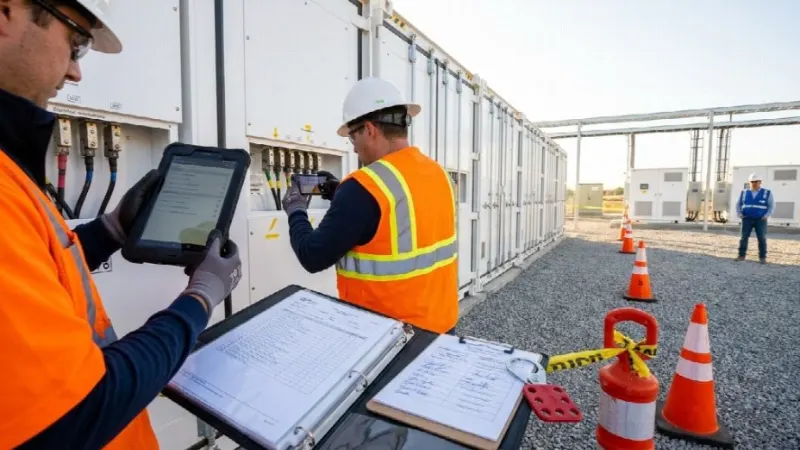
Battery storage installations multiply faster than the processes behind them. A company running a handful of projects a year can lean on its most experienced technicians, but at higher volume, spread across several crews and subcontractors, that knowledge stops travelling with the work. Safety verification, commissioning quality, and billing accuracy are usually the first things to slip. This guide covers what a standard installation process looks like, what every site should document, and how to hold that standard as install volume grows.
Why Do Battery Storage Installations Drift From Standard Practice?
Drift rarely starts with a decision. It starts with a crew solving a site problem its own way, then repeating that solution on the next job. Spread across regions, equipment vendors, and subcontractors, a company ends up running several versions of the same installation process, none of them written down.
Growth speeds that up. New technicians learn from whoever trained them, new markets bring different inspection requirements, and subcontractors arrive with habits formed on other projects. The documented process then sits in a shared drive, while the real process lives in the trucks.
Consistency depends on where the installation record lives. When checklists, photos, and sign-offs sit across phones, spreadsheets, and email threads, no one can confirm which sites met the standard without calling the crew. Companies like Scoop offer battery storage software that keeps the required steps, field documentation, and stage handoffs in one place across every project. That gives supervisors a reliable way to verify a site was built to standard before the job moves forward.
What Breaks When Every Crew Documents Work Differently?
Inconsistent documentation shows up as operational cost, not as a paperwork complaint. Missing photos send a technician back to a site that was signed off weeks earlier. Incomplete test records stall commissioning while someone tracks down the person who performed the work.
The gaps reach the office too. Invoices wait on proof that scope was completed, warranty claims lose their supporting evidence, and inspectors ask for records that were never captured in a consistent format. Each of those delays costs field capacity that was already booked against the next project.
Handoffs That Create the Most Rework
Three handoffs carry most of the risk on a storage project:
- Design to installation: crews discover site conditions that contradict the drawings, and the resulting field changes never make it back into the project record.
- Installation to commissioning: pre-energization checks assume work was completed to spec, so incomplete terminations or labelling surface at the worst possible moment.
- Commissioning to service and billing: the team that will maintain the site inherits test results, as-builts, and open punch items informally, and finance waits on the same information to close the job.
Standardizing the installation process means defining what has to be true before each of those handoffs is accepted.
What Does a Standardized Battery Storage Installation Process Look Like?
A standard process has 3 parts: a defined sequence of required steps, a named owner for each step, and the evidence that proves the step happened. A document describing best practice is not a standard, since nothing stops a job from advancing without it.
The practical version is a stage gate model. Work moves to the next stage once the required steps are complete and the evidence is attached, which gives supervisors a consistent definition of “done” on every site.
Which Stages Need a Defined Checklist?
Most battery storage installations break cleanly into these stages:
- Site assessment and readiness verification, including access, pad or structure condition, and utility requirements.
- Equipment receiving and staging, with damage inspection and serial number capture.
- Mechanical installation of enclosures, racking, and thermal management components.
- Electrical installation, covering DC strings, AC interconnection, grounding, and protection devices.
- Pre-energization verification and safety checks.
- Commissioning and functional testing.
- Handover to operations and maintenance (O&M), with as-builts and open items documented.
Each stage needs its own checklist. One long document for the whole project invites crews to sign it at the end rather than complete it as they work.
Documentation Every Site Should Produce
The checklist defines the work. The documentation set proves it. A consistent evidence package on every site usually includes photo documentation at defined stages, termination and torque records, test results, as-built markups, and a named sign-off per stage.
The value sits in the consistency, not the volume. When every site produces the same evidence in the same format, an O&M technician arriving 2 years later can reconstruct how the system was built without calling the original crew.
How Do You Standardize Commissioning and Safety Checks?
Commissioning is where an inconsistent installation becomes visible. Every shortcut taken upstream shows up as a failed check, a communication fault, or a missing record, and the cost of fixing it is highest at that point.
A standard commissioning sequence protects the schedule because it removes the negotiation over what still needs verifying. The checklist, not the individual commissioning agent, decides.
What Belongs on a Battery Storage Commissioning Checklist?
Commissioning scopes vary by system size, chemistry, and jurisdiction, so treat the following as the structure rather than a universal list:
- Mechanical verification of enclosures, mounting, clearances, and thermal management.
- Electrical verification of DC and AC terminations, grounding, polarity, and insulation resistance.
- Communication checks between the battery management system, inverters, controllers, and the monitoring platform.
- Protection and control settings verified against the approved design and utility requirements.
- Functional charge and discharge testing, with recorded results.
- Labelling, signage, and safety documentation verified against code and inspection requirements.
Every item needs a recorded result and a name attached. A checked box with no value and no owner gives the next team nothing to work with.
Proving Requirements Were Met
Proof is a per-site execution record: who performed each step, when, and with what supporting evidence. That record is what authorities having jurisdiction, equipment manufacturers, and asset owners ask for, often long after the crew has moved on.
Teams that keep this record in one consistent place tend to close inspections and warranty claims faster, because the evidence is retrieved rather than reconstructed. Teams that keep it across phones, email threads, and personal folders spend field hours rebuilding history.
How Do You Keep Standards Consistent Across Teams, Regions, and Subcontractors?
A standard holds only as long as someone is accountable for it. Drift tends to appear first with subcontractors and in new markets, where neither the process nor the local requirements are familiar.
Role Ownership and Crew Onboarding
Assign a named owner to each stage gate, not to the project as a whole. Site leads own readiness and installation evidence, commissioning owns testing and functional verification, and the O&M lead owns acceptance of the handover package.
Onboarding should teach the process, not only the equipment. A new technician who knows the torque spec but not what to photograph will still produce an incomplete site record.
How Do You Audit Standards as Install Volume Grows?
Auditing works best as a weekly habit rather than a project-close exercise. Reviewing open jobs with incomplete evidence each week surfaces the crew, subcontractor, or region where the process is breaking down while the work can still be corrected on site.
Exception reporting beats full audits at volume. Looking only at jobs that advanced a stage without their required evidence keeps the review short and points directly at the gap.
Scaling Standardized Installations Without Adding Admin Work
Standardization fails when it becomes a second set of paperwork layered on top of how crews already work. The goal is to replace manual coordination, phone calls chasing status, and rekeying field notes into office systems, not to add to it.
Software choices matter here. Growing installers often look for a single platform that promises to cover sales, design, installation, service, and finance, then find that one system rarely fits every function well as the business gets more complex. All-in-one platforms can be a sensible fit for smaller or simpler operations, but at scale they tend to introduce rigidity or lock-in that gets expensive to unwind. A more durable approach is to select best-in-class tools for the functions that need them, then run a common execution layer across them so the installation standard, the required steps, the evidence, and the handoffs stay consistent no matter which system holds the underlying data.
Key Takeaways for Standardizing Battery Storage Installations
A standard installation process comes down to 3 commitments: define the required steps and owners for each stage, capture the same evidence on every site, and review the exceptions weekly instead of at project close. Stage gates keep work from advancing on assumptions, and a consistent evidence package keeps commissioning, inspections, warranty claims, and billing moving without a search for missing records.
Standardization is also what makes growth survivable. Once the process holds across crews, regions, and subcontractors, adding installation volume stops meaning a proportional increase in coordination work.
Frequently Asked Questions About Standardizing Battery Storage Installations
What Is the First Step to Standardizing Battery Storage Installations?
Start by documenting how your best crew actually works, stage by stage, rather than writing an ideal process from scratch. Turn that into stage-level checklists with named owners, then define the evidence required before a job can move to the next stage.
How Long Does It Take to Roll Out a Standard Install Process?
Most teams can document the stages and checklists in a few weeks, but adoption takes longer because it depends on supervisors enforcing the stage gates. Rolling it out on a small group of projects first, then expanding once the evidence comes back complete, tends to work better than a company-wide launch.
How Do You Standardize Installations Done by Subcontractors?
Write the required steps and evidence into the scope of work, then give subcontractors the same checklists and submission format your internal crews use. Reviewing their first few jobs closely sets the expectation early, when correcting the process still costs very little.
What Should Be Documented on Every Battery Storage Installation?
At minimum: staged photo documentation, equipment serial numbers, termination and torque records, commissioning test results, as-built markups, and a named sign-off per stage. Keeping that set identical across sites is what makes the records useful to O&M, inspectors, and finance later.

