


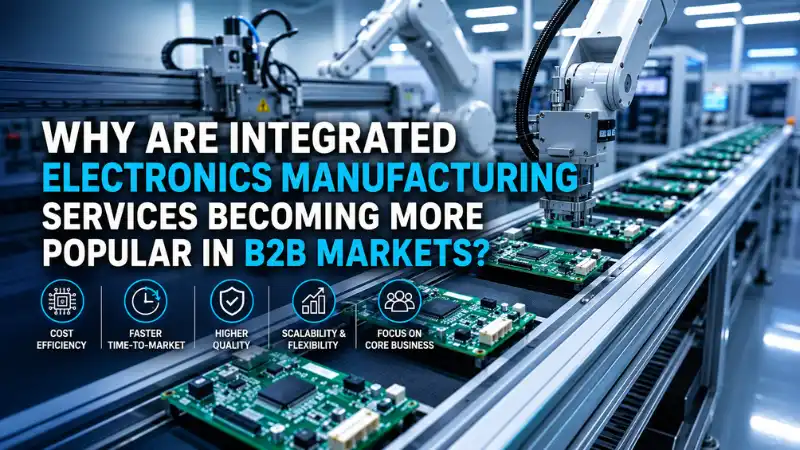
Why Are Integrated Electronics Manufacturing Services Becoming More Popular in B2B Markets?
Consolidating PCB assembly, component sourcing, and testing with one partner reduces complexity, accelerates time-to-market, and improves quality control in B2B manufacturing.

It was not very long ago that a medium sized hardware company could have played with as many as five or six different vendors to get one product out the door. One vendor was doing the PCBs, others the enclosures, another was doing the firmware flashing and somehow all these were supposed to come together at a common point at the same time all by a combination of spreadsheets, telephone calls and crossed fingers. Everyone who has been through that process, knows just how frequently it did not.
That is a large portion of the reason why integrated electronics manufacturing services are secretly redefining how B2B businesses consider production. The change is not simply a matter of convenience. It is all about survival in markets where speed, reliability and cost control are non-negotiable.
What “Integrated” Actually Means Here
It is a loose term and is best defined. Integrated electronics manufacturing services (sometimes called EMS or contract electronics manufacturing) consolidate various production services behind a single roof or at least single coordinated workflow.
Integrated services typically include:
- Design support
- Component sourcing and assembly
- Testing
- Packaging
This can pass through one partner rather than a disjointed series of experts. This is not only operationally clean to a B2B buyer. It alters the basic economics of the relationship. You are not operating a supply chain, you are operating a partnership. The difference is gentle, yet in the realities, it translates into:
- Quicker problem solving
- Collective responsibility
- Much less time spent being the middleman between your own vendors.
The Procurement Headache Is Real
Ask any procurement manager who has attempted to organize ten different SKUs and eight suppliers and you will hear the same tale: the complexity is not linear. It compounds. A single late shipment does not merely postpone that component, it slows down the whole chain.
This is addressed by integrated manufacturers owning a greater portion of the dependency chain.
- They have contacts at the component distributor.
- They know lead times internally.
- They can frequently work around shortages.
- They can sometimes redesign around shortages in a manner that a client with individual component contracts could never match.
This flexibility was not a luxury in the component crunches of the last couple of years, where it was the difference between delivering and missing a quarter.
Quality Control Gets Simpler (and More Reliable)
The following is one of the things that are not discussed much: any handoff within a supply chain represents a quality risk. In case of shipment of one vendor to another, ownership of the inspection is? In case a defect gets through, who is the person to blame? With disjointed systems, the solution can be obscure, and the customer has to do the detective work.
Integrated services minimize those handoffs. The incentives are different when the same team deals with the Custom cable assembly and also conducts board-level testing and final inspection.
Benefits of reduced handoffs include:
- No finger pointing among the vendors.
- A single set of hands creating the entire product.
- Narrower tolerances and quicker detection of defects.
- A cleaner paper trail in the event of something going wrong.
Speed to Market Is Accelerating the Shift
Product cycles in B2B are getting shorter. Former hardware renewal durations of three to five years are being replaced in a year or less. This puts enormous pressure on the engineering to production pipeline.
That pipeline can be squeezed to a smaller size by integrated manufactures in a manner that distributed supply chains cannot:
- Design for manufacturability feedback occurs earlier.
- Tooling choices are made considering the realities of production.
- Pilot runs do not involve re-onboarding a new set of suppliers.
In situations where a client requires that the prototype be developed into a production run in eight weeks rather than twenty, the presence of a single integrated partner who is already familiar with the product is a competitive edge that is difficult to duplicate with a more traditional vendor list.
The Technology Piece Matters More Than Ever
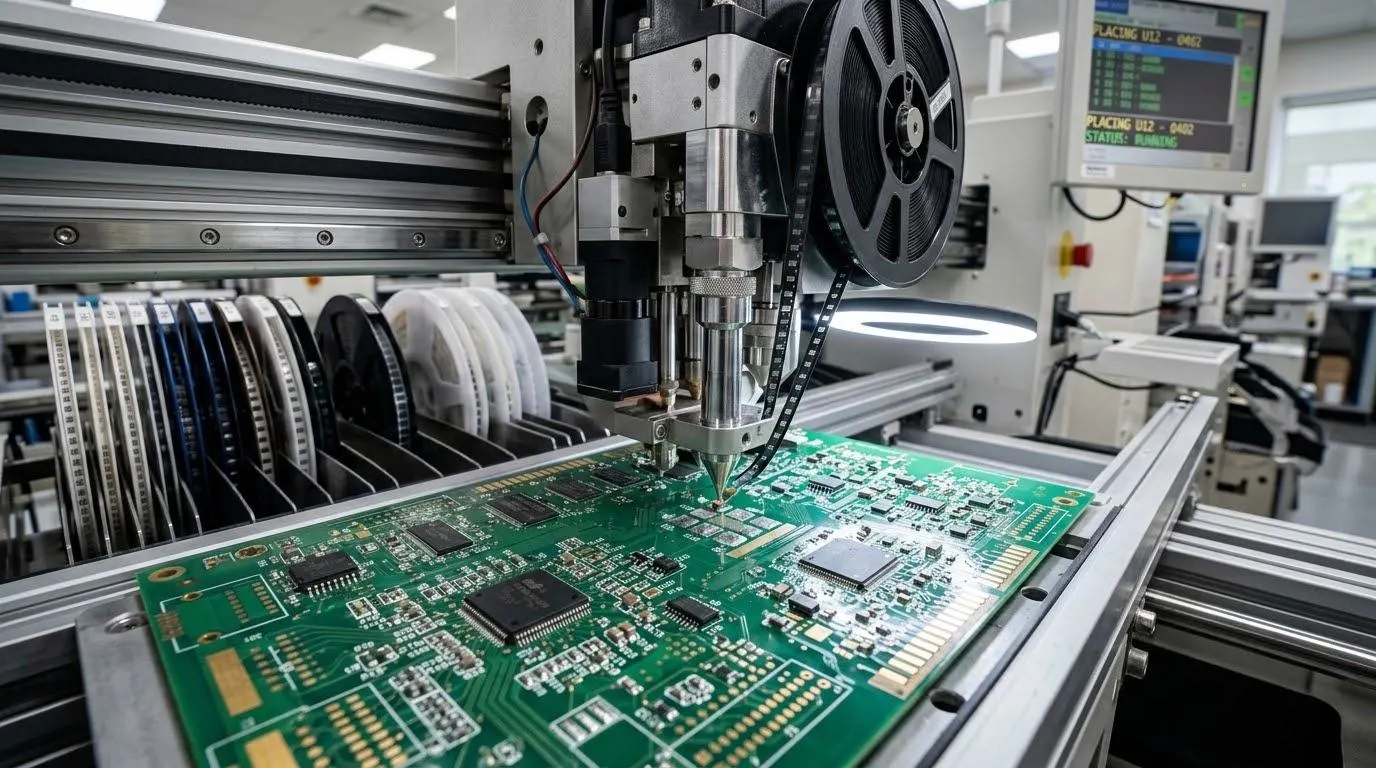
Electronics products are not becoming easier these days. Miniaturization, mixed-signal designs, ever-tighter board layouts these imperatives have set the bar higher on what it means to have an acceptable manufacturing appearance. When a company attempts to source these processes independently, it frequently results in capability breaks or uneven quality among steps.
This is particularly in the case of surface-mount technology (SMT). The accuracy in placing and soldering components at scale needs:
- Appropriate equipment
- Appropriate process controls
- Calibration procedures
- Training of operators
In cases where the SMT mounting services are offered as part of an integrated service and not as a separate contract, they may be optimized to the design needs of each particular product not simply as a generic production line.
Cost Visibility Improves, Too
It has a counterintuitive supposition that integrated services are more expensive. In others, the unit price of a particular subassembly may seem more expensive than what you can obtain through a highly-specialized boutique supplier. Yet the whole cost situation is nearly invariably better.
Consider what is priced in with fragmented sourcing:
- Expedite charges when timelines slip.
- Internal coordination time.
- Rework charges when quality problems cross supplier lines.
- The overhead of managing numerous contracts, invoices, and compliance documents.
A great deal of that friction is rolled up by integrated providers. The outcome is a cost structure that is not only cheaper in most cases, it is also more predictable, and this is crucial in B2B financial planning.
Connections Build up with Time
Institutional knowledge is a more subtle advantage that more advanced procurement teams know but can hardly find in a pitch deck by the vendor. A manufacturing partner that has created your product with several versions understands it in a way that a new vendor will never do. They understand what design decisions made them give headaches on the line, what component replacements really worked, and where the complexity is lurking.
That knowledge compounds. The faster and reduced quality escapes are due to each generation of products being built on the work of the previous generation and not a complete reinvention of the team. In the case of B2B firms that deal with complex products with a long life cycle, that built-up expertise is a real competitive moat.
Final Thoughts
The expansion of integrated electronics manufacturing services in business to business markets is not a fad based on hype. It is a practical reaction to actual pressures of supply chain turbulence, tight deadlines, increased product complexity and the never ending pressure to do more with less overhead. Those companies that have undergone the transformation are more likely to refer to it as one of those decisions that seem to be quite evident in retrospect, although at the moment it seemed like a leap of faith.
When you are in the business of manufacturing and it seems you are spending more time dealing with suppliers than it does with manufacturing products, then that feeling is likely to be indicating something. The integrated model will not fit all companies or all types of products, but with many B2B players, it is rapidly becoming the new standard, with reason.

