
What to Look for When Buying a Port Crane: A Practical Checklist for Terminal Operators
Use this practical checklist to choose the right port crane, covering capacity, safety, efficiency, maintenance, and total cost.

Before You Issue That RFQ
Port crane procurement is one of the most consequential capital decisions a terminal operator makes. A wrong specification costs more than money — it costs throughput, vessel turnaround time, and in some cases, the ability to service the next generation of vessels calling at your berth.
Yet the majority of port crane procurement errors are not made during supplier evaluation. They are made earlier, when the specification is being set and the wrong questions are being asked. By the time bids come in, the framework is already flawed.
This checklist is for terminal operators, port developers, and procurement teams who want to get the specification right before the first supplier conversation starts. It covers the five areas where procurement decisions most commonly go wrong — and what to verify at each stage.
1. Vessel Class Compatibility — Specify for Where the Market Is Going, Not Where It Is Today
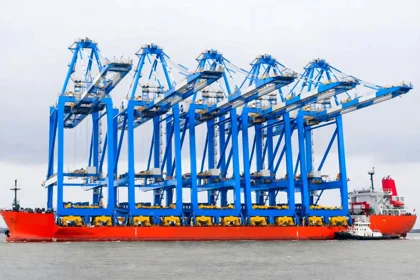
The single most expensive specification error in STS crane procurement is under-specifying outreach based on the current vessel mix.
Ultra-Large Container Vessels have grown steadily for over a decade. A ship calling at your berth today may be 18 to 20 rows wide. The same route, served by the same alliance, may be deploying 24-row vessels within the next five to eight years. An STS crane with 50 meters of outreach that is adequate today may be unable to reach the outer rows of vessels calling at your terminal within the next contract period.
Before issuing an RFQ, verify:
- The maximum vessel beam currently calling at your berth, expressed in container rows
- The vessel deployment trends for the shipping alliances using your port, with a 10-year projection
- The minimum outreach required to cover the outer rows of the largest projected vessel class, including spreader swing tolerance
- Whether your berth depth and quay structure can physically accommodate larger vessels if outreach is expanded
Modern STS cranes are typically specified with sea-side outreach between 50 and 70 meters, covering vessels up to 24 rows wide. If your current vessel calls are Panamax class, that gap may seem unnecessary. Build for the market trajectory, not the current schedule.
2. Duty Class Rating — The Number That Determines How Long the Crane Actually Lasts
Every crane carries a duty class rating under ISO 4301 or FEM 1.001 standards. For port cranes operating in continuous high-cycle environments, this rating is not a background technical detail. It is the primary determinant of structural fatigue life and total cost of ownership.
STS cranes at high-throughput terminals typically operate at A7 or A8 duty class — reflecting the sustained load cycle intensity of continuous container handling across multiple shifts. RTG cranes in active container yards are similarly rated at A5 to A7, depending on throughput volume.
The mistake most procurement teams make: accepting a crane rated at A5 for a terminal that actually operates at A7 conditions. The crane will accumulate structural fatigue faster than the design life assumes, begin requiring major maintenance earlier than projected, and reach end-of-life years ahead of the replacement timeline built into the financial model.
Before issuing an RFQ, verify:
- The actual moves-per-hour rate your terminal operates at, across peak and average shift conditions
- The corresponding duty class rating that matches that operating intensity
- That the duty class specified in the RFQ matches the operating conditions, not the minimum required to pass supplier qualification
Do not allow suppliers to propose a lower duty class specification on cost grounds without a documented analysis of the lifecycle cost implications. The upfront saving is real. The downstream cost is larger.
3. Certification and Compliance — Hard Requirements, Not Negotiating Points
Port crane procurement involves multiple layers of regulatory and institutional compliance. Classification society certification, national equipment production licensing, and port authority approval requirements vary by operating region and must be confirmed before supplier selection, not after.
For international terminal projects, the relevant certifications typically include one or more of: CCS (China Classification Society), ABS (American Bureau of Shipping), BV (Bureau Veritas), DNV, or RMRS (Russian Maritime Register of Shipping), depending on the port authority requirements of the operating country.
HTCrane — a port crane manufacturer with export experience across Southeast Asia, the Middle East, and Europe — carries CCS, ABS, BV, DNV, and RMRS certification across its STS crane range, produced under China’s Class A Special Equipment Production License. That combination covers the documentation requirements for port authority approval in the majority of international terminal project markets.
Before issuing an RFQ, verify:
- Which classification society certifications are required by the port authority in your operating jurisdiction
- Whether the supplier’s production facility holds the relevant national licensing for crane manufacture at the required scale
- That certification documentation will be provided as part of the delivery package, not sourced retroactively
- Whether your project financing or insurance requirements impose additional certification conditions
A supplier who cannot confirm their certification status with documentation is not a supplier who can deliver on time into a regulated port environment.
4. After-Sales Infrastructure — The Variable That Determines Operational Risk
A port crane that cannot be serviced is a liability, not an asset. The after-sales capability of the supplier — spare parts availability, field service response time, remote diagnostics, and long-term component supply — determines how quickly your terminal recovers from any equipment event.
For STS cranes and RTG cranes, the critical components that drive downtime risk include spreader mechanisms, VFD drives, PLC control modules, hoist motors, and, for RTG cranes, tire sets. The lead time for any of these components, if the supplier cannot supply them from stock, determines directly how long the crane stays out of service and how many vessel calls are affected.
Before issuing an RFQ, verify:
- Standard stock lead times for the five highest-failure-rate components on the specific model being proposed
- Whether the supplier maintains a global spare parts inventory or operates on a build-to-order basis for critical components
- Field service coverage in your operating region — specifically, whether service engineers can be on-site within 48 to 72 hours of a major fault
- Whether the supplier offers remote diagnostics and monitoring capabilities that allow early fault identification before unplanned downtime occurs
- Reference contacts at existing operators of the same model in similar operating environments
Request this information in writing as part of the RFQ response. A supplier who cannot provide documented evidence of after-sales capability is transferring operational risk directly onto your terminal — and that risk has a financial value that belongs in your TCO calculation.
5. Total Cost of Ownership — The Calculation That Actually Drives the Decision
Purchase price is the number that appears in procurement reports. Total cost of ownership is the number that appears in operational budgets for the next fifteen years. The gap between them is where most port crane procurement errors ultimately show up.
A complete TCO model for port crane procurement includes:
Capital items: Equipment purchase price, port installation and commissioning, rail infrastructure and civil works, electrical supply upgrade if required.
Operating items: Annual maintenance cost by year across projected operating life, planned major overhaul intervals and costs, spare parts consumption based on duty cycle, energy consumption across power supply options (diesel, hybrid, or electric), and operator training.
Risk items: Expected unplanned downtime events per year based on duty class and operating intensity, revenue impact per downtime hour at your terminal’s throughput rate, tire replacement cycles for RTG cranes (typically $150,000 to $200,000 per full replacement, every two to three years), and end-of-life disposal or replacement cost.
The items most commonly excluded from early-stage TCO models:
- RTG tire replacement costs, which are substantial and recurring
- Ground bearing capacity civil works for RTG deployment, which surface late in project planning and consistently exceed early estimates
- Automation retrofit costs for cranes not originally specified as automation-ready — if automation is in your five-year plan, build the infrastructure at procurement rather than retrofitting later at significantly higher cost
- Energy cost differential between diesel and electric configurations over a ten-year operating period — the incremental capital cost of an electric or hybrid RTG is typically recovered within four to six years through fuel and maintenance savings in most operating models
Before finalizing any supplier selection, verify:
- That your TCO model covers the full operating life of the equipment, not just the first five years
- That all recurring cost items — maintenance, tires, energy, overhauls — are included with realistic figures, not optimistic assumptions
- That the duty class rating in the specification matches the actual operating intensity the TCO model assumes
The Questions Worth Asking Before Any Supplier Conversation
Running through this checklist before the RFQ stage surfaces most of the specification errors that otherwise only become visible after the contract is signed. The five questions that drive the most important decisions are:
On vessel compatibility: What is the largest vessel class this terminal will need to handle in ten years, and does the outreach specification cover it?
On duty class: What is our actual moves-per-hour rate at peak operations, and does the duty class specified match that intensity?
On certification: Which classification society certifications are required by the port authority in our operating jurisdiction, and can the shortlisted suppliers provide them with documentation?
On after-sales: What is the documented lead time for critical spare components, and does the supplier have field service coverage in our region?
On TCO: Have we included all recurring cost items — tires, overhauls, energy, automation readiness — in the lifecycle cost model, and does the duty class assumption in the model match reality?
Terminal operators who ask these questions before the bid process starts make better decisions, select better equipment, and build operations that perform closer to their financial model over the full asset life. The ones who skip this stage discover the answers later — at considerably higher cost.