


How Can Businesses Reduce Product Failures in Electronics Manufacturing?
Learn how businesses can reduce product failures in electronics manufacturing through better testing, quality control & process optimization.

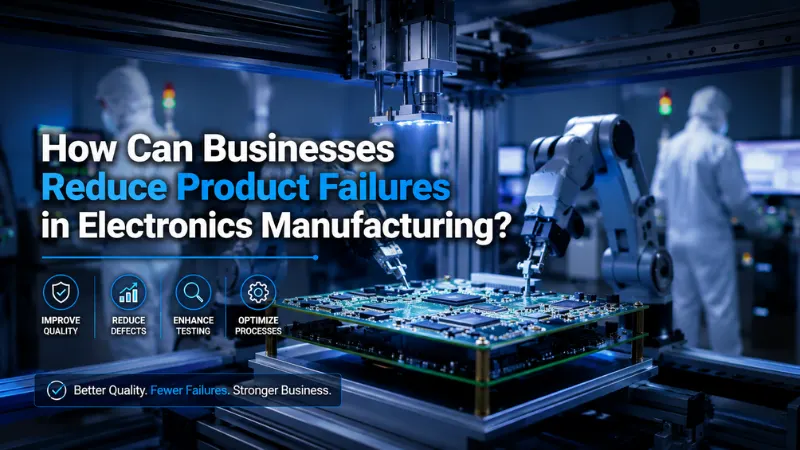
Electronics production is unforgiving. One defective part, a miscommunication between departments, or a compromise made during assembly may lead to expensive recall, negative brand image, and, at the worst, end-user safety risks. It doesn’t matter whether you are making consumer gadgets, industrial control systems, or medical devices, the need to get it right on the first try is astronomical.
The good news? The majority of product failures are not by chance. They are predictable and when the right practices are put at the right place, they are highly avoidable.
Begin with Planning
Failure that is detected late is normally the most costly. Once a defect is found in a finished product, it has gone through sourcing, assembly, testing, and packaging. That’s a lot of wasted time and money.
Design for Manufacturability (DFM) is that practice of considering the realities of production when examining product designs. It also poses the practical questions at the outset:
- Can this component be sourced reliably?
- Can this tolerance be obtained on the production floor?
- Does such a sequence of assembling cause unjustifiable risk of damage?
The key is engineering departments that work in tight cooperation with the manufacturing department at the very outset, instead of passing on finished designs and hoping that things work out, they are always less surprised in the future. The DFM reviews investment as a short payback.
Choose Your Supply Chain Partners Carefully
When choosing subcontractors and component suppliers, there is a temptation to go all the way to the lowest cost. And though price may always be a consideration, a cheap component that fails in the field is never cheap.
The Importance of Wire and Cable Quality
Wiring and cable assemblies are one of the areas where this is particularly applicable. By a poor connection, it may imply intermittent faults which are annoyingly hard to diagnose, or a failure altogether when conditions are stressed. Engaging a reliable wire harness manufacturer, who has a history of quality procedures and traceability, will greatly lessen the possibility of electrical failures, which are caused by the harness itself, but not the circuit.
Vet Your Tier-1 Suppliers
The same is applicable to all your tier-1 suppliers.
- Demand quality certifications.
- Demand samples.
- Do not overlook inspection of incoming on the ground that a supplier has a good track record.
- Trust, but verify.
Bring in Your Quality Control Processes
Quality control is not a test at the end of the line but a life-long process that is integrated into all production processes.
- Inbound Inspection: Intercepts the parts that are faulty or out of specification before they are sent to assembly. An entire production run may be polluted by a poor lot of capacitors or a delivery of connectors which have the wrong tolerances before the error is detected.
- In-process Inspection: Performed to monitor assembly in real-time. The statistical process control (SPC) methods will enable manufacturers to monitor the variation in real-time, and when a process is on its way to failure, the techniques will send an alert before it fails.
- Final Functional Testing: Verifies the completed product functions as intended. This is self-evident, yet the profundity of testing is important. Nominal testing can only inform you so much; stress testing, thermal cycling, vibration testing and accelerated life testing will inform you of failure modes which eventually will be revealed through normal use.
Don’t Underestimate the Cables
Cabling and interconnects may appear to be a trivial issue but these are some of the most common root causes of failures of electronics in the field.
- Vibration loosens connectors.
- Solder joints are fatigued by thermal cycling.
- Lack of proper strain relief will result in wire fractures in the long-term.
This is one of the reasons why high accuracy cable assembly, that is, assemblies assembled to exact length, termination and routing requirements, is more important than it may seem. By maintaining a set of standards that are consistent and verifiable when assembling cables, you are able to exclude an entire group of possible failure modes prior to the product being shipped. Even trivial tolerances in a spec sheet may prove to be critical when the product is running 24/7 in a stressful environment.
You may want to re-examine your tolerances and your inspection standards at this stage of the production process, especially when there is too much variability in your assembly process.
Invest in Traceability
In case something does go wrong and at some point or another, something will go wrong – traceability is what will distinguish between a manageable problem and a crisis. An efficient traceability system connects all completed goods to the names of the individual components, batches, operators, machines, and processes used to make the goods.
This is because when a bad batch of components materializes, you can know specifically which units are affected, and take specific measures instead of making a blanket recall. It minimizes field failures extent and expense significantly.
End-to-end traceability has been more accessible than ever with modern manufacturing execution systems (MES) being accessible to smaller manufacturers. This is one of the areas that can be modernized in case you are still using paper logs or disconnected spreadsheets.
Build a Culture That Welcomes Problem Reports
This one is harder to implement than any process change, but it might be the most important. In many organizations, there’s an unspoken pressure to not raise problems to keep the line moving, meet the shipment target, and deal with issues quietly.
Such a culture is costly. Early buried problems reoccur as field failures in the future. Another hidden liability is workers who are fully aware of quality problems but who are unable to report them.
Developing blame free communication lines about defects and near-misses and then demonstrating action on such communications develops the type of feedback loops that actually drive quality improvement as time goes by. It is also likely to uplift morale, as individuals will feel proud of what they create.
Use Failure Data to Drive Continuous Improvement
Any failure is information. Field returns, warranty claims, test failures, and customer complaints are all indications of systemic weaknesses in your product or process.
Developing an organized failure analysis capability, i.e. a formal failure mode and effects analysis (FMEA) program or a more informal routine analysis of return data, is necessary to make sure that lessons are learned and implemented, and not merely recorded. It is not simply a matter of repairing the problem at hand but rather transforming the circumstances under which the problem was created.
Closing Thoughts
There is no magic bullet to product failure reduction in electronics manufacturing. It is about creating a system, in terms of design, supply chain, assembly, testing, culture, where quality is designed in, not inspected in.
The manufacturers that do this successfully, are likely to incur lesser warranty expenses, improved relationships with customers and improved margins in the long run. It happens that quality investing is not a cost center, it is a competitive advantage. And the sooner you begin to think about preventing failure, the better and cheaper it could be.

