

Scaling Technical Hiring Without Diluting Your Evaluation Standards
Learn how to scale technical hiring without compromising evaluation standards, candidate quality, or hiring consistency.

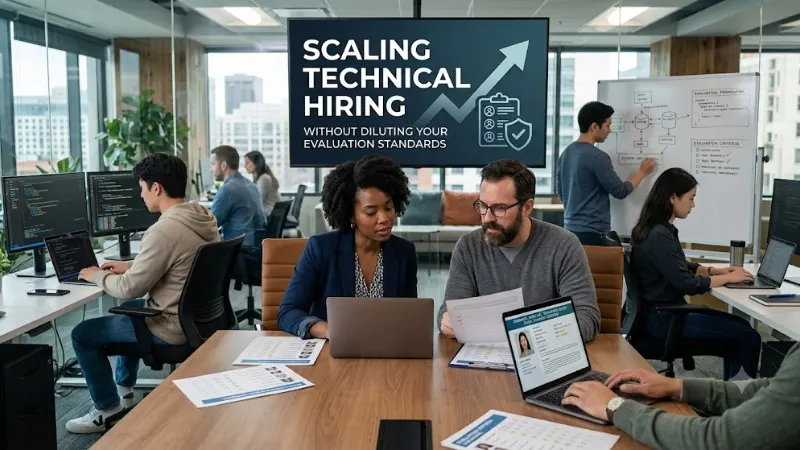
Enterprise organizations scaling technical hiring can maintain evaluation rigor by replacing ad hoc, interviewer-dependent screening with standardized, structured assessments delivered through ai interviews. This approach separates hiring velocity from hiring quality, two variables that traditionally move in opposite directions once requisition volume increases. The data on time to fill technical roles, the cost of inconsistent interviewing, and the financial impact of mis-hires all point to the same conclusion. Growth does not have to come at the expense of the bar.
This is the central challenge facing HR leaders and C-suite executives at large organizations today. Headcount plans call for faster hiring. Boards ask why technical roles remain open for months. At the same time, engineering leadership does not want compromised standards feeding into the organization. The two mandates appear to conflict, but the conflict is largely a symptom of process design, not an unavoidable trade-off.
The Core Tension in Enterprise Technical Hiring
Large organizations face a structural problem that smaller companies do not experience at the same scale. As hiring volume grows, the number of people involved in evaluation grows with it. More interviewers means more variation in how questions are asked, how answers are scored, and how much weight is given to any single signal.
Technical roles are especially exposed to this problem. The average time to fill a technical position sits at 66 days according to Second Talent, roughly 50 percent longer than non-technical roles (Second Talent, 2026). SHRM benchmarking data places engineering roles even higher, at approximately 62 days on average, with senior technical searches frequently exceeding 90 days (SHRM, 2025). When leadership pushes to compress that timeline, the instinct is often to add interviewers, shorten interview loops, or relax rubrics. Each of these responses increases throughput while quietly reducing consistency.
Where Evaluation Standards Break Down at Scale
The erosion of hiring standards during periods of rapid scaling tends to follow a predictable pattern.
- Interviewer variation increases. As more people are pulled into interview loops to meet volume demands, fewer of them have been trained on the same rubric or calibrated against the same bar.
- Interview loops get shortened under pressure. Panels that once included four or five structured rounds get compressed to two, often eliminating the rounds specifically designed to test depth over breadth.
- Fatigue lowers evaluation quality. Engineers already spend a disproportionate share of their week interviewing. Research cited by Forbes found that some engineering managers spend up to 15 percent of their time on recruiting activity, and companies effectively pay six times more for engineering time spent interviewing compared with recruiter time on the same tasks (Forbes Technology Council, 2022).
- Scheduling constraints override evaluation logic. Candidates get matched to whichever interviewer is available, not necessarily the interviewer best suited to assess a specific skill area.
None of these failure points are visible in a time to hire dashboard. They show up later, in performance reviews, in attrition data, and in the quiet erosion of technical bar over several hiring cycles.
The Cost of Sacrificing Standards to Hit Hiring Targets
The financial consequences of diluted evaluation standards are well documented. The U.S. Department of Labor estimates that a bad hire costs at least 30 percent of that employee’s first year salary (U.S. Department of Labor, cited in DistantJob, 2026). For a senior engineering hire earning 180,000 dollars annually, that baseline alone represents more than 54,000 dollars in direct cost, before accounting for lost productivity, team disruption, or the cost of restarting the search.
Other analyses place the fully loaded cost considerably higher. SHRM data referenced in multiple 2026 industry reports puts the cost to replace an employee between 50 percent and 200 percent of annual salary once recruiting fees, onboarding, ramp time, and lost output are included (SHRM, cited in Simpliverified, 2026). At the enterprise level, where technical mis-hires often affect entire product teams rather than a single role, the downstream cost of a diluted evaluation process compounds quickly across dozens or hundreds of simultaneous searches.
This is the core argument enterprise leaders should bring to the board when time to hire targets are set without corresponding investment in evaluation infrastructure. Speed without structure does not save money. It defers cost and increases it.
Why Structure, Not Speed, Is the Real Lever
Decades of industrial and organizational psychology research point to the same finding: structured interviews substantially outperform unstructured ones at predicting job performance. Schmidt and Hunter’s landmark 1998 meta-analysis found a predictive validity of 0.51 for structured interviews compared with 0.38 for unstructured interviews (Schmidt and Hunter, 1998). A more recent replication by Sackett and colleagues found validity coefficients of 0.42 for structured interviews against just 0.19 for unstructured formats, effectively doubling the predictive power (Sackett et al., 2022).
The mechanism behind this gap is consistency. Structured interviews ask every candidate the same questions, in the same order, scored against the same rubric. This removes the variation introduced by interviewer mood, familiarity with the role, or unconscious bias. Research comparing structured and unstructured formats found that unstructured interviews were significantly more susceptible to bias, with an effect size roughly two and a half times larger than structured formats (comparative meta-analysis, ResearchGate, 2020).
This is the insight enterprise hiring leaders should center their scaling strategy around. The goal is not simply to interview faster. It is to interview with less variance, at whatever volume the business requires.
How AI Interviews Preserve Evaluation Rigor at Volume
Ai interviews address the scaling problem directly by removing the two variables that most commonly degrade evaluation quality: interviewer inconsistency and interviewer capacity.
- Every candidate receives the same structured assessment. Unlike a distributed interviewer pool with varying calibration, ai interviews apply a fixed rubric across the entire candidate population, regardless of hiring volume.
- Evaluation capacity scales independently of headcount. A structured technical evaluation can run in parallel across dozens or hundreds of candidates simultaneously, something no interviewer pool can replicate without proportional headcount growth.
- Scoring is generated immediately and consistently. Because assessment criteria are fixed in advance, there is no dependency on a hiring manager’s calendar or memory of a candidate three interviews later in the week.
- Senior technical staff are reserved for final-stage judgment. Rather than spending hours on early-stage screening, technical leaders can focus their limited time on final rounds where nuanced judgment genuinely adds value.
This structure mirrors exactly what the research on structured interviewing recommends, applied at a scale that manual processes cannot sustain during periods of aggressive hiring growth.
The Hidden Cost of Manual Technical Screening
Enterprise leaders frequently underestimate how much manual screening actually costs once engineering time is properly accounted for. A senior engineer’s fully loaded cost typically ranges from 100 to 200 dollars per hour. Engineers who spend even 10 hours a week on interview related tasks, including prep, live interviews, and feedback, represent between 52,000 and 104,000 dollars annually in interviewing cost per engineer (BarRaiser, 2026). Across a team of ten senior engineers involved in hiring, that figure alone approaches the cost of two additional full time engineering hires the organization never gets to make.
This hidden cost rarely appears in a standard cost per hire calculation, which typically focuses on recruiting spend rather than internal technical time (Pin, 2026). For enterprise organizations running dozens of concurrent technical searches, the true cost of manual screening at scale is substantially higher than most finance functions realize.
A Framework for Scaling Without Diluting the Bar
Enterprise HR and technical leadership can apply a consistent framework when scaling hiring volume.
- Separate screening from final judgment. Use structured, standardized evaluation for early stage technical assessment, and reserve senior interviewer time exclusively for late stage decisions.
- Fix the rubric before scaling volume. Standards should be defined and calibrated before hiring accelerates, not adjusted reactively once volume increases.
- Measure consistency, not just speed. Track variance in scoring across interviewers and roles, not only time to fill.
- Protect technical staff capacity. Treat engineering interview hours as a finite, costed resource rather than an unlimited input.
- Audit evaluation quality on a recurring basis. Standards drift gradually. Periodic calibration reviews catch degradation before it shows up in performance data eighteen months later.
What Enterprise Leaders Should Measure
Time to fill remains a useful operational metric, but it should never be tracked in isolation. Enterprise leaders evaluating whether their hiring process is scaling correctly should also track score variance between interviewers, offer acceptance rates by evaluation method, and post-hire performance correlation against interview scores. Organizations that pair standardized evaluation, delivered through ai interviews, with these quality metrics are far better positioned to hit aggressive hiring targets without absorbing the downstream cost of a diluted technical bar.
Scaling technical hiring and protecting evaluation standards are not competing priorities once the process is designed correctly. The data is consistent across every source examined here. Structure predicts quality. Consistency reduces cost. And organizations that build hiring infrastructure capable of maintaining both at volume are the ones who scale without paying for it later.