

Treat Creator Outreach Like ABM: Using Intent Singals to Pick Influencers
Pick YouTube creators like target accounts: set a creator ICP, read sponsorship intent signals, plan for email match rates and track cost per deal.

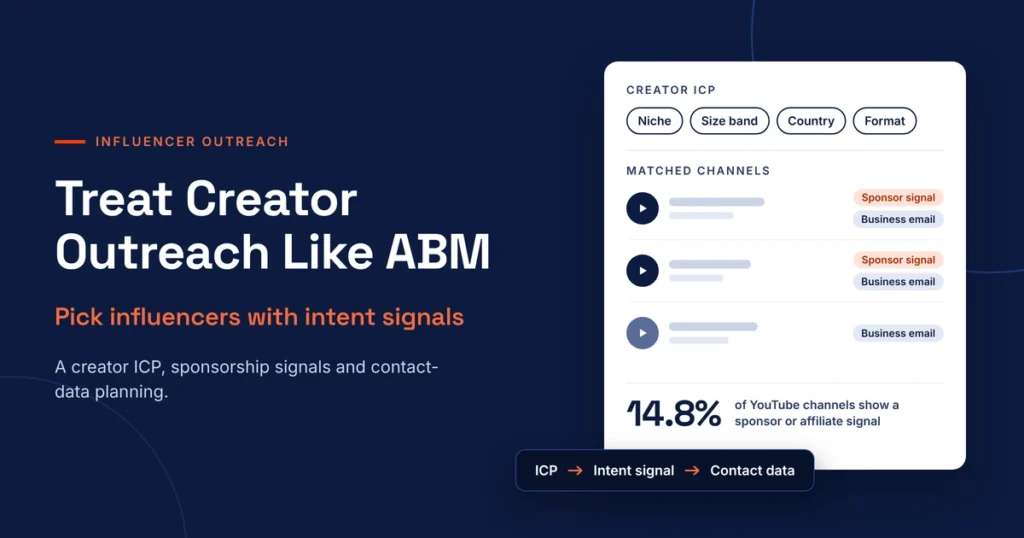
Many brands pick creators by follower count and send the first message to whoever has the biggest number. B2B teams would not choose target accounts by company size alone, since size says little about fit or timing.
Account-based marketing starts with a defined customer profile and adds signals of interest. It then checks that the contact data is good enough to reach a buyer. The same sequence works for influencer outreach, and the sections below apply it to YouTube creators.
Define a Creator ICP Before You Search
A creator ICP is a short written profile of the channels you want to reach, settled before anyone opens a search. It names the niche, the audience size band, the country and the content format.
The niche decides whether the audience resembles your buyer, and the country decides whether those viewers can buy from you. The size band affects what a partnership costs and how much attention a brand can expect from the creator.
Content format matters because a product review and a short skit give a brand very different room to explain what it sells. Writing these four fields down gives you a profile to check each candidate against, which is the job an account fit score does in a B2B funnel.
Read Intent Signals on the Creator Side
In B2B, intent data shows which accounts are already in motion. For creators, the closest equivalent is a record of past sponsorships, because a channel that has carried sponsored content before suggests it is open to deals.
In the DataAtScale data on 713,106 English-language YouTube channels with 1,000+ subscribers (US, UK, Canada, Australia, read October 2026), 14.8% show any sponsor or affiliate signal. That is about one in seven channels, and the share rises from 11.9% at 1K-10K subscribers to 26.6% at 500K-1M.
Channels with a sponsor signal also list a business email 76.7% of the time, against 54.4% for the rest. For an outreach team, that means the channels most likely to be open to a brand are also the ones easiest to contact.
The signal is imperfect, because on a hand-checked sample it was right 58.7% of the time. Treat it as a way to prioritise candidates, the way a B2B team treats an intent score, and not as a promise about any one channel. A short human check of the top candidates still belongs in the workflow.
Build Lookalike Lists With Filters Set First
B2B teams rarely build a target list from nothing. They take their strongest customers and look for accounts that resemble them, and creator selection can start the same way with the channels that have already performed well for you.
Some tools that find similar YouTube channels take the creators you already know and return channels like them. The useful part is setting the ICP filters before the search runs: size band, country, whether a business email is listed and whether the channel has past sponsorships.
A list built this way arrives already matching your profile, so your team starts from relevant channels instead of sorting through a general pool. It also keeps the ICP honest, since a field you did not set in advance cannot quietly drift during the search.
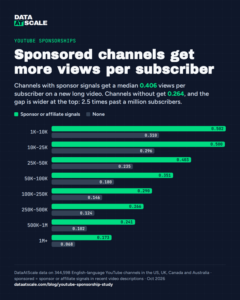
In the same data, channels with sponsor signals got more views per subscriber than others in all eight size bands. That gives a second reason to set the sponsorship filter even when you care more about viewing than about deal history.
Plan for Contact Data Match Rates
Reaching a creator is a contact data problem, and B2B teams already plan around match rates when they buy or build account lists. Creator lists need the same planning, because 54.2% of channels with 1K-10K subscribers list a business email, against 72.7% at 1M+.
That means 45.8% of the smallest channels list none, which is nearly half. A campaign aimed at that band should start with a list considerably longer than the number of conversations you want to hold.
The emails in these lists are ones creators publish on their own channels, so a channel without one is simply not offering a public way in. Plan a second route for those channels, such as a direct message, the way a B2B team falls back to another channel when an email is missing.
Match rates also change how you compare size bands. A larger channel costs more to work with, but a higher share of larger channels can be contacted at all, and your cost per conversation should include both facts.
Measure Creators Like Pipeline
Reach is the creator equivalent of impressions, and most B2B teams judge campaigns by pipeline rather than impressions. A creator campaign is easier to judge when you count the replies you get and the cost per deal.
Record those numbers against the ICP fields and the intent signal, so each list shows which profile produced conversations. After a few campaigns the profile gets adjusted by results instead of by guesses about follower counts, and the next list starts from a better ICP than the last one.