
What Is GEO (Generative Engine Optimization)? Your Ultimate Guide to AI Search Visibility
Learn what Generative Engine Optimization (GEO) is and how to boost your brand’s visibility in AI-powered search engines and results.

So you finally noticed your brand ranks on Google. But if you ask the same question on AI, you will realize it doesn’t even appear in the answer. Also, when was the last time you actually clicked on a search result for a simple informational query?
If you’re like most professionals navigating the internet in 2026, you’re getting answers straight from AI-generated summaries. Search engines don’t just scan pages anymore. They’re figuring out what you want, piecing together information, and giving answers instantly. For professionals like you, the way we find information is changing; search engines are now creating summaries and delivering answers straight from them.
We’ve moved from “ranking on page one” to “being part of the answer.”
This shift has evolved traditional SEO practices into a new visibility discipline: Generative Engine Optimization, or GEO.
If SEO was about earning clicks, GEO is about earning citations inside AI-generated responses. And for brands serious about long-term digital authority, understanding this evolution is no longer optional.
What Is GEO (Generative Engine Optimization)?
Generative Engine Optimization is the practice of structuring and distributing content so that generative AI systems can accurately interpret, extract, and reference it within synthesized responses.
Unlike traditional SEO, which focuses on ranking URLs in retrieval-based systems, GEO targets synthesis-based systems that construct answers.
When someone asks an AI a complex question, the system scans trusted sources, identifies consensus, weighs authority signals, and generates a structured reply; your brand either appears in that response or it doesn’t.
That inclusion is the new visibility metric.
GEO emerged as AI-powered search tools like ChatGPT, Google AI Overviews, and other conversational engines reshaped how discovery works. These systems prioritize semantic clarity, authority consistency, and cross-domain credibility.
Which means your website alone is no longer enough.
Why Generative Engine Optimization (GEO) Matters in AI-Driven Search
Search behavior has evolved. Users are asking full questions, not typing fragmented keywords. They expect contextual, summarized answers.
And increasingly, they’re getting them.
This changes three major things:
- Informational clicks are declining.
- AI-generated responses are shaping perception before users ever visit your site.
- Brand visibility now occurs inside synthesized answers.
If your competitor is being referenced in AI summaries and you’re not, they effectively gain an advantage in early-stage perception.
This is especially critical in B2B environments where buyers conduct deep research before engaging sales teams. Being recognized as a credible informational source during that research stage directly influences pipeline quality.
In other words, generative visibility impacts demand generation.
How Generative Engine Optimization Works
To optimize for GEO, you need to understand how generative systems evaluate information.
Unlike traditional search engines that rank pages individually, generative engines:
- Identify entities (brands, products, topics)
- Evaluate contextual relevance
- Detect informational agreement across sources
- Prioritize clarity and extractability
- Assess credibility patterns
If your content is clear but isolated, its impact is limited.
If your insights appear consistently across trusted domains, your authority strengthens significantly.
This is where distribution strategy becomes strategic infrastructure rather than a promotional afterthought.
How Generative AI Engines Interpret and Select Information
AI systems rely heavily on entity modeling. They build associations between brands and topics based on repeated contextual exposure.
For example, if your brand consistently publishes high-quality insights about B2B demand generation, and those insights are referenced across industry publications, AI systems begin associating your entity with that expertise.
- Cross-source consistency matters.
- Clarity matters.
- Structured organization matters.
- And distributed authority matters most.
GEO vs SEO: Key Differences and Strategic Implications
| Characteristic | Driven by | Measures | Optimizes for | Relationship |
| SEO | Retrieval | Rankings, impressions, traffic | Search engine algorithms | Supports GEO |
| GEO | Synthesis | Inclusion, citation, generative presence | AI interpretation systems | Complements SEO |
If SEO is about being discoverable, GEO is about being quotable.
Core Pillars of Generative Engine Optimization
1. Semantic Clarity for AI Visibility
Generative systems favor precision. Ambiguity weakens extractability.
Define key concepts clearly. Maintain consistent terminology across content. Avoid jargon that clouds interpretation.
Think of your content as knowledge architecture rather than blog copy.
2. Structured Content for Generative Engines
Clear headings. Logical segmentation. Self-contained sections.
AI models extract structured information more effectively when it’s organized in modular units. FAQ formats, definitional breakdowns, and hierarchical frameworks increase extractability.
Technical enhancements like schema markup further support machine readability.
3. Authority Signals and Content Credibility
Authority today is not just about backlinks. It is about distributed informational presence.
If your insights exist only on your domain, AI systems have limited reinforcement signals. But when your expertise appears across multiple reputable platforms, credibility compounds.
This is precisely why content syndication plays a critical role in GEO strategy.
By distributing authoritative content across trusted domains, brands strengthen cross-domain consistency, which directly influences how AI models evaluate credibility.
For a deeper breakdown of how this works, the ultimate guide to content syndication explores how strategic distribution amplifies authority signals across digital ecosystems.
4. Contextual Completeness and Informational Depth
Surface-level content struggles in generative environments.
AI systems prioritize comprehensive resources that fully resolve user intent. A complete guide with layered insights provides more extractable value than fragmented articles.
This is also why the benefits of employing a powerful content syndication strategy extend beyond lead generation. Distribution increases informational depth across ecosystems, reinforcing authority in generative contexts.
Depth plus distribution equals influence.
Measuring Generative Engine Optimization Performance
GEO success does not always correlate with traffic spikes.
Sometimes visibility increases while clicks decline because AI answers the question directly.
Key emerging metrics include:
- Frequency of brand mentions in AI responses
- Inclusion in synthesized summaries
- Share of generative presence versus competitors
- AI-assisted referral traffic
Measurement frameworks are still evolving, but early adopters tracking AI citations gain competitive learning advantage.

How Content Syndication Strengthens GEO
Let’s make this practical.
Generative systems detect patterns across the web. If multiple credible sources reinforce similar claims associated with your brand, authority signals strengthen.
This is why content syndication for B2B companies aligns so naturally with GEO objectives.
It expands informational presence across domains, increases contextual reinforcement, and builds credibility footprints that AI systems are built to recognize.
Even more strategically, AI-driven content syndication leverages intelligent targeting to ensure your expertise appears in environments most relevant to your industry.
This is not about blasting content everywhere.
It is about reinforcing expertise in the right ecosystems.
When executed properly, content distribution becomes authority engineering.
Integrating GEO Into a Modern Digital Marketing Strategy
GEO should not operate in isolation.
It integrates with:
- SEO content planning
- Demand generation initiatives
- Thought leadership strategy
- Brand positioning frameworks
Your distribution strategy should support both traffic acquisition and AI visibility objectives.
Understanding top content syndication networks and platforms helps ensure your expertise appears in credible environments that generative systems frequently reference.
Forward-thinking marketing teams are not optimizing for channels. They are optimizing for visibility ecosystems.
Common Misconceptions About GEO
“GEO replaces SEO.”
No. It expands it.
“AI citations automatically drive traffic.”
Not always. But they influence perception.
“Technical fixes are enough.”
No. Authority and clarity are equally critical.
“AI results are too unpredictable to optimize.”
Patterns exist. Strategy matters.
The brands treating GEO seriously today are building durable advantages for tomorrow.
Who Should Prioritize GEO?
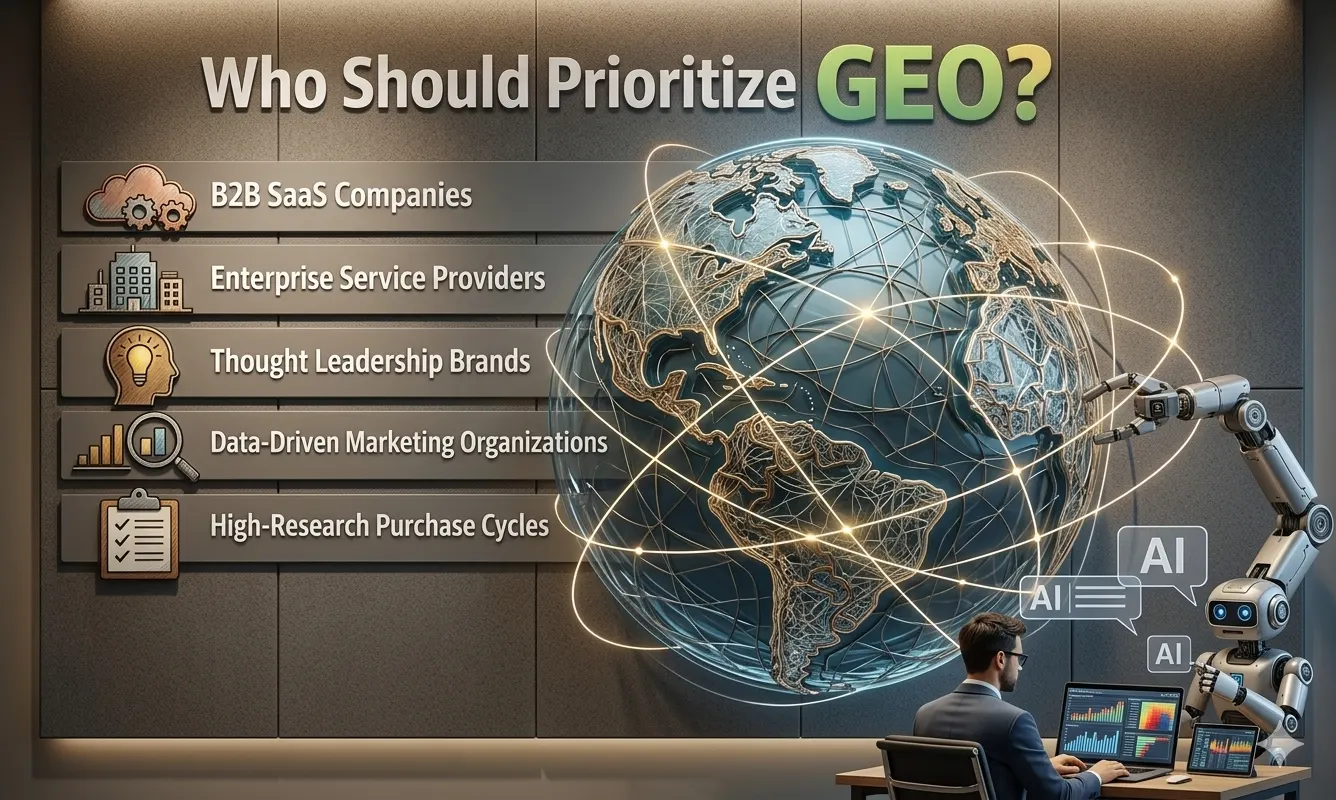
If your buyers use AI tools during research, GEO is already influencing your pipeline, whether you measure it or not.
The Future of GEO and AI Search Visibility
Search is becoming entity-centric. AI systems are modeling brands as knowledge nodes connected to topics.
The stronger your cross-domain authority signals, the more stable your generative visibility becomes.
Multimodal AI search will expand this further, incorporating video, audio, and structured datasets into synthesized outputs.
The brands investing in distributed informational authority now will not just appear in answers. They will shape them.
The Business Impact of GEO: Beyond Visibility
Let’s zoom out for a second.
GEO is not just a search trend. It is a revenue conversation.
When AI systems summarize a category, recommend vendors, explain methodologies, or compare solutions, they are shaping early-stage buyer perception. In many cases, they are doing it before a prospect ever visits your website or downloads a resource.
That means AI-generated responses are influencing:
- Shortlist creation
- Category understanding
- Vendor credibility
- Perceived expertise
If your brand is consistently referenced in generative responses related to your core competencies, you are effectively pre-positioning your sales team. Buyers arrive with contextual trust already formed.
This is especially powerful in high-consideration B2B cycles. When research spans weeks or months, generative tools become research assistants. The brands that show up in those AI conversations accumulate invisible equity.
Now layer this with distribution strategy.
When insights published on your website are reinforced through credible industry platforms, partner publications, and authoritative domains, AI systems detect informational consistency. That consistency builds entity strength. And entity strength increases the probability of inclusion in synthesized outputs.
This is why understanding how content syndication adds value to your business is no longer limited to lead acquisition metrics. In the generative era, it becomes an authority multiplier.
Forward-thinking marketing leaders are not just asking, “How do we rank?”
They are asking, “How do we become the source AI trusts when it constructs answers?”
That mindset shift changes everything.
Conclusion: Adapting to the Generative Engine Optimization Era
Generative search is not a feature update. It is a structural shift in digital visibility.
Ranking still matters. But being referenced inside AI-generated responses increasingly defines authority.
Brands that combine semantic clarity, structured content architecture, and distributed credibility through Content Syndication build the layered authority signals generative systems are designed to trust.
And when that strategy is aligned with long-term digital marketing initiatives, AI visibility becomes sustainable rather than reactive.
The future of search is not just about being found.
It is about being synthesized.
Frequently Asked Questions (FAQs)
- What is GEO used for?
GEO helps your brand get cited in AI-generated answers, boosting visibility and credibility across platforms instead of just ranking in search results. - What is the difference between SEO and GEO?
SEO drives traffic by ranking pages; GEO drives authority by getting AI systems to reference your brand in synthesized answers. - What are the 4 types of SEO?
On-Page, Off-Page, Technical, and Local SEO. All focus on visibility, with technical and authority signals now key for AI inclusion. - What is an example of Generative Engine Optimization?
Publishing structured, clear content across trusted domains so AI platforms cite your brand in answers, shaping early-stage buyer perception.