

What Should B2B Founders Automate First?
B2B founders lose hours to admin they could automate. Learn which manual tasks to hand off to software first and which to keep until your GTM is proven.

Seed-stage B2B founders tend to do everything themselves, from selling and onboarding new customers to updating spreadsheets and chasing follow-ups, often all in the same afternoon. According to Kauffman Foundation data, founders spend roughly 36% to 40% of their working hours on admin tasks, and Salesforce’s State of Sales report paints an even grimmer picture for sales reps, with about 60% of their time going to non-selling work like manual data entry and tool-switching.
Those are hours that could go towards closing deals or building product, but they don’t. So which tasks should a founder hand off to software first, and which ones will actually get worse if you automate them too early?
Where Founder Hours Disappear Fastest
Big strategic calls and product decisions aren’t what eat up most of a founder’s week. The real time killer is the boring, repetitive stuff that happens between conversations with prospects: logging contacts after a call, updating pipeline stages, sending follow-up emails, booking meetings. Each one takes five minutes on its own, but across a full week they add up to something genuinely painful.
Because most early-stage founders don’t have an ops person picking up this slack, every minute spent copying prospect details into a spreadsheet or writing a reminder email is a minute not spent talking to actual customers. And the worst part is that nobody notices admin work until something breaks, like a warm lead going cold because a follow-up fell through the cracks.
What’s Safe to Automate Early
Not all tasks are equal when it comes to automation, and the ones that work best early on share a couple of things in common: they happen the same way every time, and they don’t need much human judgement. Lead follow-up sequences are a textbook case here. If every new inbound lead gets the same three-email sequence before a call gets booked, that’s a pattern software can run reliably from day one.
Contact capture and activity logging fit the same mould. An early-stage startup CRM that pulls in contact details from emails and calendars automatically, logs calls and meetings without anyone typing anything, and triggers follow-up reminders can save a founder several hours a week. At this stage, the thing to look for is a tool that fits a small team now but won’t need ripping out and replacing six months down the line when the go-to-market process changes.
Deal-stage updates are another easy win. Moving a prospect from “demo booked” to “proposal sent” shouldn’t mean someone has to open a spreadsheet, hunt for the right row, and manually change a cell. Pipeline tools that update stages based on triggers, like a sent proposal or a completed call, get rid of that friction entirely.
What Should Stay Manual (For Now)
Automating the wrong things too early can actually create more problems than it fixes. Qualification criteria are a prime example of this, because if a founder hasn’t figured out what a good-fit customer looks like yet, automating lead scoring will just bake bad assumptions into a system that runs on autopilot. The result is wasted outreach to people who were never going to buy, but now with the false confidence that “the system” approved them.
Pricing conversations, objection handling, custom demo prep, and anything that involves reading a prospect’s specific situation should also stay in human hands during those early months. These are the interactions where founders learn the most about their market, and handing them off to templates too soon means losing the signal that will shape a stronger go-to-market strategy down the road.
The Order Matters More Than the Tools
The biggest mistake founders make with automation isn’t choosing the wrong software. It’s automating processes that haven’t settled yet. A follow-up sequence that gets rewritten every week isn’t ready for automation, because the founder will spend more time editing workflows than they would just sending the emails by hand.
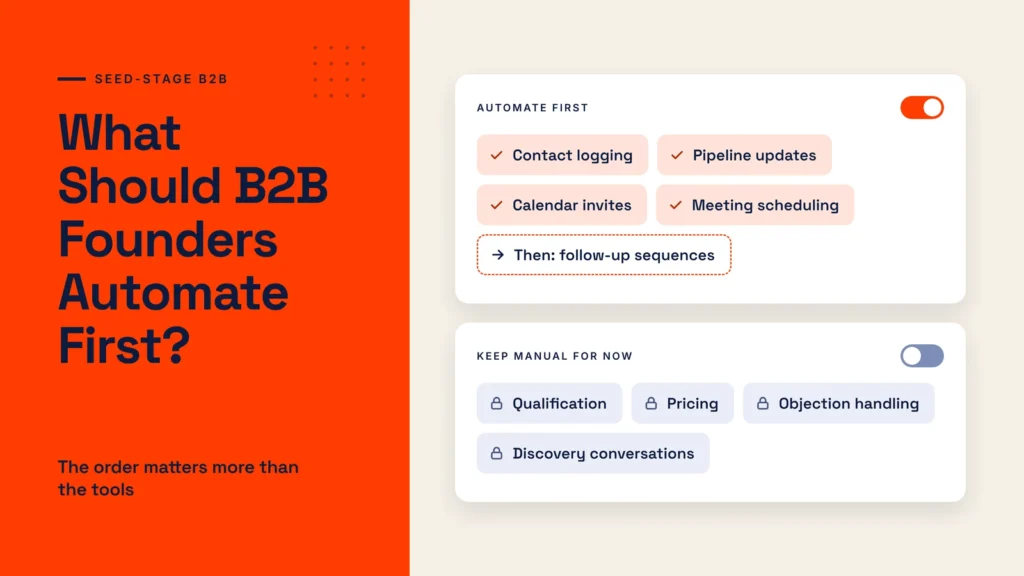
Start with whatever burns the most hours for the least strategic return: contact logging, pipeline updates, calendar invites, and meeting scheduling. Once the messaging has been tested and stays consistent, layer in follow-up sequences. Leave qualification, pricing, objection handling, and discovery conversations in human hands until the go-to-market motion is proven and repeatable. Founders who get this sequence right will free up real hours each week without sacrificing the customer insight that keeps early-stage selling effective.