
Why a Brand’s New Instagram Account Reaches Nobody
Learn why new Instagram brand accounts struggle to reach users and discover practical ways to improve visibility, engagement & organic growth.

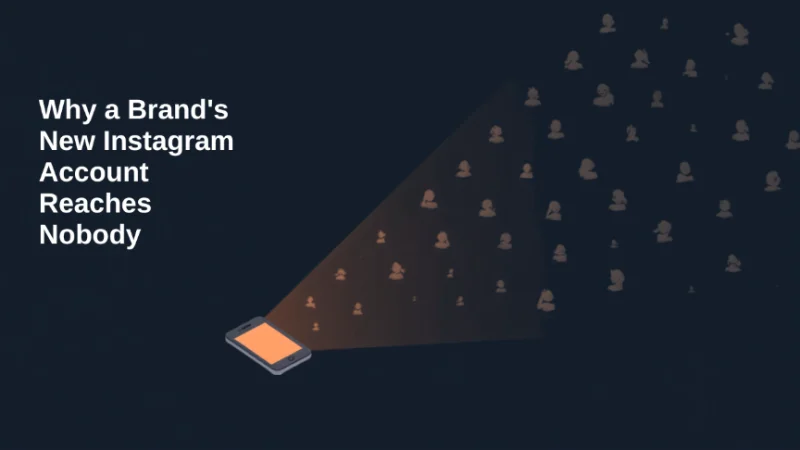
The launch follows a familiar sequence. Marketing gets approval for a social channel, someone builds out the profile properly, and the first month of posts goes up on schedule. Then the numbers arrive. Forty views on a post that took an afternoon to produce, two likes, both from colleagues.
The conclusion drawn in the review meeting is almost always about the content. It is usually about something else entirely, and the something else is not a penalty, a shadowban or a preference for paid reach. A new account is a prediction problem the platform cannot solve yet, and until it can, distribution stays deliberately small.
What the System Knows About a New Instagram Account
Ranking a post means predicting how people will respond to it, and that prediction is built from what an account has done before. A new account has done nothing before, so the system has no history to work from and falls back on the weakest inputs available. The stated category, the handful of people who followed first, and whatever can be read out of the image and the caption.
The mechanism is described clearly in a write-up of the cold start problem behind every new Instagram account, and the loop it describes is the part worth understanding. Low predicted engagement produces a small test audience, a small test audience generates almost no feedback, and the absence of feedback leaves the original estimate standing. The account looks unpromising because it was never shown to enough people to look like anything else.
This is why the first followers matter out of proportion to their number. A human deciding to follow is the first genuine signal the model receives, and it carries more weight than anything written in the bio.
Exploration Has a Budget
Platforms spend most of their distribution on content they are confident about, because that is what keeps people watching. The rest goes on testing things they are uncertain about, which is where every new account sits.
That testing allowance is small and it is not distributed evenly. Content on a widely discussed subject gets tested more often, since there is a large pool of people who might respond. A narrow B2B subject gets tested less, not out of prejudice but because the system has fewer candidates to try it on. Brands in specialist categories therefore wait longer for the same amount of evidence to accumulate, and a launch plan built on consumer benchmarks will look like a failure against numbers it was never going to hit.
Why the First Ninety Days Look Like Failure
Early reporting on a new channel measures the platform’s confidence more than it measures the work. Volume is low, cost per result is high, and the model distributing the posts is still uncertain about what it is holding.
Read as performance, those numbers end the project. Read as direction, they are informative. Repeat engagement from the same accounts, people watching to the end, saves rather than passive likes. Those movements appear well before the volume does, and they are the only things in an early dashboard that predict anything.
The practical protection is to agree the review window before launch and hold the variables steady through it. Changing the format, the subject and the posting frequency in week three guarantees that nothing measurable can be attributed to anything afterwards.
Importing an Audience You Already Have
The fastest way through the blind window is to stop asking the platform to find an audience and hand it one instead. Most companies have several and use none of them at launch.
The customer newsletter goes out to people who already chose to hear from the brand. The website has more monthly visitors than the account will reach organically for months. The sales team speaks to prospects every day. Employees have their own accounts, and a dozen colleagues following on day one is worth more than a paid campaign aimed at strangers, because their subsequent behavior is real.
The point is not vanity numbers. It is that every one of those follows and saves is a data point the model did not have, and the estimate it builds from them replaces the guess it started with.
Consistency the Model Can Read
Two kinds of consistency shorten the window, and neither is about quality.
Subject consistency lets the system place the account. An account posting about one recognizable area on Instagram for six weeks becomes classifiable, and classification is what allows it to be shown to people interested in that area. An account covering product news, office culture, industry commentary and recruitment in the same fortnight stays unplaceable.
Format consistency does the same job for prediction. When the shape of the content holds steady, the response to the last post says something useful about the next one. When every post is a different length, ratio and style, each one is effectively a new experiment and the account keeps restarting its own cold start.
Measure the Actions That Cost Something
Not all engagement carries the same information. A like costs nothing and means nearly nothing. A save means someone expects to need this again. A share means they were willing to put their own name next to it.
High-effort actions are also the ones that survive translation into a marketing report. Saves and shares on a piece of content say more about whether a message lands than impressions ever will, and a demand generation team that reports those two figures for the first quarter has something honest to show, even when the reach numbers are small enough to be embarrassing.
Frequently Asked Questions
How long does the cold start period usually last?
It ends when enough real interactions have accumulated to outweigh the initial guess, which depends on posting consistency rather than elapsed weeks. Narrow subject areas take longer because they get tested less often.
Does a complete profile speed things up?
It helps, since the category, bio and first images are among the few inputs available at the start. It is a starting position rather than a solution.
Should a brand run ads to get a new account moving?
Paid reach can supply early interactions, but only if the targeting matches the people the account wants organically. Ads aimed at a broad audience teach the system the wrong thing about who the content suits.
Is it better to launch with a backlog of posts ready?
Yes, because consistency in the first weeks is what makes an account classifiable. A queue prepared in advance survives the month when nobody has time to produce anything.