

7 AI Account-Based Marketing Software Factors B2B Marketers Should Know
Evaluate account-based marketing software across 7 key factors, including AI scoring, intent data, integrations, governance & pipeline impact

A few years ago, having AI was a competitive advantage.
Today, it’s table stakes.
Nearly every account-based marketing platform claims to use AI for scoring, intent detection, personalization, and automation. That makes choosing a platform harder than ever because AI is no longer the differentiator.
According to research on AI in account-based marketing, 91% of B2B marketers already use AI in their ABM programs. Only 19% have a formal strategy for it. So AI adoption is not the differentiator anymore. What you do with it is.
Execution is what matters.
The platforms that deliver pipeline aren’t necessarily the ones with the most AI. They’re the ones that turn signals into actions your revenue team can actually use.
TL;DR: What should B2B marketers look for in AI account-based marketing software?
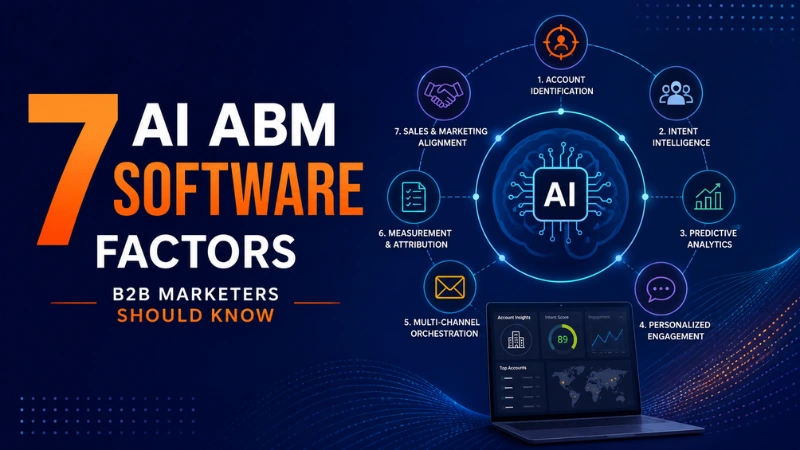
Look for these seven things: account scoring that explains itself, intent data that is timely and verifiable, buying-group intelligence that goes beyond a single contact, orchestration that tells sales what to do next, integrations that fit your existing stack, responsible AI and privacy practices your legal team can live with, and pipeline measurement that connects activity to revenue. The platform that wins is the one that shortens the distance between a meaningful signal and a pipeline outcome.
What Is AI Account-Based Marketing Software?
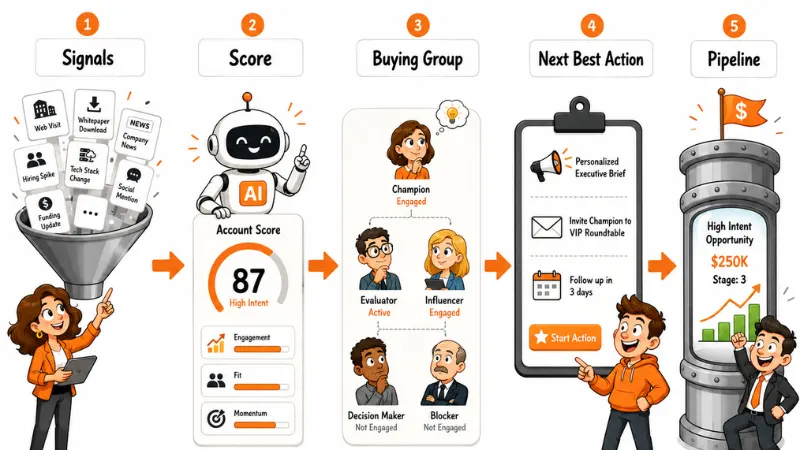
AI account-based marketing software helps B2B teams identify, prioritize, engage, and measure high-value accounts using predictive scoring, buyer intent data, buying-group intelligence, personalization, and campaign automation.
Unlike traditional lead-gen tools, ABM software starts with target companies, not individual form fills. It helps teams figure out which accounts fit the ideal customer profile (ICP), which ones are showing active demand, who inside those accounts is involved in the buying decision, and what the revenue team should do next.
This category covers a wide range: some platforms that specialize in predictive intelligence, some in advertising, some in intent data, and some in campaign execution. That is why feature comparisons alone will not get you to the right answer. You need to evaluate platforms against your actual revenue workflow.
Before evaluating platforms in detail, here are the seven factors B2B marketers should compare:
| Factor | What to Evaluate |
| 1. Account Scoring & Explainability | Accuracy, scoring logic, fit vs. intent |
| 2. Intent Data Quality & Timing | Source, coverage, freshness, reliability |
| 3. Buying-Group Intelligence | Stakeholders and role-level personalization |
| 4. Signal-to-Action Orchestration | How signals trigger next actions |
| 5. Integrations & Usability | CRM fit, adoption, implementation |
| 6. Responsible AI & Privacy | Governance, consent, security, compliance |
| 7. Pipeline Measurement & Value | Attribution, pipeline impact, revenue |
1. Account Scoring Accuracy and Explainability
A score without context is just a number.
Strong account scoring pulls from multiple signals: ICP fit, firmographic and technographic data, first-party engagement, third-party intent, historical opportunity outcomes, buying-stage indicators, and product-level relevance. The platform should be able to tell you why an account scored the way it did and what changed recently.
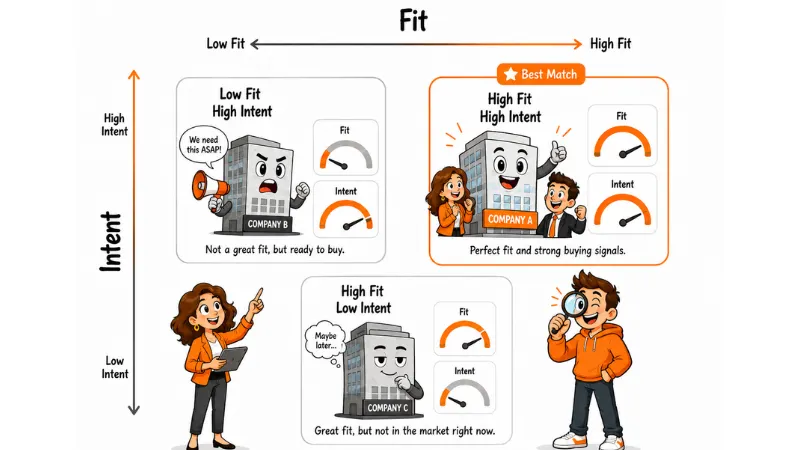
The distinction between a high-fit account and an in-market account matters. A company can look exactly like your best customer and have zero current demand. Another can be researching the right topics and sit completely outside your serviceable market. A good scoring model separates these.
What buyers should test
Pull a sample of closed-won accounts, closed-lost opportunities, current customers, disqualified leads, and stalled pipeline. Give them to the vendor without revealing the outcomes. See how the platform scores them and whether those scores match what your sales team already knows from experience.
Questions to ask the vendor
- What signals go into the model and how are they weighted?
- Can the model be adjusted for different products, markets, or segments?
- How does the platform distinguish fit from intent from engagement?
- How often does the model update?
Red flags: scores with no explanation, fixed rules marketed as predictive AI, models that cannot be reconfigured when your ICP changes.
2. Intent-Data Quality, Coverage, and Timing
Intent data can tell you when companies are researching topics related to your product. It cannot tell you whether they are ready to buy.
That distinction matters more than most vendors will volunteer. A signal that an account has been reading about “cloud data governance” might mean they are actively evaluating vendors. It might also mean a junior analyst is writing a white paper. Intent data adds context. It does not replace judgment.
What you should examine:
- signal source and methodology
- geographic and industry coverage
- topic availability
- data-refresh frequency
- how first-party and third-party signals are combined
- company identification accuracy
- account-level or person-level intent reports (If available)
Timeliness is underrated. According to the B2B Buyer Experience Report, the winning vendor was already on the buyer’s initial shortlist 95% of the time and the pre-contact favorite won about four out of five deals. A signal that arrives after the account has already built a shortlist is not useful. It is noise.
What buyers should test
Select a controlled group of accounts during the pilot. Compare platform signals against what you already know: website activity, CRM history, campaign responses, and what your sales reps have heard in conversations. You are testing whether the data adds reliable context, not just more alerts.
Questions to ask the vendor
- Where does the intent data come from, and how is it collected?
- How frequently is it refreshed?
- How does the platform handle false positives?
- What is the coverage for our target geographies and verticals?
3. Buying-Group Intelligence and Personalization
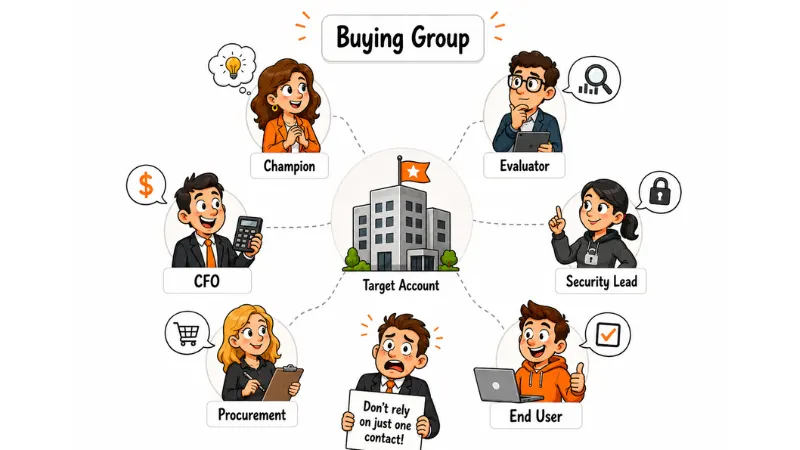
B2B SaaS purchases do not happen because one lead filled out a form. Users, technical evaluators, financial approvers, procurement teams, executives, legal, and security stakeholders can all influence the outcome. Your ABM platform should help you find them, understand their role, and reach them with something relevant.
One active researcher in an account could be a student, a competitor, a consultant, or someone three levels below the actual decision-maker. Account-level interest without buying-group context regularly sends sales down the wrong path.
Effective account-based marketing campaigns require the platform to distinguish decision-makers from champions from influencers from gatekeepers and to recommend different content and outreach angles for each. Swapping a company name into the same message for every contact is not personalization. It is a mail merge.
What buyers should test
Ask the vendor to demonstrate how the platform identifies buying-group members beyond the primary contact. Check whether it flags missing stakeholders. Then test whether it recommends different content or messaging for a CFO versus a security lead in the same account.
Questions to ask the vendor
- How does the platform identify buying-group members?
- How does it handle gaps in contact coverage?
- What personalization is possible at the role or persona level?
- How does it distinguish an active evaluator from a passive researcher?
4. Signal-to-Action Orchestration
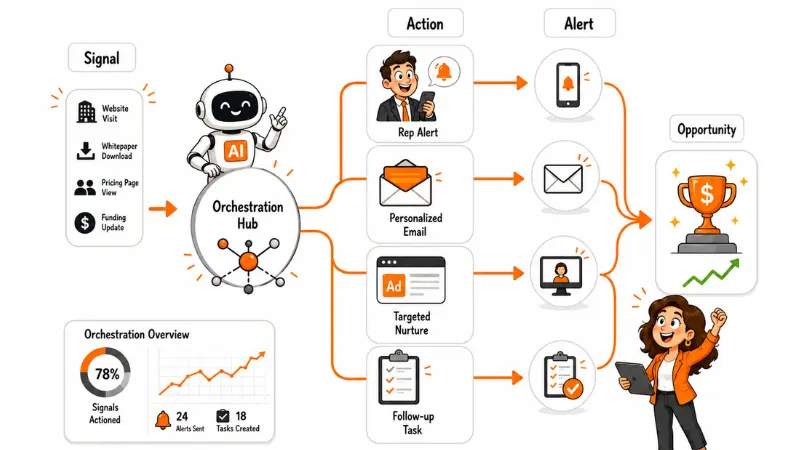
Most ABM platforms are good at showing you what happened. Fewer tell you what to do next.
A signal that an account is in-market is useful. A recommendation for what marketing and sales should do with that signal, right now, is what drives the pipeline. Strong orchestration means the platform can connect a buying signal to a sales alert, a recommended next action, an outreach angle, a nurture sequence, an advertising campaign, relevant content, a stage update, or a routing decision, depending on where the account sits.
McKinsey’s research on how growth champions rewire B2B sales with AI found that fragmented data, disconnected teams, and manual handoffs continue to limit the value companies get from AI. The firms that see results are the ones redesigning complete commercial workflows, not layering AI onto isolated tasks.
What buyers should test
Ask the vendor to walk through one complete workflow: from account signal to pipeline action, without jumping between disconnected screens. If the demo requires you to connect the dots yourself, the platform will require the same from your sales team.
Questions to ask the vendor
- What happens automatically when a signal threshold is crossed?
- Can alerts be routed to the right rep based on territory or account ownership?
- How does the platform help sales understand the context behind a recommendation?
- Does it pause outreach when engagement drops?
5. Integration, Usability, and Time to Value
A sophisticated AI layer can still fail if nobody uses it.
Check which integrations exist for Salesforce, HubSpot, marketing automation, sales engagement, advertising platforms, website analytics, data warehouses, and collaboration tools. For mid-market teams especially, a platform that works inside existing workflows will see higher adoption than one that requires a separate login and manual syncing.
The Sales 2026 report found that sales teams use an average of eight standalone tools, and 46% of sales professionals using AI agents report that data-quality issues hurt their sales performance. More tools without better data governance make the problem worse.

Total cost is also not what the subscription slide says. Include implementation costs, data and usage credits, integrations, training, consulting, additional headcount, campaign activation support, and ongoing administration.
A lower headline price with heavy professional services can cost more than a higher-priced platform that ships with managed support.
What buyers should test
Ask how long it takes a new team to launch their first target-account campaign. Ask which internal resources are required to maintain the platform week-to-week. That will tell you more than a demo environment.
Questions to ask the vendor
- What does a standard implementation look like for a team our size?
- Which integrations are native versus requiring a third-party connector?
- What level of ongoing support is included?
- How do you handle sales adoption?
6. Responsible AI, Privacy, and Data Governance
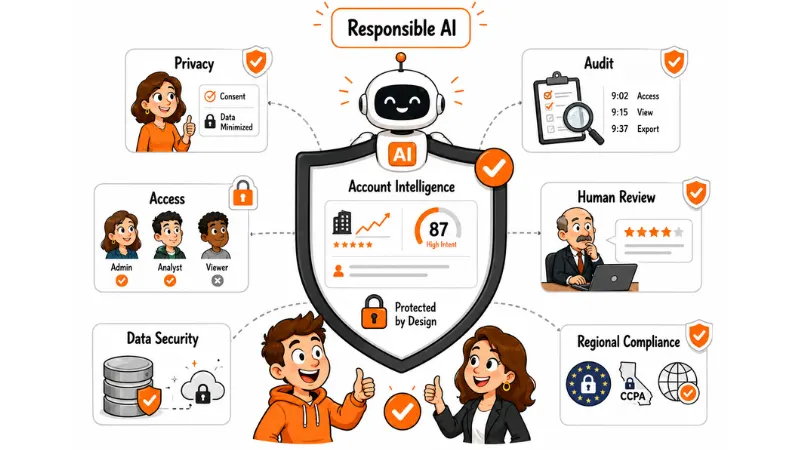
ABM platforms combine company data, behavioral signals, contact information, engagement history, and predictive models. That is a significant data surface. Governance is not a legal checkbox. It is a core purchasing factor.
Evaluate
- Data provenance
- Consent practices
- Retention controls
- Regional processing
- Role-based access
- Audit logging
- Security certifications
- Human review of AI-generated recommendations
- The vendor’s data-processing agreement.
Global teams need to pay particular attention to cross-border data transfers and third-party intent data practices.
Intent-driven ABM that combines contact-level signals with personalized outreach sits close to the line between what buyers find relevant and what they find intrusive. That line shifts depending on region, vertical, and audience. Your platform should help you stay on the right side of it.
What buyers should test
Ask the vendor to walk through how they collect, process, and retain third-party intent data. Request documentation for security certifications. Check whether the Data Processing Agreement (DPA) covers your relevant operating regions.
Questions to ask the vendor
- How is third-party intent data sourced and what consent mechanisms are in place?
- How long is contact and engagement data retained?
- What controls exist for role-based access and audit logging?
- How do you support GDPR and applicable US state privacy requirements?
7. Pipeline Measurement and Business Value
If your ABM reporting still looks like a lead-gen report, something went wrong.
Clicks, email opens, and MQL volume do not tell you whether account-based marketing is working. Gartner recommends that ABM leaders measure account engagement, buying-group behavior, pipeline progression, attribution, and marketing ROI rather than defaulting to traditional demand-generation metrics.
The metrics worth tracking include:
| Measurement Focus | Metrics |
| Reach & Engagement | Target-account reach, engaged accounts, buying-group coverage |
| Account Progression | Account progression, sales-accepted accounts |
| Pipeline | Opportunities created, pipeline value, pipeline velocity |
| Revenue | Win rate, average contract value, expansion revenue |
| Efficiency | Cost per qualified account |
Before implementation, establish a baseline. During the pilot, compare prioritized accounts against a similar control group wherever possible. Track whether AI-selected accounts progress faster, produce more opportunities, or convert at a higher rate than accounts selected without the platform.
Also ask how the platform attributes the pipeline. Sourced pipeline and influenced pipeline are different claims. A platform that reports “influence” on accounts that were already in motion is not proving its value. It is borrowing credit.
What buyers should test
Ask the vendor to show a sample attribution report and explain the methodology. Ask where the data comes from, how sourced and influenced are defined, and what the platform does when an account appears in multiple programs.
Questions to ask the vendor
- How does the platform distinguish sourced from influenced pipeline?
- Can we run control group comparisons during a pilot?
- What does a standard reporting dashboard look like for a team our size?
- How do you help us connect ABM activity to revenue outcomes?
Which AI ABM Solution Is Best?
There is no universal answer. The right platform depends on your ABM maturity, team size, existing systems, campaign goals, and operational capacity.
Some context on platform categories:
Demandbase and 6sense are commonly evaluated for enterprise-level account intelligence and orchestration. Both platforms have extensive feature sets and tend to suit teams with mature RevOps infrastructure.
HubSpot and RollWorks are often relevant to mid-market teams that want account-based functionality within or alongside existing CRM workflows, or teams focused on account-based advertising.
Bombora specializes in third-party intent data and is often used as a data layer alongside other platforms rather than as a standalone ABM solution.
VAIS (Valasys AI Score) is positioned for teams that need AI-powered account intelligence combined with intent-based prioritization, prospect discovery, and campaign execution within one platform.
The best fit is the one that closes your biggest gap. That might be target-account selection, intent-signal quality, buying-group visibility, sales activation, or measurement. And start there.
Final AI ABM Software Evaluation Checklist
Before selecting a platform, confirm it can:
- Explain why individual accounts receive specific scores
- Validate intent signals against known activity during a pilot
- Identify and track buying-group members beyond the primary contact
- Convert signals into clear next actions for sales and marketing
- Integrate with your current CRM, MAP, and sales engagement tools
- Meet your legal, security, and privacy requirements
- Connect account engagement to qualified pipeline in reporting
- Fit your team size, budget, and current ABM maturity level
Conclusion
AI ABM software should reduce the guesswork in your revenue workflow, not replace one form of complexity with another. The platforms worth considering are the ones that help your team identify the right accounts, understand buying readiness, coordinate engagement across channels, and measure what it all means for pipeline.
If your current evaluation is stuck on feature comparisons, step back and test against your actual workflow. Ask vendors to prove it works with your data, your stack, and your team.
To see how VAIS connects account scoring, buyer intent, prospect prioritization, and campaign execution, visit the VAIS product page.
Frequently Asked Questions (FAQs)
- What is account-based marketing software?
Account-based marketing software helps marketing and sales teams identify, engage, and measure a defined set of high-value target companies. It typically includes account selection, intent data, personalization tools, campaign activation, buying-group intelligence, and account-level reporting. Unlike traditional lead-gen software, it focuses on accounts first, not individual contacts.
- What should I look for in an ABM platform?
Look for explainable account scoring, verified intent data, buying-group identification, signal-to-action orchestration, strong CRM and MAP integrations, clear data governance practices, and measurement that connects account activity to pipeline outcomes. A smaller feature set with strong usability and reliable data often outperforms a larger platform with low adoption.
- What is the best account-based marketing platform for demand generation?
The best platform is the one that identifies high-fit accounts, detects meaningful demand signals early, activates coordinated campaigns, and ties activity back to qualified pipeline. Demandbase and 6sense are frequently evaluated for enterprise demand generation. Mid-market teams often consider HubSpot, RollWorks, or VAIS depending on their stack and operational resources.
- Which AI ABM solutions improve key account engagement?
Solutions that combine buying-group mapping, timely intent signals, role-based personalization, multichannel activation, and CRM-connected workflows tend to produce stronger key account engagement. The right choice depends on your team’s current capabilities and which part of the engagement process is your biggest constraint.
- What is the difference between intent data and predictive account scoring?
Intent data indicates that a company is researching topics related to your product. Predictive scoring goes further, combining intent with ICP fit, firmographic and technographic data, engagement history, and historical opportunity outcomes to estimate an account’s priority or conversion likelihood. Intent data is an input. A score is a composite judgment.
- Is account-based marketing software suitable for mid-market B2B companies?
Yes. Mid-market teams often benefit the most from AI-driven prioritization because they have fewer resources to waste on low-fit accounts. That said, mid-market buyers should evaluate total cost carefully, including implementation, data credits, and personnel requirements, and prioritize platforms with faster onboarding and managed support options.
- How does AI improve account-based marketing?
AI improves ABM by automating account scoring, identifying intent signals at scale, surfacing buying-group members, personalizing content by role and stage, routing signals to the right sales rep, and connecting engagement data to pipeline measurement. The value comes from making these workflows faster and more consistent, not from replacing human judgment.
- How should marketers measure ABM software ROI?
Measure target-account reach, engaged accounts, buying-group coverage, sales-accepted accounts, opportunities created, pipeline value, pipeline velocity, win rate, and average contract value. Establish a pre-implementation baseline and, where possible, compare results with a control group of non-prioritized accounts. Do not rely on lead volume, email opens, or clicks as primary ABM metrics.
- How long does ABM software take to implement?
Implementation timelines vary significantly depending on integration complexity, data readiness, team size, and platform type. Some platforms can support a basic pilot campaign within a few weeks. Full integration with CRM, MAP, and sales engagement tools can take several months. Ask vendors to define what “live” means and which internal resources are required to get there.
- Can ABM software integrate with Salesforce and HubSpot?
Most enterprise and mid-market ABM platforms offer native integrations with Salesforce and HubSpot. The depth of those integrations, including bidirectional sync, field mapping, workflow triggers, and real-time data updates, varies considerably. During evaluation, ask for a technical integration overview and speak with a customer reference who uses the same CRM as your team.