
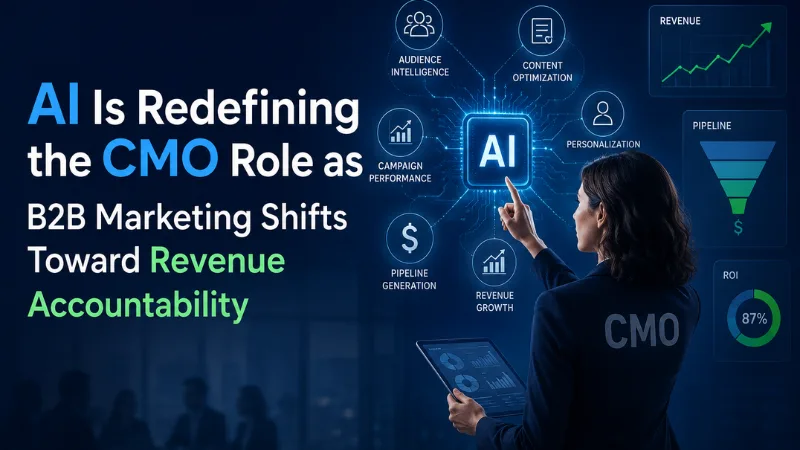
AI Is Redefining the CMO Role as B2B Marketing Shifts Toward Revenue Accountability
Explore how AI is reshaping the CMO role as B2B marketing moves toward revenue accountability, data-driven strategy, and measurable growth.

Jersey City, N.J., May 14 2026: The role of the Chief Marketing Officer (CMO) is undergoing one of its biggest transformations in years, as enterprise brands increasingly tie marketing leadership directly to business outcomes, pipeline growth, and return on investment.
That shift gained attention in May 2026 after PwC India Chief Marketing Officer Ruchi Mann said modern B2B marketing leaders are now expected to influence core business metrics rather than operate as standalone brand custodians. In an interview, Mann said the CMO role is now “closely tied to business outcomes.” The comment reflects a broader global trend across enterprise marketing organizations.
The comments arrive at a time when global marketing teams are facing mounting pressure to justify spending, prove AI-driven efficiency gains, and demonstrate direct impact on revenue generation.
A recent PwC executive insights report said CMOs are now at the center of “enterprise reinvention” as artificial intelligence rapidly changes how companies engage buyers, measure performance, and build customer loyalty. The report noted that leading marketers are increasingly using AI to turn “data into decisions” and “creativity into measurable enterprise value.”
Industry analysts say this marks a structural shift in B2B marketing rather than a temporary trend.
According to Research from Forrester, AI is pushing CMOs beyond campaign performance toward “growth accountability,” forcing marketing leaders to take greater ownership of how pipeline and revenue are generated across the organization.
The pressure is intensifying even as budgets remain constrained. At the same time, AI adoption inside B2B marketing teams has accelerated sharply.
Multiple 2026 industry studies indicate that AI tools are now being used across campaign orchestration, content generation, attribution modeling, buyer intent analysis, and predictive targeting.
A Demand Gen Report study cited in industry discussions found 96% of B2B marketers now use AI in some capacity, while LinkedIn benchmark data showed growing demand for AI-driven ROI measurement and predictive analytics.
Yet analysts warn that widespread AI adoption has not automatically translated into measurable business value.
Forrester has cautioned that ungoverned generative AI deployments could collectively cost B2B companies more than $10 billion in enterprise value through legal, compliance, and operational failures.
The evolution of buying behavior is also reshaping how B2B marketers operate.
Research published by Gartner found that AI-driven search and conversational discovery tools are becoming central to enterprise buying journeys, while buying committees continue to expand in size and complexity. The report said 74% of B2B buying groups now experience internal conflict during purchasing decisions, increasing pressure on marketers to deliver more targeted and trustworthy engagement.
That growing complexity is pushing enterprise marketers toward data-driven campaign orchestration and intent-focused engagement strategies designed to improve conversion quality instead of simply increasing lead volume.
Industry executives say the modern CMO is increasingly expected to operate at the intersection of marketing, revenue operations, AI governance, and customer intelligence. The role is significantly broader than traditional brand leadership.
As AI adoption matures, analysts believe the next competitive divide in B2B marketing may not be between companies that use AI and those that do not, but between organizations that can connect AI investments to measurable business outcomes and those still optimizing for visibility metrics alone.