AI Search Optimization Statistics 2026 Point to a CTR Reset for B2B Marketers
2026 GEO data shows AI citations replacing traditional clicks: 8% CTR with summaries vs 15% without, but 73% of B2B buyers now use AI search tools.

New data from Pew, Seer Interactive and Loganix shows AI summaries are changing clicks, citations and how B2B teams measure hidden demand.
AI search optimization statistics for 2026 are forcing B2B marketers to rethink click-through rate as a core search metric. Data from Pew Research Center, Seer Interactive and Loganix shows that AI-generated answers are changing where users click, when they visit websites and how much buyer intent remains invisible to analytics tools.
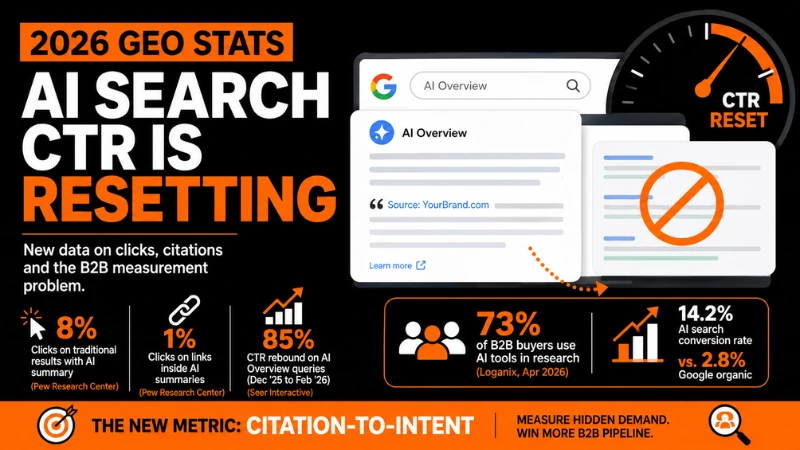
Pew Research Center reported in July 2025 that Google users were less likely to click traditional search results when an AI summary appeared. In its browsing-data study, users clicked a traditional result in 8% of visits with an AI summary, compared with 15% of visits without one. Users clicked a link inside the AI summary in only 1% of visits.
The finding gave marketers an early public view of the zero-click pressure around AI-generated answers. For B2B and SaaS companies, the issue is not only traffic loss. It is the possibility that buyers can research, compare and shortlist vendors without creating a measurable website session.
Industry data for 2026 shows the picture is more complicated than a simple CTR decline. Seer Interactive’s 2026 analysis found that organic CTR on AI Overview-present queries rebounded from 1.3% in December 2025 to 2.4% in February 2026, an 85% increase in two months.
Seer’s analysis, also covered by Search Engine Land, studied 53 brands, 5.47 million queries and 2.43 billion impressions from January 2025 to February 2026. The findings suggest that AI Overviews may suppress some clicks, but citation inside those answers can still influence whether users engage with a brand.
Loganix added a buyer-side signal in April 2026. Its multi-source analysis said 73% of B2B buyers now use AI tools such as ChatGPT and Perplexity during purchase research. The same release cited data showing AI search traffic converted at 14.2%, compared with 2.8% for Google organic traffic.
That creates the real measurement problem for B2B marketers. The old search model treated ranking, click, visit and conversion as a trackable chain. AI search breaks that chain. A buyer can compare vendors, read summarized claims, absorb third-party validation and narrow a shortlist before visiting a company website.
When the click finally arrives, it may appear as branded search, direct traffic or a late-stage visit. The earlier AI-assisted influence may not show up in standard attribution reports.
AI Search Optimization, often called GEO or Generative Engine Optimization, focuses on improving a brand’s visibility inside AI-generated answers. That includes citations, mentions, summaries, source links and recommendations across platforms such as Google AI Overviews, ChatGPT, Perplexity, Gemini and Claude.
Google’s own guidance says SEO remains relevant for generative AI search because Google’s AI features are rooted in its core Search ranking and quality systems. Google also says pages must be indexed and eligible to appear in Search with a snippet to be eligible for its generative AI features.
Google’s guidance does not support a separate technical shortcut for AI visibility. It says website owners should focus on valuable, unique, non-commodity content, clear technical structure, crawlability and people-first information. It also says special AI files, AI-only markup and overfocusing on structured data are not required for Google’s generative AI features.
For B2B teams, the implication is sharper than “SEO is dead” or “traffic is down.” Search reporting now needs to separate ordinary ranking visibility from AI citation visibility, then connect both to downstream account behavior.
The next operating metric may be citation-to-intent rather than traffic alone. That would track whether AI search presence is followed by branded search growth, review-site engagement, content syndication response, sales conversations or pipeline movement from target accounts.
As AI summaries become a normal part of B2B research, the advantage may go to companies that can measure hidden demand before it becomes a visible website session. In 2026, the CTR reset is not just about fewer clicks. It is about understanding which unseen AI touchpoints shaped the clicks that remain.