Atlas Bets AI Research Needs More Workflow and Less Chat
Atlas launches a structured AI research platform for R&D teams, betting that review checkpoints and repeatable workflows can outperform general-purpose chatbots.

July 13, 2026: Atlas launched its research intelligence platform on July 13 with a simple proposition: turn a research brief into a technology landscape, literature review or competitive analysis without forcing employees to manage dozens of searches, prompts and revisions.
The idea is timely, but not new. OpenAI, Google, Glean, AlphaSense and Elicit already offer tools that search multiple sources, synthesize evidence and generate cited reports. Atlas is not competing on whether AI can conduct research. It is competing on whether a controlled workflow can make that research consistent enough to review, trust and reuse.
For enterprises, the challenge is turning an ambiguous question into a repeatable process with defined scope, traceable evidence and human accountability.
What You Need to Know
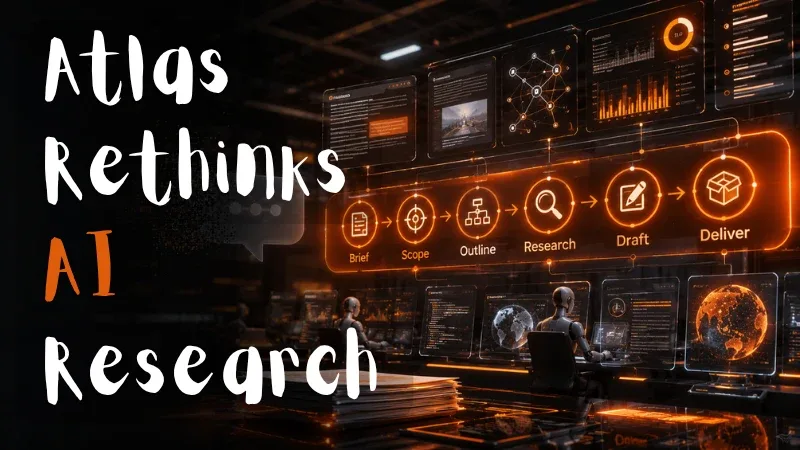
- Atlas uses six stages: Brief, Scope, Outline, Research, Draft and Deliver.
- Human approval is built into key stages.
- The product targets R&D, innovation and technology-scouting teams.
- Pricing starts with four free reports; the $99 Professional plan includes eight.
- Atlas has not published independent benchmarks or detailed source coverage.
Inside the Atlas Workflow
Atlas supports four report types: technology landscapes, company intelligence, literature reviews and competitive-position analyses.
A user submits a question, chooses a format and adds documents. Atlas creates a proposed scope and outline. Specialist agents conduct parallel research, while a Review Agent checks for gaps and can trigger another targeted search. The user reviews the scope, outline and draft before the report is finalized.
This is more structured than asking a general chatbot to research a broad market. In a chat interface, the user must decide whether the prompt is precise, whether important categories are missing and whether citations support the conclusions. Atlas tries to encode those decisions into the product.
Reports can be exported to Word or PDF and rerun on a schedule. Versioned updates could help teams monitor fast-moving markets without rebuilding static reports.
Why It Matters
Atlas reflects a shift from information retrieval to research operations. AI can already reduce the time required to find and summarize public information. The next challenge is governing the resulting work.
Scope and outline approvals may reduce a common failure: answering the wrong version of the question. A pharmaceutical scouting team may need a narrow analysis of one therapeutic modality rather than a broad biotechnology overview. Catching that mismatch early can save more time than faster writing.
Scheduled reruns could turn a one-off document into an ongoing intelligence process.
How Atlas Compares
Atlas sits between general-purpose deep-research assistants and specialized platforms.
OpenAI and Google already offer research planning, web search, uploaded-file analysis and cited reports. Their advantages are flexibility, broader ecosystems and existing enterprise adoption. Atlas offers a more opinionated process built around predefined report types and review checkpoints.
AlphaSense competes through proprietary business and financial data, while Elicit and Consensus focus on scientific literature. Glean starts with internal enterprise knowledge. Atlas may appeal to teams needing scientific and commercial evidence in one report, but its public materials do not fully explain database coverage or integrations.
What Businesses Should Do
Buyers should run a research bake-off rather than rely on a product demonstration. Test Atlas on completed internal assignments where employees already know the required evidence and expected conclusions.
Measure factual accuracy, source authority, citation alignment, omissions, recency and correction time. The key metric is verified analyst time saved. A report produced in two hours is not efficient if experts need two days to repair it.
Companies should also examine data handling, report limits and responsibility for final approval. High-impact conclusions should still be checked against primary sources.
Limitations
Atlas’s biggest challenge is trust. The company has not released independent benchmarks, citation-error rates or evidence that its Review Agent materially improves research quality.
Source coverage, security certifications, retention policies, model-training controls and integration depth remain unclear publicly. Those gaps matter for organizations handling confidential product plans, unpublished research or acquisition targets.
Atlas has a credible thesis: AI research may work better as a governed production process than as an extended chat. The market still needs proof that Atlas can execute that thesis better than larger and more specialized rivals.