Rampiq Study Shows Trust Sites Now Drive B2B AI Search Citations
Rampiq and Arobis AI research shows third-party review sites now drive B2B AI search citations more than brand websites, forcing marketers to prioritize external validation over owned content.

New Rampiq and Arobis AI findings suggest B2B brands need third-party validation, structured content and clearer proof to appear in AI-generated answers.
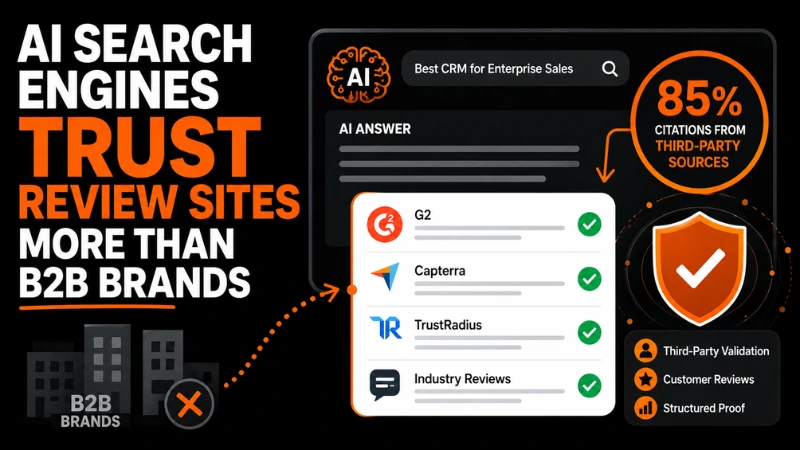
Third-party review and validation sites are becoming central to B2B AI search visibility, according to new findings from Rampiq’s AI Visibility Optimization Program and separate SaaS research published by Arobis AI. The data points to a clear shift in how to get cited in AI search engines B2B: brands need more than optimized website pages; they need trust signals across review platforms, comparison pages, customer proof and third-party sources.
Rampiq said in findings released May 31, 2026, that about 85% of citations for broad B2B category queries came from third-party sources rather than company websites. Demand Gen Report also covered the findings, noting that sources such as G2, Capterra and TrustRadius consistently influence whether AI systems recommend B2B brands.
The findings matter because B2B buyers increasingly use AI search tools to compare vendors before visiting company websites. For queries such as “best CRM for enterprise sales,” “top compliance management software” or “best project management tool for SaaS teams,” AI-generated answers often rely on sources that compare, rank or summarize multiple vendors.
Arobis AI added another signal on July 1, 2026. Its study analyzed 100 SaaS brands across 10 software categories and thousands of prompts tested across ChatGPT, Gemini, Claude, Perplexity and Google AI Overviews. The company said SEO dominance and AI recommendation frequency were not closely aligned, with some strong Google performers failing to appear in AI-generated answers for their own category terms.
That creates a different problem for SaaS and enterprise B2B marketers. AI search systems do not appear to judge a brand only by its own website. They also read the wider web: review profiles, directory listings, community discussions, comparison articles, partner pages and editorial explainers.
For B2B brands, the risk is not only lower traffic. A buyer may ask an AI engine for vendor options, receive a shortlist based heavily on third-party sources and never reach the company’s own product page. In that environment, reviews, category-page accuracy, customer evidence and market positioning become part of search infrastructure.
A B2B AI search citation is a mention, source link or recommendation inside an AI-generated answer from tools such as ChatGPT, Gemini, Claude, Perplexity or Google AI Overviews. Unlike a traditional ranking, it is not just about where a page appears in search results. It is about whether the brand is included in the answer itself.
“Many businesses still think AI visibility is a content problem. What we’ve learned is that it’s really an ecosystem problem. AI models learn from the entire digital footprint of a company, not just its website,” said Liudmila Kiseleva, founder and CEO of Rampiq, while describing the shift.
Rampiq’s data also complicates the standard generative engine optimization playbook. The company reported that structured tables were cited about 2.5 times more often than equivalent unstructured content. It also found that pages updated within the previous two months earned about 28% more citations, while original research with first-hand data appeared frequently among top ChatGPT citations.
That suggests format, freshness and proof may now matter as much as conventional on-page keyword use. A generic product page may rank, but a clear comparison table, updated category guide or evidence-led report may be easier for AI systems to read, verify and cite.
Google’s own AI features and your website documentation says there are no additional technical requirements to appear in AI Overviews or AI Mode beyond existing Search requirements. Google says eligible pages must be indexed and eligible to appear in Search with a snippet.
Google’s newer guide on optimizing your website for generative AI features also says generative AI visibility remains tied to core Search ranking and quality systems. The guidance points site owners toward useful, unique, non-commodity content, clear technical structure and people-first information rather than AI-only tactics.
For B2B brands, the risk is not only lower traffic. A buyer may ask an AI engine for vendor options, receive a shortlist based heavily on third-party sources and never reach the company’s own product page. In that environment, reviews, category-page accuracy, customer evidence and market positioning are becoming part of search infrastructure.
The practical next step for SaaS marketing teams is an AI citation audit. That means identifying which review sites, comparison pages, partner listings, editorial guides, forums and analyst-style explainers AI systems already cite for core category terms.
In 2026, the brands improving AI search visibility may not be the ones publishing the most content. They may be the ones whose positioning, proof and customer validation are easiest for machines to find, read and trust.