
Walker Sands Study Finds B2B Brands Appear in Just 3% of Google AI Overviews
Walker Sands benchmark reveals enterprise B2B brands rank for 9,700 queries but appear in only 3% of Google AI Overviews, creating new visibility gap in 2026.

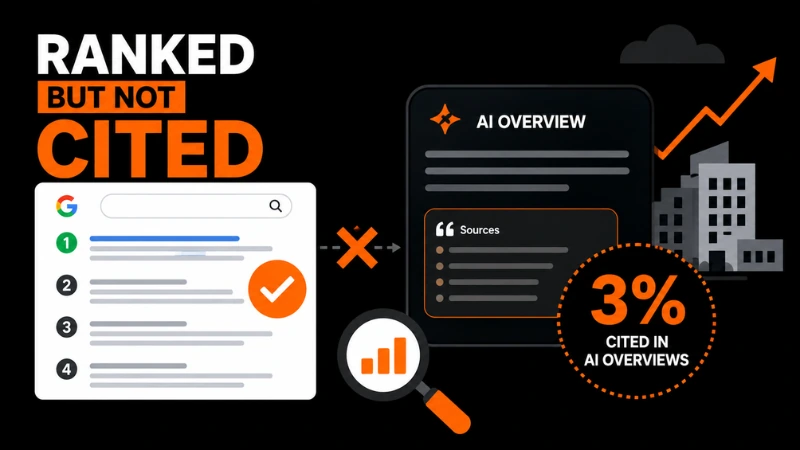
The benchmark shows enterprise B2B companies can rank across thousands of Google searches but still miss the AI-generated answer layer.
Enterprise B2B brands appear in only 3% of relevant Google AI Overviews, according to a Walker Sands benchmark reported by Search Engine Land on June 24. The study found that ranking on Google no longer guarantees visibility inside AI-generated answers, a shift that could affect how SaaS, technology and professional services companies measure search performance in 2026.
The benchmark analyzed more than 45 million search queries across 828 enterprise B2B companies in 14 industries. Walker Sands found that the typical company ranked organically for about 9,700 queries, yet the median brand was cited in only 3% of relevant AI Overviews.
The finding exposes a widening gap between traditional SEO rankings and AI search visibility. For years, B2B marketers have tracked keyword positions, impressions, clicks and organic sessions to understand search performance. Those metrics show whether a brand appears in Google’s search results. They do not show whether the brand is selected as a cited source inside an AI-generated answer.
Walker Sands found that AI Overviews appeared in nearly half of the search results where enterprise B2B companies already ranked. Even with that organic footprint, many brands were missing from the AI answer itself. Search Engine Land reported that 4.6% of brands in the study were not cited in any relevant AI Overviews analyzed.
That difference matters for B2B buying journeys. A software vendor, cybersecurity provider, cloud platform or consulting firm may rank on page one for a high-intent search and still be absent from the summary a buyer reads before clicking through to vendor websites.
A B2B AI Overview citation rate measures how often a brand or domain appears as a cited source inside Google’s AI-generated answers for relevant queries. It is different from organic ranking because it measures selection within the answer layer, not only placement in the traditional search results.
Google’s Search Central documentation says generative AI features, including AI Overviews and AI Mode, are rooted in core Search ranking and quality systems. Google also says pages must be indexed and eligible for a search snippet to be eligible for generative AI features. However, eligibility does not mean a brand will be cited.
Google’s guidance continues to point site owners toward useful, original and people-first content rather than tactics designed only for AI systems. It also stresses technical accessibility, crawlability and clear content structure as part of broader search visibility.
That makes the Walker Sands benchmark especially important for enterprise B2B teams. The issue is not only whether a website can be crawled, indexed or ranked. The harder question is whether the brand has enough clear, current and trusted information to be selected when Google summarizes a topic.
The impact is likely to reach demand generation, content, SEO and revenue teams. If buyers increasingly use AI-generated summaries to compare vendors, brands missing from those summaries may lose visibility before the buyer reaches a website, landing page or sales form.
The study also suggests that B2B search reporting may need a new metric: citation coverage. Marketing leaders may need to compare where a brand ranks organically with where it is cited in AI Overviews across product, category and buyer-intent queries.
For enterprise B2B companies, the 2026 search question is no longer only whether they rank. It is whether they are trusted enough to be cited.