Generate More B2B Leads With Webinars
Get proven strategies, templates, and tactics to generate qualified B2B leads through high-converting webinars.
 Lead-Gen now on Auto-Pilot with
Build My Campaign
Lead-Gen now on Auto-Pilot with
Build My Campaign

Learn why most B2B webinars fail to generate sales pipeline and how to improve engagement, lead quality, and conversion rates.


Generate More B2B Leads With Webinars
Get proven strategies, templates, and tactics to generate qualified B2B leads through high-converting webinars.
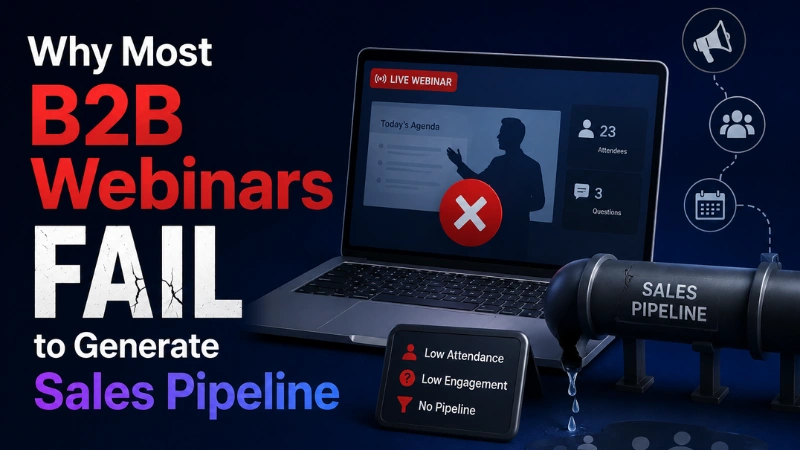
There is no audience more optimistic than a B2B marketing team looking at webinar registration numbers.
Six hundred sign-ups? Fantastic.
Three hundred attendees? Even better.
Strong engagement? Outstanding.
The post-event report looks great. The dashboard is full of healthy percentages. The webinar gets labeled a success before anyone asks the question that matters.
Then, a few weeks later, someone opens the CRM and discovers that the webinar generated roughly the same amount of pipeline as a motivational poster.
That’s the moment many teams realize they weren’t measuring webinar success. They were measuring webinar activity.
Generate More B2B Leads With Webinars
Get proven strategies, templates, and tactics to generate qualified B2B leads through high-converting webinars.
The webinar looked successful. Registrations were good. Attendance was decent. The slides loaded without a hitch. The speaker did not freeze mid-sentence or forget to unmute. The post-webinar email went out on schedule, and everyone nodded at the dashboard like it had just told them something important.
And then the sales pipeline barely moved.
If that sequence feels uncomfortably familiar, you are not alone. Most B2B webinars fail to generate sales pipeline not because webinars are a tired format, but because most teams are still running them like attendance-driven events instead of buyer-relevant, signal-rich demand generation moments. The webinar did its job. Nobody listened to what it was trying to tell them.
Let’s get one thing out of the way: webinars still work. They are not a dying format propped up by nostalgia and free coffee mugs. Recent benchmark data shows webinars continuing to drive real engagement, with healthy registration-to-attendance conversion and attendees spending meaningful time in-session rather than tabbing away after five minutes.
So if the format is fine, what is broken? The strategy behind it. Most teams plan webinars the way they planned them a decade ago: pick a broad topic, promote it everywhere, count the registrations, declare victory. That approach made sense when webinars were a novelty. It does not make sense now, when buyers have more independence, more research tools, and considerably less patience for generic content.
A webinar is not a campaign tactic you check off. It is a moment where a buyer is paying attention to you, on purpose, for up to an hour. What you do with that attention is the entire game.
Here is an uncomfortable truth nobody puts on the all-hands slide: your registration number is the least useful number in the entire report.
A registrant is not automatically a buyer. Half of them registered because a colleague forwarded the invite, or because the title had the word “AI” in it, or because they wanted the on-demand link for later and never intended to show up live.
An attendee is not automatically sales-ready either. Plenty of attendees are competitors doing recon, students researching a class project, or someone’s manager who joined for two minutes to make sure the team showed up.
And a no-show may still be one of your best leads. Some of the most engaged buyers register with full intent, get pulled into a client call, and watch the recording later, twice, while taking notes.
B2B webinars fail to generate sales pipeline when teams optimize for registrations instead of buyer fit, engagement quality, and timely sales follow-up. The registration volume tells you how good your promotion was. It tells you almost nothing about whether pipeline is coming.
Nobody logs into a Tuesday afternoon webinar hoping to get pitched. They show up because they have a problem, and they are hoping you will help them think about it more clearly. The moment your “educational” webinar turns into a forty-minute product demo with a Q&A bolted on, you can watch the chat go quiet and the tab close.
This matters more than ever because the buyer in front of you has usually already done a lot of homework before your invite ever landed in their inbox. Many B2B buyers begin the buying process with a front-runner vendor already in mind, shaped by research they did entirely on their own.
By the time a buyer attends your webinar, they may have already completed a large portion of their buying journey without talking to a single salesperson.
And many B2B buyers actively prefer a rep-free experience for as long as they can manage it.
None of this means sales should disappear from the webinar. It means the webinar’s job is to build trust and earn the right to a real conversation later, not to close a deal in real time disguised as “thought leadership.”
Here is a small, slightly humbling exercise. Pull up your last webinar title. Now ask yourself honestly: could forty-seven other companies in your category have hosted the exact same session?
If the answer is yes, that is your pipeline problem, right there, in the subject line.
“5 Trends Shaping the Future of [Your Industry]” is not a topic. It is a placeholder where a real point of view should be. Buyers can smell a recycled webinar deck from three scrolls away, and recycled decks do not get cancelled lunches.
Buyers are already overwhelmed by content that feels generic or overly salesy, and that fatigue makes them more selective, not less, about what earns their hour.
A sharp, specific, slightly opinionated topic does two jobs at once. It filters out the casually curious, and it pulls in the people who actually have the problem you are describing. That filtering is not a loss. That is the entire point.
Marketing has a complicated relationship with big numbers. A thousand registrants feels like a win on a slide. But if nine hundred of them are outside your Ideal Customer Profile (ICP), you have not built a pipeline. You have built a very expensive newsletter.
A webinar with two hundred attendees, where sixty of them sit inside your target accounts and at the right stage of their buying journey, will outperform a thousand-person webinar full of students, competitors, and people who will never buy anything from anyone in your category.
This is where account fit and buying-stage relevance matter more than reach. A procurement leader six weeks from a decision and a curious analyst eighteen months out are not the same lead, even if they clicked the same registration button. Treating them identically is how the pipeline quietly disappears between the webinar and the CRM.

Most webinar platforms hand you a goldmine of behavioral data: poll answers, questions asked, time spent watching, which slide made someone click a resource link, who came back to rewatch a section. This is, frankly, some of the richest intent data marketing ever gets handed for free.
And most of it dies in an export nobody opens.
Marketing pulls a spreadsheet, sends it to sales, and calls it a day. Sales opens it, sees names with no context, and moves on to leads that came with an actual story attached. The signal was there. Nobody translated it into something a rep could act on.
A question asked live, a download clicked twice, a poll answer that flags budget authority: these are buying signals, not vanity metrics. Treating them as an afterthought is the difference between a webinar that informs a dashboard and one that informs a pipeline.
This is where Valasys Media Webinar Tracker becomes useful: helping teams move beyond surface-level webinar engagement and focus on the signals that actually deserve sales action.
Even when the signal is captured correctly, plenty of webinars still die quietly in the follow-up step. Sending the same generic “thanks for attending” email to everyone who registered, regardless of whether they watched for three minutes or fifty-five, is not a follow-up strategy. It is a mail merge.
A highly engaged attendee from a target account should not receive the same email as someone who registered, never logged in, and forgot the webinar existed by Thursday. One deserves a personal note referencing the specific question they asked. The other deserves patient nurture, not a chase.
Speed matters too, and most teams underestimate by how much. Slow response times can sharply reduce the chance of ever converting an online lead, a finding that has held up for over a decade and, if anything, has gotten more true as buyer patience has gotten shorter.
Fast, specific, and proportional to engagement. A rep reaching out within a day, referencing the actual question someone asked or the resource they downloaded, will outperform a templated email sent a week later to everyone on the list, every single time.
Most webinars get one moment of glory: the live event. Then the recording gets dropped on a landing page, where it sits, unloved, generating the occasional lonely view from someone who registered late and forgot to cancel the calendar reminder.
That is a waste of genuinely good content. A solid forty-five-minute session usually contains three or four standalone ideas worth their own life: a sharp answer to a tricky question, a clear opinion the speaker stated, a moment buyers leaned into in the chat. Cut those into short clips. Turn the strongest answer into a blog section. Pull the best audience question into an FAQ. Feed the sharpest insight into sales enablement so reps can reuse it on calls.
Most organizations are already doing exactly this, repurposing webinar content into clips, articles, and social posts rather than letting it expire after one live airing.
In some cases, organizations have built libraries containing hundreds of hours of webinar footage, viewing each session not as a one-time event but as a source of ongoing content for marketing, sales, and demand generation initiatives.
Yes, and often more useful than the live event itself, because they reach buyers exactly when they are ready to research, not just when your calendar said go. A buyer watching at 11pm three weeks after the live date is still a buyer, and the recording deserves to be findable, not buried.
This also matters for how buyers find you in the first place. Search behavior increasingly favors content that is genuinely useful and specific rather than generic, which means a well-repurposed webinar can keep generating visibility and pipeline long after the live chat has gone quiet.
What Should B2B Teams Measure Instead?
What webinar metrics matter more than attendance? The ones that connect to actual revenue motion, not just calendar activity. A short, practical list worth tracking:
None of these need a new dashboard built from scratch. They need a team willing to stop reporting on attendance like it is the finish line, when it is really just the starting gun.
A great B2B webinar is not measured by how many people showed up. It is measured by whether the people who showed up left smarter, more confident, and closer to a decision than when they logged in.
A great webinar helps a buyer understand a real problem more clearly, compare their options honestly, and feel confident enough to take the next step. It does not waste forty-five minutes on vague thought leadership followed by a product pitch wearing a thin disguise. Buyers can tell the difference within the first three minutes, and they will mentally check out the second they sense a bait-and-switch.
Respecting that time is not a soft, feel-good idea. It is a commercial strategy. The companies that treat every minute of a buyer’s attention as something to be earned, not extracted, are the ones whose webinars quietly turn into pipeline instead of just turning into a number in a slide deck.
Because most teams still measure the wrong things, talk to the wrong audience as if they were the right one, and follow up like every attendee is identical. B2B webinars do not fail because buyers hate webinars. They fail because buyers hate wasting time, and too many webinars are built around the company’s convenience instead of the buyer’s actual decision-making process.
The winning webinar is not the one with the biggest registration number on the recap slide. It is the one that helps the right buyer think more clearly, decide more confidently, and move one real step closer to a deal.
If your webinars are creating attention but not enough pipeline clarity, Valasys Media Webinar Tracker can help bring the right buying signals back into focus.
Most B2B webinars fail because teams optimize for registrations and attendance instead of buyer fit, engagement quality, and fast, relevant sales follow-up. The webinar itself usually works fine. The strategy around it treats every attendee the same, which is where the pipeline gets lost.
No, not on their own. Registrations measure how well you promoted the event, not whether the right buyers showed up or whether they are close to a purchase decision. A smaller, more targeted audience will usually generate more pipeline than a large, generic one.
A sales-ready attendee usually comes from a target account, engages actively through questions or polls, and shows behavior like rewatching key sections or downloading follow-up resources.
Quickly, and proportional to how engaged the person actually was. A highly engaged attendee deserves a specific, personal follow-up within a day or two, while a passive registrant is better served by patient nurture rather than an identical, generic email blast.
Yes. On-demand viewing often reaches buyers exactly when they are ready to research, not just on the live date, and repurposed webinar content can continue generating visibility and pipeline for months after the original event.
Metrics tied to revenue motion rather than calendar activity: ICP-fit registrations, target-account attendance, high-value questions and downloads, sales conversations created, pipeline influenced, and follow-up speed. Attendance is a starting point, not a scoreboard.
Generate More B2B Leads With Webinars
Get proven strategies, templates, and tactics to generate qualified B2B leads through high-converting webinars.