
BANT Qualification Checklist for Demand Generation Teams
Use this BANT qualification checklist to assess budget, authority, need, and timeline for better demand generation and lead qualification.

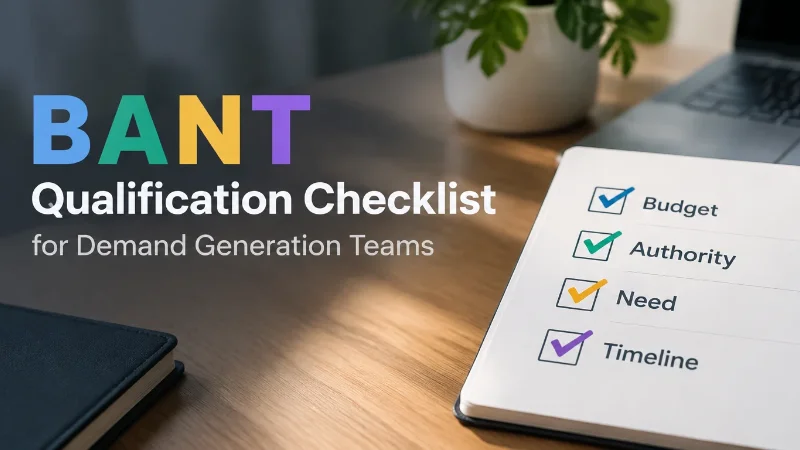
What is the BANT Qualification Checklist?
A BANT qualification checklist is a set of four checks demand generation teams use to confirm a lead has a real buying situation before passing it to Sales: Budget, Authority, Need, and Timeline. Each check should rest on something the buyer said or confirmed, not on something you inferred from clicks.
Here is what to verify:
- Budget: Is there a realistic path to funding? Is it allocated, planned, or still waiting on approval?
- Authority: Does this person influence, recommend, approve, or own the purchase? Who else is involved?
- Need: Has the buyer named a specific business problem, and why it matters now?
- Timeline: Is a real milestone, such as a deadline, renewal, or budget cycle, driving the decision?
Demand gen isn’t just trying to find people who are interested. It’s trying to find leads with enough evidence to have a meaningful conversation with Sales. The sections below walk through what that evidence looks like for each part of the modern BANT qualification framework.
BANT Qualification Checklist: What Should You Verify?
Why verify at all? Because even when buyers arrive well-informed, their readiness to purchase still needs to be confirmed.
6sense’s 2025 Buyer Experience Report surveyed nearly 4,000 B2B buyers and found they evaluated an average of 5.1 vendors, with about 3.6 already on the shortlist on Day One. The respondents had made purchases of at least $25,000, so this describes higher-value buying, not every buyer.
The takeaway for demand gen is simple. By the time a lead engages with you, a buying situation may already be well underway. Your job is to find out what it looks like, not to guess from clicks.
Here is what to verify for each part of BANT.
Budget: Is There a Realistic Path to Funding?
Budget is the criterion most often filled in by assumption. A company looks big, a funding round made the news, so someone ticks the box.
What you are trying to establish is whether there is a realistic path to paying for a solution. Useful evidence includes:
- Whether budget is allocated, planned, or still needs approval
- Known purchasing constraints, such as spending freezes or review cycles
- Whether procurement is involved, and at what stage
- Whether the organization has identified funding for this problem or solution category
One distinction matters more than the rest. Interest in pricing is not proof of budget.
A pricing-page visit or a pricing request is a useful signal. It tells you the person is evaluating cost. It does not tell you that money has been approved, planned, or even discussed.
You also don’t need a universal dollar amount here. What counts as enough budget depends entirely on the buyer and the solution. Your goal is to know where the lead stands: confirmed, partly known, or unknown.
Authority: Who Is Involved in the Buying Decision?
A senior title feels like authority. It often isn’t.
A VP might love your content and still have no say in the purchase. A manager might be the person who runs the evaluation, writes the recommendation, and effectively shapes the outcome. Titles describe rank. Authority describes role in the decision.
Try to learn:
- Whether this person influences, recommends, approves, or owns the purchase
- Who else needs to take part in the decision
- Whether an economic buyer or other decision-makers must be involved
This does not mean only C-suite contacts qualify. Plenty of real deals start with a mid-level champion who knows exactly how the decision gets made. What you need is clarity about how the person fits into the buying process, not a bigger title.
Need: Is There a Specific Business Problem?
This is usually where engagement and qualification separate most clearly.
Someone can read five articles on a topic out of professional curiosity, a school assignment, or a passing interest. Content consumption shows attention. It does not show an active problem.
Stronger evidence of need looks like this:
- A clearly identified business problem
- The process or team affected
- The consequence of leaving it unresolved
- A desired business outcome
- A reason the problem matters now
Hypothetical example: Two contacts download the same guide on reporting. The first, a marketing operations manager, replies to a follow-up and says leadership reports take eight hours a month to build because data sits in three systems, and a quarterly review is coming up. The second says the guide was interesting and she is “exploring options.”
Same content, same engagement. Only the first contact has told you the problem, who it affects, and why it matters now. That is a need, backed by evidence.
Timeline: Is There a Real Buying Milestone?
Plenty of leads say they are looking “this quarter.” Fewer can tell you what is driving that.
Compare two statements:
“We are interested in doing this eventually.”
“We need to evaluate a solution before a specific business milestone.”
The first is an intention. The second is a timeline, because something real is attached to it.
Evidence can include a project deadline, a contract renewal, a planned implementation, a budget cycle, a business initiative, an operational deadline, or a procurement milestone.
Avoid setting a universal rule such as “under 90 days equals qualified.” A short window with no trigger is weak. A longer window with a clear milestone can be strong. The milestone is what matters.

What Counts as BANT Evidence and What Doesn’t?
Behavioral signals are valuable. They help you decide who to pay attention to first. The mistake is presenting them as verified evidence of Budget, Authority, Need, or Timeline.
This table separates what each signal can tell you from what it can’t.
| Signal | What it can indicate | What it does not prove |
| Pricing-page visit | The person is looking at cost | Budget exists or has been approved |
| Webinar attendance | Interest in the topic | An active problem or a buying decision |
| Multiple content downloads | Sustained research behavior | Who the buyer is, or that a purchase is planned |
| Demo request | Intent to see the product | Authority, budget, or a deadline |
| Stated business problem | A specific need | Funding, decision role, or timing |
| Identified decision role | Where the person sits in the purchase | That the problem is urgent or funded |
| Confirmed purchasing process | A path for approval and procurement | That a solution has been chosen or a date set |
| Known implementation deadline | A real timeline | That budget or authority are in place |
Look at how the bottom four rows differ from the top four. They come from what the buyer told you, not from what the buyer did. That is the line between observed signals and verified evidence.
A simple habit helps. For every BANT field, ask whether it is based on something the buyer said or confirmed, or something you inferred from behavior. Both are useful. They just shouldn’t be labeled the same way.
How to Turn BANT Qualification Into a Better Marketing-to-Sales Handoff
A handoff that says “BANT qualified, high intent” gives Sales almost nothing to work with. The rep still has to rediscover everything, and the buyer ends up answering questions they thought they had already answered.
A better handoff carries the reasoning, not just the verdict. For each lead, capture:
- BANT status for each criterion
- The evidence behind each one
- Where that evidence came from
- What is confirmed
- What is inferred
- What remains unknown
- A recommended next action
Writing evidence down this way is what the modern BANT qualification framework is built around. It also keeps lead status and qualification separate. If you want that distinction explained, see how BANT differs from HQL, MQL, and SQL.
Hypothetical handoff example:
Instead of: “BANT qualified = High intent.”
Try this:
Need: Confirmed. Contact said monthly pipeline reporting takes about eight hours because data is split across three systems (stated on discovery call).
Authority: Partially known. Contact manages the evaluation and will recommend a solution. A department head signs off, but we haven’t spoken to them.
Budget: Unknown. Contact said they would “find out” whether funds are available this year.
Timeline: Partially known. A quarterly leadership review in six weeks is driving the evaluation. No purchase date confirmed.
Next step: Sales to ask about budget ownership and to request an introduction to the department head.
This is an illustration, not a customer result. But notice what the rep gets: what is solid, what is shaky, and exactly where to start the conversation.
When Should a Lead Not Be Marked BANT-Qualified?
Good qualification discipline sometimes means saying “not yet.” That isn’t being restrictive. It protects the rep’s time and your credibility with Sales.
Hold back the BANT-qualified label in cases like these:
High engagement, no identified need. Plenty of clicks, but no one has described a problem. This is an interested lead, not a qualified one.
Senior contact, unclear role. The title is impressive, but you don’t know whether the person influences, recommends, or approves anything.
Pricing interest, no funding path. The person looked at cost. Nobody has said whether money is available or how it gets approved.
A vague future timeline. “Sometime next year” with no trigger event is a hope, not a milestone.
Intent signals, no confirmed buying situation. Third-party or behavioral intent can point you toward an account. Without enough human confirmation to establish the underlying situation, it stays a signal.
Notice that none of these mean “throw the lead away.” Partial qualification is a legitimate status. A lead with confirmed need and unknown budget can still move forward, as long as the handoff says so honestly.
BANT Qualification and Lead Scoring: How Should Demand Gen Use Them Together?
Lead scoring and BANT qualification do different jobs, and they work best side by side.
Lead scoring helps you prioritize. It uses the signals you have, such as engagement and firmographic fit, to decide who deserves attention first.
BANT qualification structures the evaluation of buying conditions. It asks whether the evidence for budget, authority, need, and timeline actually exists.
A few practical rules follow from that:
- A high score is a reason to look closer, not proof of every BANT criterion.
- A lead can score well and still have major unknowns. That is normal.
- BANT evidence helps Sales understand why a lead was passed, which a score alone can’t explain.
- Don’t copy a scoring formula or threshold from somewhere else. The right setup depends on your own sales process and data.
Think of it this way: scoring tells you where to look. BANT tells you what you found.
Frequently Asked Questions (FAQs)
What should Marketing verify before a lead is BANT-qualified?
Marketing should verify clear evidence for every BANT criterion. Budget requires a realistic funding path, while Authority depends on the contact’s role in the buying decision. Need should be tied to a specific business problem, and Timeline should reflect a genuine buying milestone. Engagement alone does not confirm any of these factors. Each criterion should be marked as confirmed, partially known, or unknown, with the supporting evidence source recorded.
Can intent data prove BANT qualification?
No. Intent data can show that an account is researching a topic, which helps with prioritization. It cannot confirm the budget, a person’s decision role, a specific problem, or a purchase deadline. Those usually require direct confirmation from the buyer. Use intent data to decide where to focus, then gather evidence through conversation, forms, or engagement.
Should demand generation or Sales own BANT qualification?
It depends on how your teams divide the work, and there is no single right answer. What matters is agreeing on who verifies what and what evidence is needed before a handoff. Demand generation often captures early evidence. Sales often confirms and deepens it. A shared definition of “qualified” prevents the two teams from working with different assumptions.
Is a BANT-qualified lead automatically sales-ready?
Not always. BANT qualification describes buying conditions, but readiness also depends on how much is confirmed and how much is still unknown. A lead with strong need and a clear timeline but unknown budget may still be worth a sales conversation. A lead with all four marked unknown is not. The handoff note should say which situation you’re in.