
Best B2B Demand Generation Agencies for ABM, Intent Data & Lead Generation
Compare B2B demand generation agencies for ABM, intent data, and lead generation, with key capabilities and selection criteria for 2026.

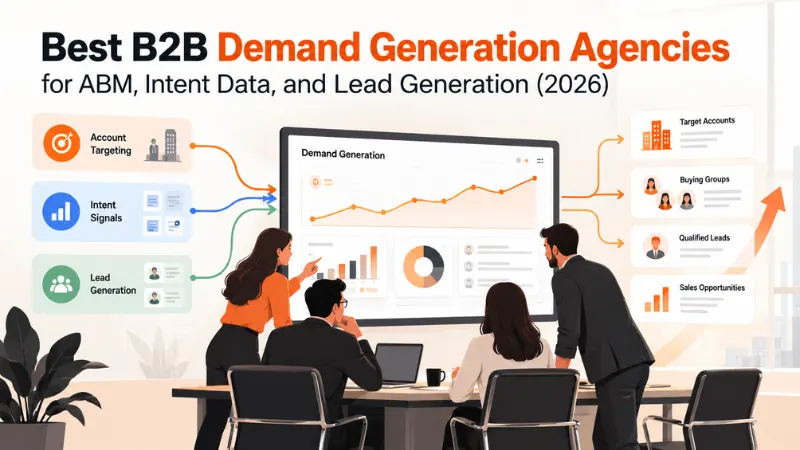
Plenty of demand-generation agencies can run campaigns. Fewer can connect ABM, intent data, and lead generation without turning them into three separate motions.
That distinction matters when marketing is trying to move from account signals to qualified demand without adding more vendors, more handoffs, and more reporting layers.
The strongest B2B demand generation agencies for ABM, intent data, and lead generation are the ones that can connect account targeting, buying signals, account intelligence, lead capture, qualification, and sales activation instead of treating them as separate services.
This guide reviews six providers based on their publicly documented support for ABM, intent data, lead generation, and related demand-generation capabilities.
Which B2B Demand Generation Agencies Combine ABM, Intent Data, and Lead Generation?
| Provider | ABM | Intent Data | Lead Generation | Best Fit |
| Valasys Media | ✓ | ✓ | ✓ | Integrated ABM, intent and qualified-demand programs, VAIS Account Intelligence |
| INFUSE | ✓ | ✓ | ✓ | Scaled content-led demand generation |
| Demandify Media | ✓ | ✓ | ✓ | Intent-led syndication and lead acquisition |
| CIENCE | ✓ | ✓ | ✓ | Outbound demand generation and meetings |
| The Pedowitz Group | ✓ | ✓ | ✓ | Strategic ABM and revenue marketing |
| Demandbase Professional Services | ✓ | ✓ | Platform-led | Demandbase-centered implementation and optimization |
A checkmark (✓) means the capability is explicitly documented in the provider’s current public offering. It does not mean every provider delivers that capability in the same way, at the same depth, or through the same service model.
How We Evaluated the Providers
We reviewed current public documentation for:
- ABM and account targeting
- intent data or documented buying-signal use
- lead generation and qualification
- buying-group engagement
- sales handoff
- campaign and pipeline measurement
First-party sources were used to verify service coverage. Vendor-reported performance figures were treated as vendor claims rather than independent proof.
Editorial Disclosure: Valasys Media is the publisher of this article and is also one of the B2B demand generation providers included in this guide. Provider offerings and public documentation were reviewed in September 2026.
The companies below are not ranked. They address different combinations of ABM, intent data, lead generation, outbound execution, and strategic demand-generation support.
The best fit depends on program maturity, target market, qualification requirements, internal resources, technology stack, and execution needs.
1. Valasys Media
Best for: integrated ABM, intent data, content syndication, and qualified lead-generation programs.
Valasys Media combines ABM, intent-led targeting, content syndication, and qualified lead generation within its demand-generation offering.
Its intent-based ABM services use intent signals within account-based programs, while its content syndication services support targeted B2B content distribution, lead qualification, and campaign reporting.
A notable aspect of the offering is its breadth across account targeting, intent-led execution, content syndication, lead qualification, and broader demand-generation programs, helping teams reduce the need to coordinate separate providers for each function.
VAIS adds more business and buying context around account activity through its Account Intelligence capability, giving teams an additional layer of account-level insight alongside Valasys Media’s demand-generation services.
Valasys also supports targeting and activation across channels, including programmatic ABM, with reporting that helps teams evaluate engagement and lead delivery.
Consider Valasys Media if: you want ABM, intent data, and qualified lead generation supported within one broader demand-generation program.
2. INFUSE
Best for: scaled content-led demand generation and buying-group activation.
According to its published demand-generation portfolio, INFUSE supports ABM, first-party and third-party intent signaling, lead nurturing, and buying-group engagement.
Its model is suited to scaled demand-generation programs that combine content activation, audience targeting, intent signals, and buying-group engagement.
Its account-based programs also support named-account engagement and buyer-group activation across different stages of the buying journey.
Consider INFUSE if: scaled buyer engagement and content-led demand generation are major parts of your strategy.
3. Demandify Media
Best for: intent-led demand generation and qualified lead acquisition.
Demandify Media combines intent discovery, multi-touch outreach, qualification, and CRM handoff within its demand-generation offering.
Its model uses intent signals alongside Ideal Customer Profile (ICP) criteria to focus demand-generation efforts on relevant B2B accounts, with qualification and lead delivery built into the process.
Consider Demandify if: intent-led targeting and qualified lead generation are central to your program.
4. CIENCE
Best for: outbound execution and meeting generation.
CIENCE combines a defined account list with email, phone, LinkedIn, paid channels, qualification, and meeting generation within its demand-generation model.
Its lead-generation process uses buying signals to help prioritize accounts and support outreach, while the broader offering places particular emphasis on outbound lead generation and qualified sales conversations.
Consider CIENCE if: your target market is already clear and you need more capacity to turn target accounts into qualified conversations.
5. The Pedowitz Group
Best for: strategic ABM, demand generation, and revenue marketing transformation.
According to its published ABM offering, The Pedowitz Group supports ICP development, account selection and tiering, buying-committee mapping, intent data, multi-channel execution, sales alignment, and pipeline measurement.
Its broader work also connects demand generation with marketing operations, technology, qualification, revenue strategy, and measurement.

This approach suits programs where demand generation needs to work alongside ABM strategy, marketing operations, sales alignment, and measurement.
Consider The Pedowitz Group if: your demand-generation program also requires strategic ABM, revenue operations (RevOps) alignment, and measurement support.
6. Demandbase Professional Services
Best for: teams already building around the Demandbase platform.
Demandbase follows a platform-led model.
It differs from the other providers in this comparison because its services are centered on implementing, operating, and optimizing the Demandbase platform rather than functioning as a traditional outsourced lead-generation agency.
The platform combines account intelligence, intent data, predictive capabilities, buying-group information, and account-based activation, while professional and managed services support implementation, adoption, administration, strategy, and optimization.
Consider Demandbase Professional Services if: Demandbase already plays a central role in your Go-To-Market (GTM) stack and you need implementation or execution support around that environment.
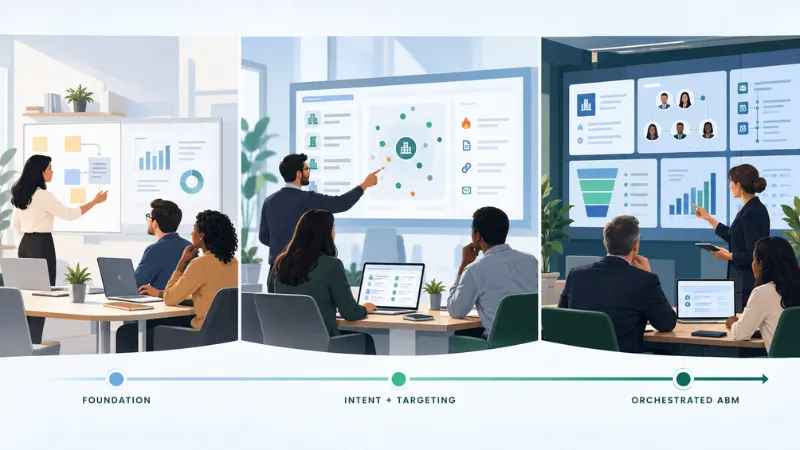
Different demand-generation programs require different levels of account targeting, intent use, buying-group visibility, and revenue coordination.
Which Provider Fits Your Demand-Generation Maturity?
The right provider can change as a demand-generation program matures. The table below maps potential fit based on each provider’s publicly documented capabilities and delivery model, not performance ranking.
| Program Maturity | Typical Requirement | Potential Provider Fit |
| Building the foundation | Audience reach and lead generation | Valasys, INFUSE, Demandify |
| Adding intent signals | Better account targeting and campaign prioritization | Valasys, INFUSE, Demandify |
| Moving into ABM | Named-account and buying-group activation | Valasys, INFUSE, The Pedowitz Group |
| Scaling outbound execution | More prospecting and meeting-generation capacity | Valasys, CIENCE |
| Mature demand program | ABM orchestration, Revenue Operations (RevOps) alignment, measurement | Valasys, The Pedowitz Group |
| Platform-supported enterprise ABM | Account intelligence, intent, prioritization, and ABM activation through a technology platform | Valasys, Demandbase Professional Services |
Program maturity matters because two companies asking for “demand generation” may be buying very different things.
One may need qualified demand entering the funnel. Another may already generate plenty of activity but needs better coordination between ABM, sales, data, and measurement.
For complex B2B programs, it is also worth looking beyond individual leads. ABM engagement across the buying committee can help show whether activity is spreading across the people involved in the purchase.
Full-Funnel Demand Generation Agency Selection Scorecard
A full-funnel demand-generation program connects target accounts, engagement, qualification, sales handoff, and pipeline measurement.
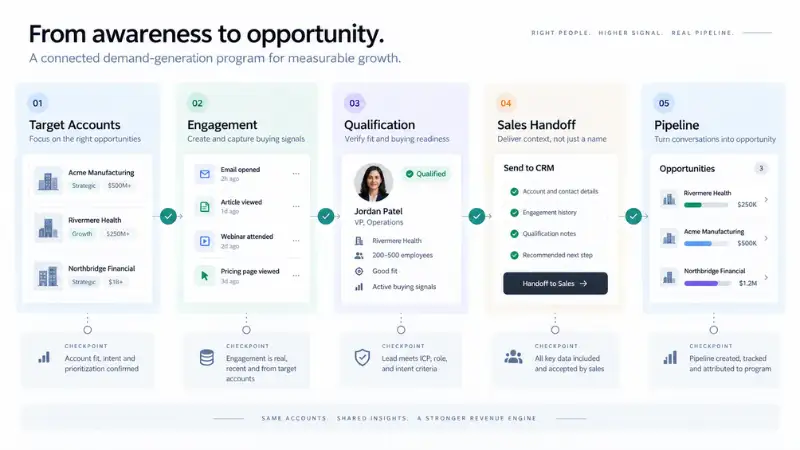
A provider should not be evaluated only on what happens before a lead is generated.
The stronger question is whether the program holds together from targeting through pipeline.
| Funnel Stage | What to Evaluate |
| Targeting | ICP accuracy, account selection, data quality, intent sources |
| Engagement | ABM execution, channels, buying-group coverage |
| Qualification | Lead criteria, verification, scoring, acceptance rules |
| Sales Handoff | Routing speed, CRM integration, context passed to sales |
| Pipeline | Meetings, opportunities, account progression, pipeline contribution |
Ask for evidence at each stage, not just a total lead number. That includes qualification rules used before delivery, how rejected leads are handled, what context reaches sales, and whether reporting connects account engagement with meetings, opportunities, and pipeline. Case studies are most useful when they reflect a comparable ICP or sales motion.
Intent deserves particular scrutiny. Ask what signals are used and what actually changes because those signals exist, especially when evaluating how B2B intent data is used within the program.
If lead generation itself is the bigger requirement, this comparison of B2B lead generation agencies in the US looks more closely at provider selection for that specific use case.
Questions to Ask Before Signing
- Which parts of ABM, intent data, and lead generation do you deliver directly?
- Where does the intent data used in our program come from?
- Can you work with our existing ICP and target-account list?
- How do you identify and engage buying-group members?
- What exactly qualifies a lead for delivery?
- How are rejected or invalid leads handled?
- How quickly does relevant engagement reach sales?
- Which CRM and marketing automation systems can you work with?
- What will you measure beyond lead volume?
- What evidence should we review before expanding or renewing the program?
The pitch tells you what the provider offers.
These questions tell you how the engagement is likely to work.
Choose the Demand Model Before the Provider
If you’re comparing B2B demand generation agencies, start by checking whether ABM, intent data, and lead generation actually work together within the provider’s delivery model.
Then look at fit. Some teams need more qualified demand. Others need outbound execution, strategic ABM support, or help operating an existing platform.
There is no reason to buy more capability than the problem requires.
Ready to bring ABM, intent data, and lead generation into one coordinated program? Contact Valasys Media to request a demand-generation assessment and see how ABM, intent data, and qualified lead generation can work together within your current program.
Frequently Asked Questions (FAQs)
Q1. Should one agency own ABM, intent data, and lead generation?
A single agency can simplify coordination when ABM, intent data, and lead generation need to operate together. Multiple specialists may work better when your internal team already manages orchestration and only needs deeper expertise in one area.
Q2. How should a CMO compare demand-generation agencies with different delivery models?
Compare providers against the business problem they are expected to solve. An outbound partner, strategic consultancy, platform-services team, and integrated demand-generation agency may all support growth, but their roles, economics, and expected outcomes differ.
Q3. What should executives require in demand-generation reporting?
Executive reporting should move beyond lead volume. Depending on program scope, look for sales acceptance, buying-group engagement, held meetings, opportunities, pipeline contribution, account progression, and the cost of generating qualified demand.
Q4. Who should own campaign data when working with a demand-generation agency?
The contract should clearly define access to account lists, lead records, engagement history, reporting exports, and enrichment created during the program. Executives should know what data remains accessible if the agency relationship ends.
Q5. How should a CMO evaluate demand-generation ROI with a long sales cycle?
Separate leading indicators from revenue outcomes. Account engagement, accepted leads, meetings, and opportunities can provide earlier evidence, while pipeline progression and revenue should be assessed against the company’s normal sales cycle.
Q6. When should a company replace the agency rather than change the program?
Replace the agency when its expertise, delivery model, data quality, or execution no longer fits the requirement. Change the program when the real issue is internal, such as an unclear ICP, weak qualification, poor follow-up, or unrealistic measurement expectations.