Turn First-Party Data Into Pipeline Growth
Explore proven ways to capture, organize, and activate customer data for smarter B2B marketing decisions.
 Lead-Gen now on Auto-Pilot with
Build My Campaign
Lead-Gen now on Auto-Pilot with
Build My Campaign

Discover 10 reasons your first-party data activation strategy isn’t driving revenue and learn how to improve targeting, engagement, and ROI.


Turn First-Party Data Into Pipeline Growth
Explore proven ways to capture, organize, and activate customer data for smarter B2B marketing decisions.
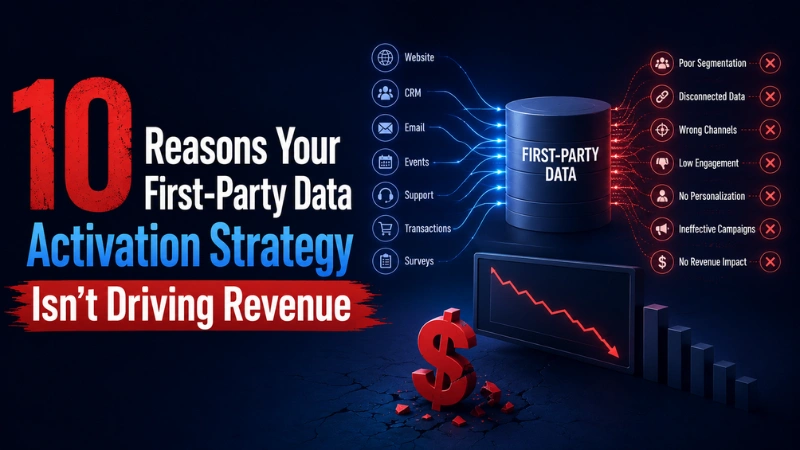
Here’s a question for whoever owns the martech stack at your company: if every system you’ve bought in the last three years is “data-driven,” why does pipeline still feel like a guessing game?
Most revenue leaders didn’t lose the first-party data race. Cookies are dying, third-party tracking keeps getting squeezed by browser and regulatory changes, and almost everyone has dutifully built their own first-party data foundation in response. The CRM is full. The website tracks everything. Email opens get logged. So why does revenue still feel disconnected from all that effort?
Because collecting data and activating it are not the same skill, and most teams only built muscle for the first one. While some organizations have mastered certain aspects of data activation, most struggle with creating seamless, real-time responses across their entire tech stack.
Effective First-Party Data Activation is a critical component that turns stored signals into timely actions that can significantly influence pipeline and revenue. It’s worth knowing the actual difference between first-party and third-party data before you can fix what’s broken downstream of it. Here are the ten places where gaps usually show up and why each one is quietly costing you revenue right now.
A prospect visits your pricing page three times in a week. Nothing happens. No alert, no follow-up sequence, no nudge to a sales rep. The behavior was logged somewhere in an analytics dashboard, but it never left that dashboard to actually do anything.
This is the difference between a collection engine and an activation system. First-Party Data Activation ensures website behavior becomes a trigger for engagement rather than a data point that sits unused. A collection engine stores the visit. An activation system reads “pricing page, three times, this week” as a signal and fires a response while the prospect is still warm. If your stack can tell you what happened on your site but can’t act on it within minutes, you’re paying for visibility you’re not using.
Pre-sale, this looks like a deal sitting in “Proposal Sent” for six weeks with nobody nudged to follow up. The stage field changed. Nothing downstream noticed. Marketing kept sending generic nurture content to a prospect who’s already three conversations deep with your AE, which is particularly counterproductive. A strong First-Party Data Activation strategy connects CRM stage changes directly to marketing and sales actions.
Turn First-Party Data Into Pipeline Growth
Explore proven ways to capture, organize, and activate customer data for smarter B2B marketing decisions.
The fix isn’t a better CRM. It’s wiring stage changes to actual behavior, so a stalled deal automatically triggers a different message, a different channel, or a flag to the rep instead of silently aging in a pipeline report nobody opens until the forecast call.
Someone opens five emails about a product feature and clicks none of them. The system logs five opens. It does not change a single thing about what that person receives next. They get the same generic sequence as someone who’s never opened anything. This is where First-Party Data Activation helps marketers adapt messaging based on actual engagement signals instead of sending every prospect through the same path.
This is a sequencing problem dressed up as an engagement problem. Pair it with a clean acquisition strategy like the one in Email List Building in the Privacy-First Era, and engagement data should be reshaping the next message automatically, not just sitting in an open rate dashboard that makes the email team appear positive in weekly reporting.
Two accounts hit your site this week. One is mildly curious, browsing the blog. The other has had four people from the same company researching your category across multiple sites for two weeks straight. Your reps spend equal time on both, because nothing told them the second account was different.
This is usually a first-party intent data gap. To Salesforce and SAP’s credit, the industry has real proof this works: SAP Concur ran targeted account-based advertising through Demandbase and saw a 52% increase in closed-won revenue, 57% larger deal sizes, and 59% more pipeline within four months, simply by prioritizing accounts already in motion instead of treating every visitor the same.
Don’t confuse this with #2. Deal stage problems happen pre-sale. This one happens after the contract’s signed, when usage drops, support tickets spike, or a champion quietly leaves LinkedIn for a competitor’s page. Those are first-party signals too, just living in product and CS tools instead of the CRM. Many organizations overlook First-Party Data Activation after the sale, even though retention and expansion signals can be just as valuable as acquisition signals.
Most activation strategies stop at acquisition and never touch retention, which is backwards given how much cheaper it is to keep an account than win a new one. If renewal risk isn’t triggering an action the same way a hot lead does, you’re treating your most predictable revenue as an afterthought.
This is the structural version of problems 1 through 5. Even when each system individually triggers something, none of them know what the others know. Marketing automation doesn’t see CRM stage. The CRM doesn’t see product usage. Email doesn’t see intent. Successful First-Party Data Activation depends on these systems sharing data in real time rather than operating independently.
The cost of this is not abstract. Richard Joyce, Senior Analyst at Forrester estimates “a 10% increase in data accessibility translates to more than $65 million in additional net income for a typical Fortune 1000 company”, the same research found less than 1% of organizational data ever actually gets analyzed because it’s locked away in systems that don’t talk to each other.
A Customer Data Platform (CDP) is one fix, but only if you treat it as a connective layer, not another silo you bought to feel better. It’s also worth checking whether the root issue is governance rather than tooling. A lot of silo problems trace back to the same mistakes covered in 7 First-Party Data Governance Mistakes That Could Cost You Your Revenue, where unclear ownership is what kept the systems apart in the first place.
| Reason | Funnel Stage | What It Actually Costs You |
| Website behavior ignored | Top of funnel | Warm visitors go cold before anyone reacts |
| CRM stages don’t trigger action | Mid funnel | Deals stall quietly for weeks |
| Email engagement unused | Mid funnel | Generic messaging to already-warm leads |
| Intent signals not prioritized | Mid to late funnel | Reps split attention evenly on unequal accounts |
| Renewal signals ignored | Post-sale | Preventable churn, missed expansion |
| Systems siloed | Cross-funnel | Up to 1% of data ever gets used |
| Sales blind to engagement | Cross-funnel | Reps work from partial information |
| Signals not enriched | Top to mid funnel | Volume without prioritization |
| Collection measured, not activation | Strategic | Dashboards full, pipeline flat |
| Manual campaign creation | Execution | Good data, slow response time |
Different problem from #6. Here, the data is connected, but it never reaches a human who can act on it. Modern buyers do most of their research anonymously, with 6sense’s 2025 Buyer Experience research finding that 94% of B2B buying groups have already ranked their preferred vendors before talking to sales, after consuming an average of 13 pieces of content on their own. If your reps only see the moment someone fills out a form, they’re walking into conversations where the buyer already decided most of the outcome without them.
Picture this: a rep opens their CRM Monday morning and sees a lead that just converted. What they don’t see is that this account read six blog posts, compared three competitors, and downloaded a pricing guide over the past three weeks. They’re not starting a relationship. They’re catching up on one, blind.
Your own data tells you someone visited your site. It doesn’t tell you whether they’re comparing you to three competitors right now or just stumbled in from a random search. That’s the gap zero-party data, things a buyer tells you directly through preference centers, surveys, or configurators, is built to close, by adding declared intent on top of observed behavior.
Without that enrichment layer, #4’s prioritization problem can’t actually get solved. You can’t rank accounts by intent if you have no intent signal to rank them by. Behavioral data alone tells you what happened. It takes an enrichment layer to tell you what it means.
This is the quiet root cause sitting underneath most of the other nine. Most quarterly reviews report on data volume: records collected, fields enriched, and integrations implemented. Almost none report on activation: how many of those records triggered a real action that moved a deal forward. This is one of the biggest barriers to effective First-Party Data Activation, because teams optimize for data volume rather than revenue impact.
It’s a measurement trap, and an easy one to fall into because collection metrics are simpler to report. “We added 40,000 enriched records this quarter” sounds like progress. Whether any of those records changed what a seller did on Tuesday is a harder, more useful question, and almost nobody’s asking it.
Even teams that solve every problem above sometimes lose the race on speed. A marketer manually builds a
When the use case is paid-account activation at scale, programmatic ABM can turn those verified signals into coordinated media execution.campaign for a hot account segment. By the time it ships, the buying window has moved. Intent data with a 48-hour campaign-build lag is better than no intent data at all.

This is the layer where the right toolset matters more than the strategy slide. Activation has to happen close to real time, with campaigns and outreach built directly from verified intent rather than assembled by hand after the fact.
None of these ten problems are really about having “more data.” First-Party Data Activation is ultimately about reducing the gap between a signal and a meaningful response. Every team reading this already has plenty. The actual gap is the distance between a signal showing up somewhere in your stack and a human or system doing something useful with it before the moment passes.
That’s the exact gap VAIS’s Build by Campaign feature is designed to close. Instead of your team manually translating intent signals into campaigns, VAIS turns verified intent personas directly into ready-to-launch campaign suggestions, so the time between “this account is in-market” and “this account is getting the right message” shrinks from weeks to hours.
Ready to transform your intent data into revenue opportunities? Valasys Media’s VAIS platform helps B2B organizations identify, prioritize, and activate high-intent accounts using behavioral signals and account-level intelligence. Contact us to learn how our data-driven approach can accelerate your pipeline and turn behavioral signals into closed deals.
Q1. What does “data activation” actually mean in marketing?
First-Party Data Activation means turning stored customer data into an automatic action, a triggered email, an alert to a rep, a personalized ad, rather than letting it sit in a dashboard as a record of what happened.
Q2. What’s the real difference between collecting first-party data and activating it?
Collection is observation. Activation is response. You can have excellent collection and zero activation if nothing in your stack is set up to react to what you’ve gathered.
Q3. How do I know if my activation strategy is broken?
Check how much time passes between a high-value signal (a pricing page visit, a deal stage change, a renewal risk flag) and a corresponding action. If that gap is measured in days instead of minutes, activation is the problem, not data quality.
Q4. Why do high-intent accounts get missed even with good first-party data?
Usually because behavioral data alone isn’t enough to separate real intent from casual browsing. Without an enrichment layer like declared or third-party intent signals, every visitor looks roughly the same.
Q5. Do data silos really cost that much revenue?
Industry estimates from IDC put silo-related inefficiency at 20-30% of annual revenue, and Gartner separately estimates bad-data-driven decisions cost mid-sized businesses upward of $15 million a year.
Q6. What’s the fastest fix for sales not seeing buyer activity?
Start by surfacing anonymous and known engagement directly inside the CRM view reps already use daily, rather than asking them to check a separate dashboard they’ll eventually stop opening.
Q7. Is a CDP required to fix data silos?
Not strictly, but it’s the most common structural fix because it’s purpose-built to unify identity across systems. A CDP without clear data governance, though, just becomes a more expensive silo.
Q8. How is zero-party data different from first-party data?
First-party data is observed (what someone did on your site). Zero-party data is declared (what someone directly told you they want or need). Pairing both gives you behavior plus context.
Q9. Why does manual campaign creation undercut a good activation strategy?
Because intent has a shelf life. A buying signal that’s a week old by the time a campaign ships has likely already cooled, no matter how accurate the original signal was.
Q10. Where should a team start if all ten of these problems sound familiar?
Start with measurement, not tooling. Find out how many of your “hot” signals from the last quarter actually triggered a human or automated action. That number will tell you whether the problem is data, process, or speed.
Turn First-Party Data Into Pipeline Growth
Explore proven ways to capture, organize, and activate customer data for smarter B2B marketing decisions.