Turn First-Party Data Into Pipeline Growth
Explore proven ways to capture, organize, and activate customer data for smarter B2B marketing decisions.
 Lead-Gen now on Auto-Pilot with
Build My Campaign
Lead-Gen now on Auto-Pilot with
Build My Campaign

Learn how first-party data measurement proves pipeline impact and marketing ROI without relying on third-party cookies.


Turn First-Party Data Into Pipeline Growth
Explore proven ways to capture, organize, and activate customer data for smarter B2B marketing decisions.
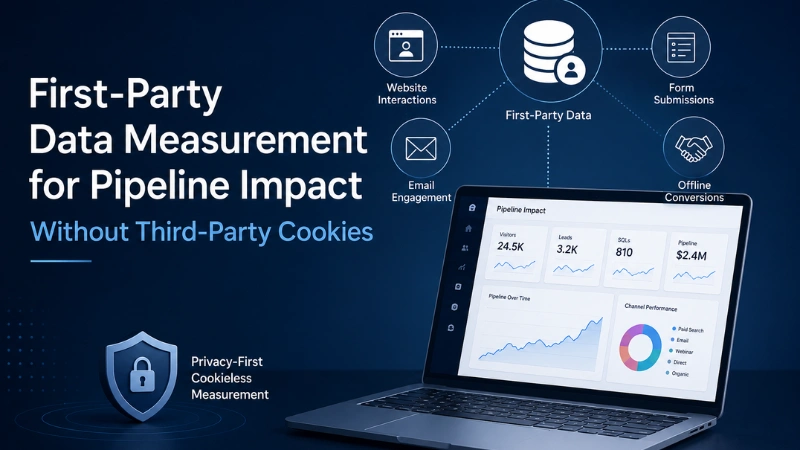
Your attribution model has been lying to you. Not maliciously. Just quietly, politely, and with a level of confidence it never actually earned. While third-party cookies provided valuable cross-site behavioral insights, their reliability has been compromised by evolving privacy regulations and user behavior changes.
For years, the entire marketing measurement machine ran on third-party cookies. Those tiny digital trackers followed prospects from your webinar landing page to a competitor’s site, back to your LinkedIn ad, and eventually into your CRM as a clean, unquestioned entry. The reporting looked beautiful. Dashboards glowed. Leadership asked fewer questions.
Then reality hit. Safari blocked third-party cookies. Firefox followed. Chrome’s privacy changes and growing user preference for consent controls have further reduced the reliability of traditional tracking methods. Suddenly, the comfortable fiction that you knew exactly where your pipeline came from started unraveling. Welcome to the era of cookieless B2B marketing, where old tracking habits go to die.
Here’s what’s actually wild: this is not a technology problem. It is a measurement philosophy problem. Transitioning to a sustainable infrastructure requires a comprehensive B2B first-party data strategy guide to reconfigure how you view your audience. First-party data measurement isn’t a frantic workaround. It is the upgrade your pipeline reporting has desperately needed for a decade.
First-party data measurement is the process of using customer interactions collected through your own channels, such as website activity, form submissions, CRM records, email engagement, event participation, and sales conversations, to measure marketing’s contribution to pipeline and revenue.
Unlike cookie-based tracking, which relies on observing behavior across external websites, first-party measurement focuses on signals that your organization owns and can directly validate. The result is a more reliable framework for attribution, forecasting, and revenue reporting.
In practical terms, first-party data measurement answers questions like:
Turn First-Party Data Into Pipeline Growth
Explore proven ways to capture, organize, and activate customer data for smarter B2B marketing decisions.
Those answers become increasingly valuable as third-party tracking becomes less reliable.
Most superficial strategy guides tell you to collect data. Far fewer actually tell you how to turn it into proof you can confidently take to the CFO. That widening gap is exactly where pipeline attribution goes to die.
True measurement is not just about collecting scattered signals from your own properties. It is about building a closed-loop system where every touchpoint, whether it is a webinar registration, a content download, a demo request, or a sales email reply, flows into a unified model. This is the core engine that tells you which activities are genuinely moving accounts through the funnel.
Without this architecture, you are tracking a cross-country road trip by only checking the odometer when you stop for gas. You know the distance traveled, but you have no idea which roads got you there, what caused the bottlenecks, or if you even went in the right direction.
The financial stakes are massive. According to McKinsey research, companies that successfully implement personalization at scale through first-party data can see revenue increases of up to 15% while optimizing marketing spend by 20%. That isn’t a rounding error. That is a completely different budget conversation with your executive team.
To bridge this operational gap, savvy teams are building a robust first-party data collection engine to automate how customer touchpoints are ingested. When data flows smoothly from collection to analytics, proving revenue contribution stops being a quarterly crisis and becomes a standard report.
Before you can build a better system, you have to understand what you actually lost versus what you only thought you had. Third-party cookies offered cross-site behavioral tracking. If someone visited a competitor’s pricing page, you could retarget them. If someone downloaded an ebook from a media partner site, you tried to match their identity to your database. Multi-touch attribution models could, theoretically, assign neat credit across every digital footprint.
That was the theory. In practice, that journey was always wildly incomplete.
The average enterprise buying group consumes massive amounts of content and requires dozens of marketing touchpoints before ever speaking to a sales representative. Old tracking methods completely missed enormous chunks of that journey: private browsing, multiple devices, offline conversations, dark social, and internal Slack threads where your best case studies are actually shared. The cookie-based model never captured that nuance. It just gave you a confident-sounding number for the narrow sliver of things it could see.
So when revenue teams lament that they have lost visibility, what they really mean is they have lost the illusion of perfect measurement. Shifting to an intentional first-party vs third-party data B2B marketers mindset isn’t a downgrade. It is simply more honest.
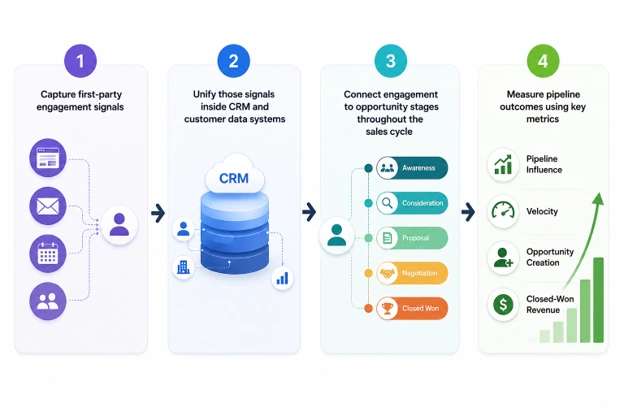
Organizations that successfully prove marketing’s contribution to revenue typically follow the same process:
When these four elements work together, attribution becomes less about tracking clicks and more about proving business outcomes.
A first-party measurement strategy succeeds when every major revenue milestone can be traced back to verified customer interactions. For example, if a prospect first downloads a research report, attends a webinar, requests a demo, and later becomes a closed-won opportunity, your measurement system should connect those activities into a single account history.
The goal is not to track every click. The goal is to prove that marketing activity influenced pipeline creation, accelerated opportunity progression, or contributed to revenue outcomes. That distinction separates activity reporting from true pipeline measurement.
Skip the foundational stack sequence, and your reporting falls apart the moment leadership asks a hard question. Since the core infrastructure setup is mapped across our broader content library, we will focus strictly on the operational execution gaps here.
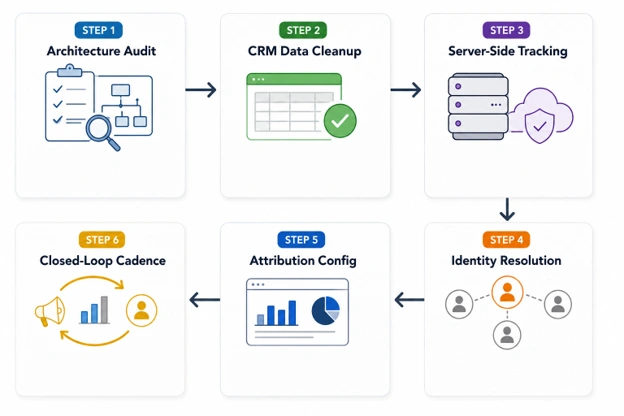
Every measurement crisis traces back to fragmented identity. If you attribute a dollar of pipeline before tying anonymous web sessions and multiple corporate emails to a single CRM entity, you are running arithmetic on broken data. Resolving these inputs requires a functional identity graph before you attempt to deploy a broader audience data gathering system across your digital properties.

Standard browser-based tags are fundamentally broken by modern privacy restrictions. True event-level tracking requires server-side tagging, routing behavioral data directly from your server to your analytics platform. This secures complete data quality for high-intent actions like form interactions and session depth, forming the basis of a reliable cookieless tracking model framework.
Marketing automation platforms and CRM records frequently live in separate silos. To prove commercial impact, your measurement model must map marketing data points directly to specific sales milestones. This structural alignment allows you to extract maximum value from an owned data roadmap rather than just looking at isolated dashboard metrics:
Applying a generic attribution model to a complex enterprise motion creates immediate strategic gaps. Your reporting framework must match the structural reality of your sales cycle.
Passive behavioral tracking only shows you what an account did, not why they did it. To build a predictive pipeline model, you must layer behavioral activity with explicitly declared insights from your forms, preference centers, and onboarding surveys. Integrating this zero-party data directly into your attribution framework bypasses proxy guesswork entirely, allowing you to instantly separate casual content browsers from accounts with active, 90-day purchase intent.
However, this multi-source data is useless if it is siloed. A centralized database must serve as the core translation layer, continuously ingest web events, CRM histories, and declared intent to resolve them into unified account profiles. Making the decision to invest in a unified B2B data repository is what prevents your measurement stack from devolving into disconnected spreadsheets and conflicting platform dashboards.
Moving away from legacy tracking models is an operational necessity. B2B organizations are actively replacing proxy guesswork with unified first-party structures to drive clear revenue results.
OpenText unified fragmented tracking across business units and connected behavioral signals to revenue reporting. The initiative produced a 27% increase in marketing-influenced revenue, a 15% lift in anonymous web activity, and a 600% increase in conversions from high-intent account engagement.
As Zendesk expanded its enterprise focus, the company shifted from contact-level lead tracking to an account-based approach that surfaced high-intent buying activity across entire target accounts. By combining behavioral engagement data with intent signals, sales teams gained clearer visibility into active opportunities and could prioritize outreach more effectively. The result was a consistent 8% to 10% average increase in opportunity creation from MQLs globally while also helping identify net-new accounts that had previously gone unnoticed.
Attribution is only valuable if it actively informs strategic capital allocation. When presenting to the C-suite, pivot away from vanity metrics and focus on the indicators that prove commercial impact.
| Metric | What It Genuinely Measures | Why the C-Suite Cares |
| Pipeline Influence Rate | The % of closed-won deals that featured an authenticated marketing touchpoint within 90 days of opportunity creation. | Clearest proof of marketing’s direct contribution to revenue generation. |
| Content-to-Pipeline Correlation | The specific assets that appear most frequently in the verified engagement history of converting accounts. | Eliminates subjective guesswork in content budgets and editorial investments. |
| Channel Velocity | The exact duration from an account’s first channel touchpoint to formal opportunity creation, segmented by source. | Highlights which specific acquisition channels produce high-velocity revenue. |
| Engagement Depth Ratio | The statistical correlation between high account engagement scores and actual conversion rates to open opportunities. | Validates the predictive accuracy of your internal lead scoring models. |
| ICP Match Conversion | The win rate of Ideal Customer Profile (ICP) accounts engaged by target programs versus non-targeted accounts. | Confirms that your strategic go-to-market targeting is working efficiently. |
| Dark Funnel Baseline | Changes in direct traffic volume, organic brand search, and self-reported attribution patterns over time. | Accounts for critical buying behaviors happening entirely outside of tracked properties. |
Avoiding common first-party data governance mistakes is what separates teams that scale these metrics from teams that stall out. If your underlying data inputs are plagued by duplicates or missing consent records, your metrics will be confidently wrong. Clean governance ensures your pipeline reporting is bulletproof during high-stakes budget conversations.
Building a new measurement framework comes with predictable failure modes. Knowing where these projects go off the rails can save your team months of wasted effort.
Executing a flawless first-party data activation strategy driving revenue means auditing these gaps regularly. Your metrics should look clean, but more importantly, they must match the actual financial realities of your sales pipeline.
When a first-party measurement system operates correctly, your conversations with revenue leadership change completely. Instead of defensively explaining top-of-funnel spend, you enter the boardroom armed with verified account histories, content correlation, and precise channel velocity. You can show exactly how an initial interaction matured into an open opportunity and a closed-won deal.
The shift to first-party data measurement isn’t just about compliance. It’s about building a more accurate, predictable revenue engine. When implemented correctly, this approach transforms marketing from a cost center into a measurable revenue driver with clear pipeline attribution.
Ready to transform your pipeline measurement strategy?
Stop defending unverified reporting. Book a strategy session with us today to deploy our data-driven approach, build a bulletproof engine, and secure true, privacy-compliant attribution before your next budget review.
You track it by routing user actions directly from your server to your analytics instead of using a browser tracker. For example, when a prospect registers for a webinar, your website backend instantly matches their corporate email and session history into your CRM. This builds a secure, private pipeline view.
Safari deletes standard tracking cookies after seven days, but enterprise B2B sales take months. For example, if a buyer clicks your ad on day one but requests a demo on day ten, Safari treats them as a brand-new stranger. Moving to server-side tracking stops this erasure entirely.
You measure it by adding a mandatory, open-ended question to your high-intent forms. For example, ask buyers, “How did you first hear about us?” When a prospect types “Recommended in our private Slack channel,” you capture high-value brand awareness data that traditional software tracking completely misses.
Because AI engines strip out traditional web tracking parameters, look for surges in direct traffic and unbranded organic search. For example, if a popular AI tool begins recommending your software in industry roundups, you will see a sudden, measurable spike in high-intent visitors typing your domain name directly.
A customer data platform is the library; an identity graph is the index. For example, a platform stores separate data points from a user’s phone, laptop, and work email. The identity graph instantly links those fragmented touchpoints together, proving they all belong to the exact same corporate buyer.
Standard attribution tracks individual people, while B2B deals involve whole teams. For example, your marketing tool might give credit to a designer downloading an ebook, while sales is working a deal with the CFO. Switching to account-based attribution combines these actions into a single, unified account record.
Browser-based tags are easily blocked by privacy extensions, leading to broken data. For example, if an executive uses an ad blocker during a high-intent form submission, your system misses the conversion entirely. Moving your collection infrastructure to server-side execution fixes this blind spot safely and legally.
Turn First-Party Data Into Pipeline Growth
Explore proven ways to capture, organize, and activate customer data for smarter B2B marketing decisions.