
Fortinet Acquires Virtue AI to Strengthen AI Agent Security
Fortinet acquires Virtue AI, adding agentic AI red-teaming, runtime protection and governance capabilities to its enterprise security portfolio.

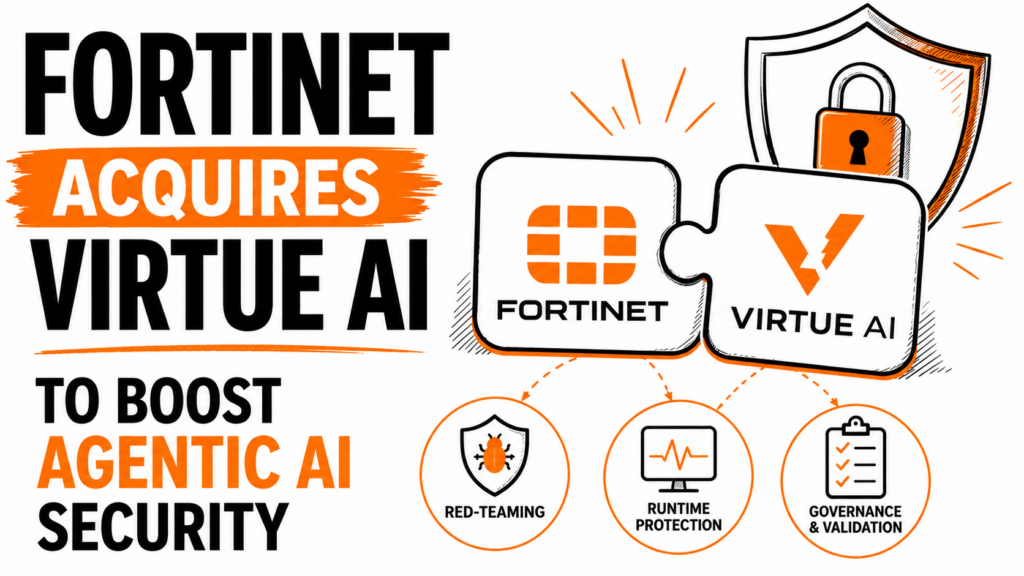
The cybersecurity company is adding Virtue AI’s red-teaming, runtime protection and governance technology as enterprises deploy more autonomous AI agents.
Aug. 17, 2026 – Fortinet has acquired Virtue AI, an AI security company focused on runtime protection, automated validation and security for autonomous AI systems, as the cybersecurity vendor expands its defenses for enterprise AI agents. Fortinet announced the completed acquisition Monday and said Virtue AI’s technology will become part of its broader Security for AI strategy and AI-Native Security Fabric.
The acquisition gives Fortinet additional tools to test AI agents for vulnerabilities, monitor their behavior, scan Model Context Protocol, or MCP, tools for risks and apply security guardrails while AI systems are running. Those capabilities address an expanding enterprise attack surface that now includes prompts, models, AI agents, APIs, MCP tools and the infrastructure supporting AI workloads.
Financial terms were not disclosed. Fortinet said the amount it paid for Virtue AI was immaterial to its business, without providing a purchase price or other financial details.
Key Facts:
- Fortinet acquired Virtue AI on Aug. 17, 2026, expanding its enterprise AI security portfolio.
- Virtue AI specializes in AI runtime protection, automated validation and autonomous-agent security.
- Its technology covers agentic red-teaming, MCP security, agent governance, continuous validation and real-time guardrails.
- Virtue AI’s red-teaming platform supports more than 50 sandboxed environments and 14 high-stakes domains.
- Financial terms were not disclosed, and Fortinet said the consideration paid was immaterial to its business.
- The acquisition complements Fortinet’s existing FortiAIGate and AI-Native Security Fabric strategy.
What does Virtue AI add to Fortinet?
Virtue AI brings four main areas of technology to Fortinet: agentic AI red-teaming, agent governance and visibility, continuous AI validation, and real-time guardrails.
Its agentic red-teaming technology tests autonomous agents for weaknesses across more than 50 sandboxed environments and 14 high-stakes domains. The testing includes simulated prompt-injection attacks and attacks involving MCP, a protocol increasingly used to connect AI models and agents with external tools and services.
Virtue AI also scans MCP tools and source code for potential vulnerabilities and hidden prompt injections. Its runtime technology can monitor agent behavior and block malicious tool calls before they execute, according to Fortinet and Virtue AI.
The company’s continuous validation tools test AI systems as models and policies change. Fortinet said the technology covers hundreds of attack vectors and more than 1,000 risk categories and can produce evidence for security, risk and compliance reviews.
Virtue AI’s guardrail technology also works across text, images, video, audio and AI-generated code, allowing organizations to enforce policies around sensitive data, harmful content, jailbreak attempts and vulnerable code.
How does Virtue AI fit with Fortinet’s existing AI security products?
The acquisition builds on Fortinet’s existing push into enterprise AI security.
Earlier in 2026, Fortinet introduced FortiAIGate to protect large language model applications against risks including prompt injection, data leakage, model poisoning and excessive resource consumption. Virtue AI extends that approach further into AI model testing, autonomous-agent security and protection during runtime.
Fortinet is positioning the combined technologies around securing AI throughout its lifecycle rather than protecting only the network traffic around an AI application. Virtue AI’s automated validation and runtime controls are expected to complement FortiAIGate and Fortinet’s broader Security Fabric, alongside threat intelligence from FortiGuard Labs.
“AI is fundamentally changing enterprise computing, and security must evolve just as quickly,” Fortinet CEO Ken Xie said in announcing the acquisition.
Xie said Virtue AI would support Fortinet’s push toward what the company calls “continuous AI assurance,” covering AI systems across their lifecycle and at enterprise scale.
Why does the Fortinet-Virtue AI deal matter?
The acquisition reflects a cybersecurity problem emerging alongside enterprise adoption of AI agents: autonomous systems do more than generate text.
Agents can access company data, call APIs, interact with software tools, execute workflows and take actions with limited human intervention. That creates security questions around what agents can access, which tools they can invoke, whether their instructions have been manipulated and what happens when an agent behaves outside company policy. Virtue AI has built products specifically around monitoring and controlling those interactions.
Fortinet also cited Gartner research estimating that the market for securing AI ecosystems and AI agents could expand from $2.8 billion in 2026 to $16.4 billion by 2030. Fortinet referenced Gartner’s July 30, 2026 research in its acquisition announcement.
That growth would put AI security alongside networking, endpoint protection, cloud security and security operations as another area competing for enterprise cybersecurity budgets.
Who is Virtue AI?
Virtue AI describes itself as an enterprise AI security and safety company focused on protecting AI systems and autonomous agents.
Its leadership includes founder and CEO Bo Li, founder and board director Dawn Song, founder and Chief AI Officer Sanmi Koyejo, and founder and Chief Scientist Carlos Guestrin. The company’s platform includes AgentSuite-Red for agent red-teaming, AgentSuite-Blue for runtime protection, VirtueRed for automated AI testing and VirtueGuard for real-time AI guardrails.
Fortinet has not announced a detailed product-integration schedule for Virtue AI, and changes to Virtue AI’s branding, workforce or standalone product availability have not yet been confirmed.