Gartner: AI Platforms and Models Spending to Reach $64.25 Billion in 2026
Gartner forecasts AI platform and model spending will reach $64.25 billion in 2026 as buyers prioritize cost, performance, governance and measurable value.

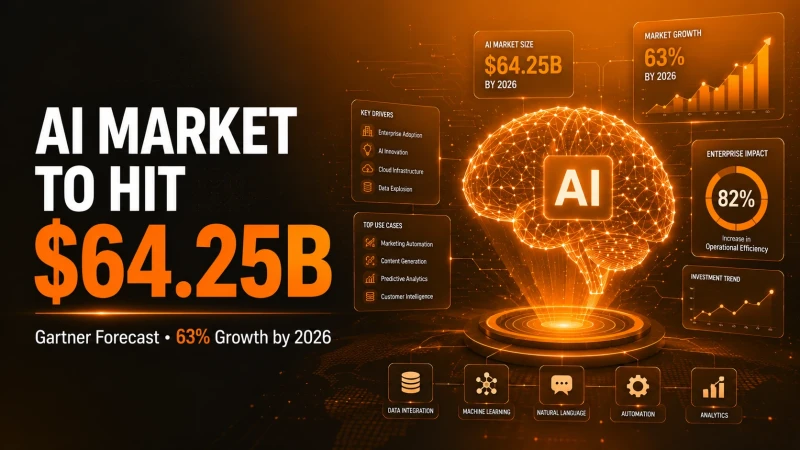
Gartner forecasts worldwide end-user spending on AI platforms and models will rise 63.4% in 2026, from $39.31 billion to $64.25 billion. Generative AI will lead the growth, but buyers are focusing less on technical capability alone and more on cost, reliability, governance and measurable business outcomes.
Combined spending on foundation and specialized generative AI models is expected to grow 117%. Spending on AI application development and machine-learning platforms is forecast to rise 36.9%.
For enterprise technology teams, budgets are moving toward providers that can show sustained adoption, predictable costs and operational value.
Key Takeaways
- Worldwide spending reaches $64.25 billion
- Specialized generative AI models grow 210%
- Machine-learning platforms remain the largest segment
- Cost control and measurable outcomes become key buying criteria
Specialized Generative AI Models Will Grow Fastest
Specialized generative AI models are expected to record the strongest growth. Gartner forecasts spending will increase 210%, from $1.58 billion in 2025 to $4.91 billion in 2026.
These models are designed for narrower, domain-specific workloads where businesses need greater control over performance, cost and implementation. The category is still relatively small, but its growth suggests enterprise demand is shifting toward purpose-built AI rather than one-size-fits-all models.
Companies increasingly want systems that understand their workflows, terminology and compliance requirements. That creates an opening for providers that can deliver focused capability without the cost and complexity of a larger general-purpose model.
Foundation Model Spending Will Pass $23 Billion
Spending on foundation generative AI models is forecast to reach $23.36 billion in 2026, up 104.2% from $11.44 billion in 2025.
Foundation models will remain central to enterprise AI strategies, but buyers are evaluating them differently. Model quality still matters, but it is no longer the only differentiator.
Companies are comparing providers on latency, reliability, governance, usage costs and business value. A strong model with unpredictable costs may lose to an alternative that is easier to manage at scale.
Machine-Learning Platforms Remain the Largest Segment
Data science and machine-learning platforms will remain the largest category. Gartner expects spending to grow 36.3%, from $19.41 billion to $26.44 billion.
AI application development platforms are forecast to increase 38.6% to $9.54 billion. These tools help companies build and manage AI applications while connecting models with enterprise data and internal systems.
Businesses are investing not only in models, but also in the infrastructure needed to deploy, manage and govern AI at scale.
AI Budgets Face More Scrutiny
“Enterprise AI budgets are coming under greater scrutiny, with increased focus on usage efficiency, cost control and measurable outcomes,” said Arunasree Cheparthi, senior principal research analyst at Gartner.
Technology leaders will need to connect AI spending with revenue, productivity, customer service, risk reduction or operating efficiency. Projects stuck in pilot mode may struggle to secure further funding.
The same applies to tools that attract interest but fail to produce regular usage. Spending remains strong, but tolerance for unclear value is falling.
Cost Control and Governance Become Buying Criteria
Consumption-based pricing can make AI costs difficult to predict, especially when several teams use different models and providers.
Businesses need centralized controls for monitoring usage, spending, performance and outcomes. CIOs also need oversight of model selection, data access, security policies and overlapping purchases.
“As more models enter the market and usage-based pricing becomes harder to predict, buyers will turn to platforms that help them choose the right tools, monitor performance, enforce policy and keep costs under control,” Cheparthi said.
Governance is becoming a purchasing criterion rather than simply a compliance requirement, making it part of the vendor selection process itself.
Vendors Must Prove Durable Use
Rapid market growth does not guarantee long-term success for AI vendors. As enterprise buyers demand measurable outcomes, providers will need to demonstrate sustained adoption rather than initial experimentation. Long-term performance will depend on recurring usage, retention, delivery costs and stable margins.
The $64.25 billion forecast shows that enterprise AI spending is accelerating. The more important signal is how enterprises plan to allocate those budgets. Providers that combine useful models with cost control, governance and measurable outcomes will be better positioned than vendors competing on technical capability alone.