Google Expands AI Ecosystem With Gemini Omni Flash and 100 Key Launches at I/O 2026
Google unveils Gemini Omni Flash and Gemini 3.5 Flash at I/O 2026, accelerating agentic AI, multimodal video, and enterprise automation.

May 26, 2026 – Jersey City, N.J.
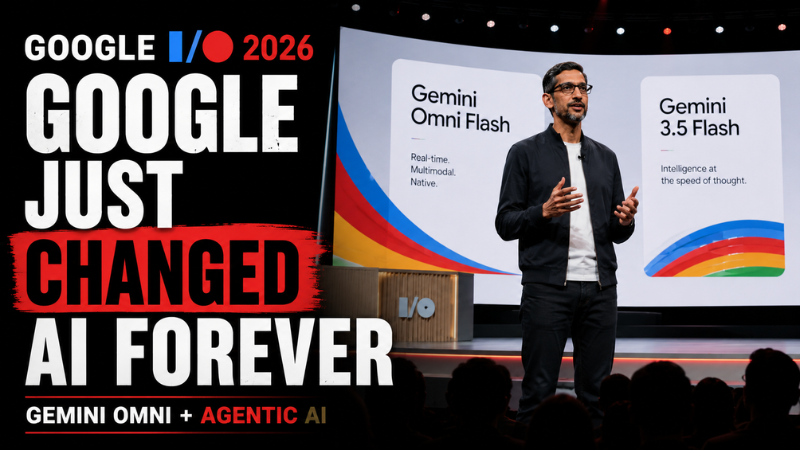
Google expanded its artificial intelligence ecosystem at its annual I/O 2026 developer conference, introducing a broad slate of 100 advancements headlined by the launch of Gemini Omni Flash, a natively multimodal generative video model, and Gemini 3.5 Flash, an agentic reasoning engine. The announcements signal an aggressive shift by the technology giant to transition from standalone conversational chatbots toward fully integrated networks of autonomous AI agents and multimedia production workflows. By embedding these models directly into enterprise cloud environments, developer APIs, and consumer platforms like YouTube Shorts, Google is positioning its infrastructure to capture a dominant share of the accelerating enterprise AI market.
Multimodal Visual Production and Agentic Frameworks
The core structural development of the conference centered on the debut of Gemini Omni Flash, the first release in a new “Omni” family of world models. According to official company statements during the keynote presentation, Gemini Omni Flash collapses previously fragmented pipeline stacks, such as separate models for text, images, and audio, into a singular, natively multimodal architecture. The system processes simultaneous inputs of text, images, existing video footage, and audio to generate or conversationally edit video content. Google demonstrated that the model applies contextual reasoning regarding physics, fluid dynamics, and gravity to ensure scene continuity and character consistency across edits.
“With world models, AI is moving from predicting text to simulating reality,” Google CEO Sundar Pichai stated during the keynote address. “Gemini Omni is the next step in that direction.”
Simultaneously, Google released Gemini 3.5 Flash to immediate general availability, establishing it as the default backend model for the Gemini app and Google Search. Data published by Google DeepMind indicates that Gemini 3.5 Flash executes multi-step workflows four times faster than comparable frontier models while outperforming older iterations, like Gemini 3.1 Pro, on dedicated coding and agentic benchmarks. To showcase this architecture, Google DeepMind CEO Demis Hassabis described Omni as a crucial step toward artificial general intelligence, noting that the long term goal for Omni is to generate any type of output from any kind of input.
To facilitate the management of these autonomous models, Google launched Antigravity 2.0, an agent-first desktop application and development platform designed to let enterprises orchestrate dozens of specialized sub-agents concurrently within isolated cloud environments.
B2B Industry Impact and Enterprise Workflows
For B2B organizations, SaaS companies, and digital marketing agencies, the integration of these tools represents a critical shift toward automated multimedia asset creation and persistent data monitoring. The deployment of Managed Agents within the Gemini API allows businesses to authorize background agents to browse databases, run code, and execute multi-layered corporate workflows via a single API call.
Furthermore, Google announced Search Agents and Generative UI frameworks. These systems autonomously track custom financial markets, news cycles, or internal data pipelines, dynamically generating custom interactive dashboards, visualizations, and application layouts tailored to an executive’s exact operational queries.
Industry Perspectives on the Agentic Shift
Technology analysts view the sudden volume of agent orchestration platforms as a direct challenge to the enterprise frameworks developed by OpenAI, Microsoft, and Anthropic. The market consensus points toward an infrastructure price war, as Google pitched that shifting heavy enterprise workloads to Gemini 3.5 Flash could yield massive infrastructure savings for high volume corporate clients.
Independent enterprise software analyst Rachel Bradley said in a research briefing following the keynote, “Google is effectively attempting to commoditize the agentic layer, by bundling complex multi-agent orchestration tools directly into Google Cloud and lowering the cost per token on Flash models, they are forcing competitors to defend their enterprise pricing models.”
However, industry experts also emphasize that the ultimate enterprise adoption curve will depend heavily on corporate governance, safety alignment, and content verification. To mitigate compliance and deepfake liabilities in commercial video production, Google confirmed that all video outputs generated via Gemini Omni Flash automatically embed SynthID, an imperceptible digital watermarking standard verifiable via Google Search and the Chrome browser.
Rollout Timeline and Availability
Google confirmed that while consumer access to Gemini Omni Flash and Gemini 3.5 Flash has commenced via subscription tiers and YouTube tools, developer and enterprise API access will roll out in a phased approach over the coming weeks. The broader commercial scaling of the Gemini Omni and Antigravity platforms throughout the summer of 2026 will serve as a primary indicator of how rapidly B2B organizations can successfully move autonomous AI applications from isolated experimental phases into large scale, automated production pipelines.