

Google adds multimodal search data to Search Console
Google adds multimodal search data to Search Console, helping marketers track performance across text, image, and visual search.

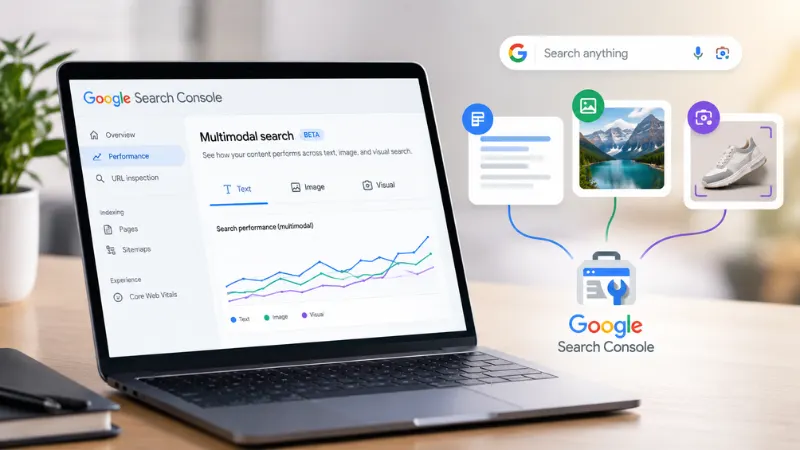
Sept 29, 2026: For years, website owners have had limited visibility into how their pages perform when users search with images instead of traditional text queries. Google is now adding its new multimodal search filter to Search Console, giving site owners a way to measure traffic and visibility from image-led searches.
The update began rolling out globally on September 24 and is available in the Performance reports for both Search results and Generative AI features. It covers searches made through Google Lens, Circle to Search on Android, image uploads to Google Search and Chrome’s “Search this image” feature.
What the new filter shows
The new report separates text-based searches from multimodal searches. Site owners can select the multimodal search type in Search Console to see how their pages performed when an image was part of the search.
For the Search results report, the data includes impressions and clicks. Google also allows the data to be exported for analysis in other tools. The Generative AI features report provides impression data for multimodal searches appearing in Google’s AI-driven search experiences.
Google Search Relations representative John Mueller said the report shows which pages appeared and how often, but does not show the image used to initiate the search. “No, you don’t see the photo :-), but you can see which of your pages showed up & how often.”
The key limitation: no query data
The new report does not provide the Queries dimension for multimodal searches. Google’s documentation explains that these searches primarily use images rather than text, so conventional query information is not available.
For SEO teams, this means Search Console can show which pages received impressions or clicks from image-led searches, but it cannot show the traditional keyword associated with that interaction. The report also does not show the image that triggered the search.
This makes the new data different from traditional Search Console reporting. Instead of starting with a keyword and measuring the resulting page performance, marketers can now examine how their content performs when the search starts with something visual.
Google says the data is new
The update also changes how marketers should interpret historical Search Console data.
When users asked whether multimodal impressions had previously been included in the broader Web search figures, Mueller initially said he would check with Google’s team. He later confirmed that the data had not previously been included.“The data wasn’t previously in the counts, the report has new data.”
This means the new filter is not simply a new way of segmenting an existing pool of Search Console data. Google is exposing multimodal search data that was not previously part of those reported counts.
The change comes as Google expands visual search
The Search Console update follows broader changes to how Google handles image-based searches.
Google has been expanding the role of Lens and multimodal capabilities in Search. In March 2026, Google said updated Lens and Circle to Search capabilities could identify multiple objects within an image and conduct searches for them simultaneously. Google describes this process as using AI to understand the image and then triggering multiple searches based on what it identifies.
Google has also incorporated visual search into AI Mode. The company said its “visual search fan-out” technique can analyze an image, identify primary and secondary objects and run multiple searches to understand the broader visual context.
What it means for SEO measurement
The immediate change is in measurement, rather than a new ranking system.
Google’s existing image-search guidance focuses on helping its systems understand images through factors such as relevant page context and descriptive information. The new Search Console filter does not introduce a separate set of ranking factors for multimodal search.
For publishers and SEO teams, the practical value is that image-led discovery can now be measured separately. They can identify pages receiving visibility and clicks from multimodal searches and compare that performance with their text-based search traffic.
The limitation is that the reporting provides less information about why a particular page appeared. Without the initiating image or conventional query, marketers have fewer signals for connecting an individual search to a specific user intent.
The change therefore adds a new measurement layer to Search Console rather than replacing traditional keyword reporting. As Google expands Lens, Circle to Search and other multimodal experiences, what users show the search engine is becoming measurable alongside what they type.