
How to Prioritize In-Market Accounts Using Fit, Intent, Engagement, and Buying Stage
Learn how to prioritize in-market accounts using ICP fit, engagement, third-party intent, and buying stage so sales teams can focus on better opportunities

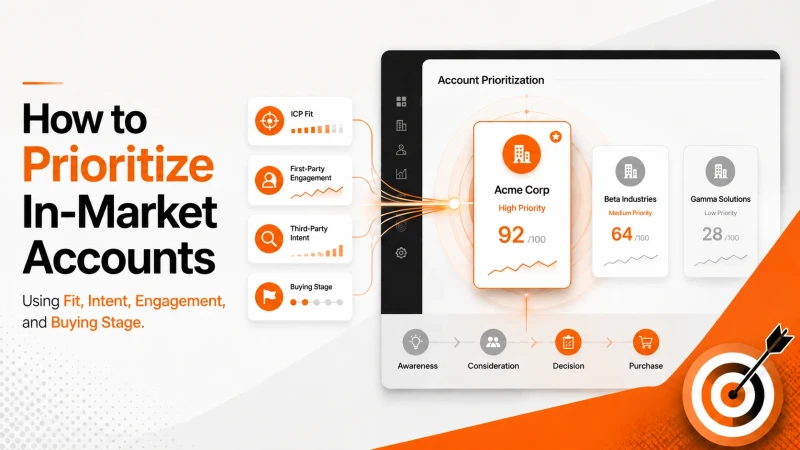
Sales teams should prioritize in-market accounts using four signals: ICP fit, first-party engagement, third-party intent, and buying stage. Accounts become stronger sales priorities when these signals reinforce one another and show both commercial fit and active buying behavior.
An account can look perfect on paper and still be nowhere near a buying decision. Another can light up your website and still be a terrible customer.
The job is not to find the loudest signal. It is to find the accounts where fit, engagement, outside research, and the buying stage reinforce one another.
B2B teams spent years asking for more buyer signals, and now they have plenty.
Now the harder problem is deciding which of those signals actually deserve sales attention.
A target account visits your pricing page. Another starts researching your category across third-party sites. Three people from a third company engage with a webinar and case study. All three could be interesting. They should not automatically receive the same treatment.
That is the difference between detecting activity and prioritizing an account.
| Approach | What It Looks At | Decision It Supports |
| Target-List Building | Firmographic and ICP criteria | Which accounts belong in the target universe? |
| Lead Scoring | Individual contact attributes and behavior | Which leads deserve follow-up? |
| Account Prioritization | Fit, engagement, intent, and buying-stage context | Which accounts deserve attention now? |
The Four-Signal Model for Prioritizing In-Market Accounts
Each signal answers a different question.
| Signal | The Question It Answers |
| ICP Fit | Should this company realistically buy from us? |
| First-Party Engagement | Is the account paying attention to us directly? |
| Third-Party Intent | Is the account researching the problem or category outside our channels? |
| Buying Stage | How far has that research progressed? |
Using any one of these as the sole basis for priority leads to bad decisions.
- High fit without activity tells you who could buy.
- Intent without fit tells you who is researching.
- Engagement tells you who is interacting with you.
- Buying stage tells you how urgent that activity may be.
Priority confidence increases when multiple signals point in the same direction.
1. ICP Fit: Does the Account Belong in Your Market?
Start with the least exciting signal because it prevents the most expensive mistakes.
ICP fit measures how closely an account matches the customers your business is built to serve.
Depending on your offer, that can include:
- Industry
- Company size
- Revenue
- Geography
- Technology environment
- Business model
- Product use case
- Similarity to successful customers
Intent cannot fix a fundamentally poor fit.
A company may research your category heavily while being outside your supported geography, target segment, budget range, or technical requirements.
That makes it an interesting research activity signal. It does not necessarily make it a good sales opportunity.
Valasys AI Score (VAIS) handles the account-alignment side through its VAIS Score, which runs from 55 to 95. VAIS groups accounts into Elite Fit, High Potential Fit, Moderate Fit, Limited Fit, and Low Fit based on that score.
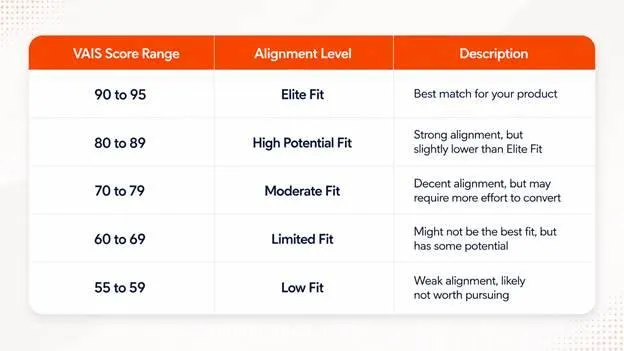
Fit answers: Should we care about this account at all?
The remaining signals tell you whether you should care right now.
2. First-Party Engagement: What Is the Account Doing With You?
First-party engagement is behavior your company can observe through channels it owns or directly manages.
Examples include:
- Product-page visits
- Pricing-page activity
- Demo requests
- Case-study views
- Webinar attendance
- Email clicks
- Content downloads
- Repeat website visits
- Event interactions
The mistake is counting activity instead of interpreting it.
Someone reading one educational article is not behaving like someone repeatedly viewing product pages and implementation content.
And one person engaging heavily with everything is not necessarily the same as several relevant stakeholders participating.
That distinction becomes especially important in account-based selling because buying decisions are usually spread across multiple people. Valasys Media’s guide to ABM engagement across the buying committee looks more closely at why account-level activity should not be reduced to one enthusiastic contact.
First-party data gives you visibility into behavior occurring on your own channels. Valasys Media’s guide to first-party versus third-party data explains the difference between data your organization observes directly and data collected through external sources.
First-party engagement answers: Are they interested in us?
Third-party intent asks something broader.
3. Third-Party Intent: What Is Happening Before the Account Reaches You?

Most buying research does not happen neatly inside your website analytics.
Accounts research problems, categories, technologies, competitors, and implementation questions across the wider B2B web.
Third-party intent helps make some of that activity visible and can help identify in-market accounts that are actively researching a relevant problem, category, or solution.
Bombora’s Company Surge, for example, identifies increases in research activity around relevant B2B topics by comparing an organization’s content consumption with its normal behavior.
That can help uncover an account that is actively researching a problem even if nobody from the company has filled out your form yet.
But this signal has limits.
Research activity does not prove:
- An approved project exists
- Budget has been allocated
- Your product is being considered
- The right buying committee is involved
- A decision is imminent
Intent tells you that something is happening.
Fit, engagement, and stage tell you how much that something matters.
VAIS layers Bombora intent into account prioritization. When building an intent list, users can select relevant intent topics, while the exported data includes market trend activity and a corresponding funnel stage for each account.
For more context on how external intent should work alongside owned behavioral data, see Valasys Media’s guide to intent data in a first-party world.
4. Buying Stage: Is the Account Curious or Actually Progressing?
A buyer can be interested for months without becoming ready for sales.
The buying stage adds timing to the signal.
Broad educational research looks very different from product evaluation or final vendor comparison. Bombora itself describes intent-based buying-stage mapping across early, mid-stage, and late-stage research.
With its recent development, the AI Account Intelligence feature in VAIS now gives sales teams a more detailed view of buying-stage progression:
Awareness → Consideration → Active Evaluation → Vendor Selection → Decision
That added stage context matters because two equally strong-fit accounts may still need completely different treatment. An account in Awareness may still need education and nurture, while one moving through Vendor Selection or Decision is much closer to a direct sales conversation.

How the Four Signals Turn Into Account Priority
A useful prioritization model should make the sales decision clearer, not just add another score to the dashboard.
Sales Priority = Strong Account Fit + Direct Engagement + External Intent + Buying-Stage Progression
Treat this formula as a decision rule, not a fixed weighting. The more independent signals that reinforce one another, the stronger the case for prioritization.
Fit acts as the gate.
Recency matters too. A meaningful signal from this week should generally carry more weight than the same behavior from several months ago. A pricing-page visit yesterday, for example, says more about current interest than a pricing-page visit from the previous quarter with no follow-up activity.
Intent should not become a permanent label. If supporting engagement disappears or activity declines, account priority should be reviewed.
Strong intent from a poor-fit account may still deserve investigation, but it should not automatically outrank a strong-fit account showing credible demand.
What This Looks Like in Practice
Consider two fictional accounts.
Northstar Analytics is an Elite Fit account. It has recent product-page and case-study engagement, rising third-party intent around relevant topics, and buying-stage activity that suggests active evaluation.
BrightPeak Systems is showing strong third-party intent, but its account fit is weaker. Most of its direct engagement happened several months ago, and there has been little recent first-party activity.
| Signal | Northstar Analytics | BrightPeak Systems |
| ICP Fit | Elite Fit | Weaker fit |
| First-Party Engagement | Recent, high-value activity | Limited recent activity |
| Third-Party Intent | Rising across relevant topics | Strong |
| Buying Stage | Active Evaluation | Unclear |
| Recency | Current | Older / inconsistent |
Northstar Analytics should rank higher.
Its stronger fit is being reinforced by recent first-party engagement, rising external research, and clearer buying-stage progression.
BrightPeak Systems may be generating a louder intent signal, but that signal is doing more work on its own. Its fit is weaker, its direct engagement is older, and there is less evidence that the account is actively moving toward a buying decision.
That is where prioritization becomes useful: the account with the most activity is not automatically the account with the strongest case for sales attention.
Turn That Evidence Into Priority Tiers
Once the signals are interpreted together, the account needs a clear place in the queue.
| Priority Tier | Typical Pattern | Action |
| Prioritize Now | Strong fit + direct engagement + strong intent + later buying stage | Sales review and personalized outreach |
| Investigate | Several strong signals but one important conflict | Validate context before outreach |
| Nurture | Strong fit with early or incomplete buying activity | Continue targeted marketing |
| Monitor | Isolated or weak evidence | Wait for stronger signals |
Use these as routing categories, while VAIS Alignment Levels remain separate measures of account fit.
When to Route, Nurture, or Take a Closer Look
Route for sales review when:
- Account fit is strong
- High-value first-party behavior appears
- Relevant third-party research is elevated
- Buying stage indicates evaluation or decision activity
- Multiple relevant stakeholders are involved
Keep in nurture when:
- ICP fit is strong
- Engagement is mostly educational
- The buying stage remains early
- Intent exists but has not yet been reinforced by direct activity
Investigate before routing when:
- Intent is strong, but fit is weak
- One person creates most of the engagement
- External research spikes without direct engagement
- Buying stage and actual account behavior appear inconsistent
Good routing is also part of good account engagement in account-based marketing. The next touch should reflect what the account is doing, not merely the fact that a signal appeared.
Edge Cases That Can Fool the Model
Some account patterns look obvious at first glance but become less reliable once the signals are viewed together.
| Signal Pattern | Why It Can Mislead You |
| High Intent, Poor Fit | Heavy research can create urgency even when the account is not commercially aligned with your ICP. |
| Excellent Fit, No Intent | A perfect target account may still have no active buying need right now. Fit alone does not create urgency. |
| One Extremely Active Contact | One person’s activity can inflate the account picture without proving that the wider buying group is involved. |
| Moderate Activity Across Several Stakeholders | Lower individual activity can look less impressive on a dashboard even when interest is spreading across the buying committee. |
| Strong Third-Party Intent, No First-Party Engagement | External research shows interest in the category, not necessarily interest in your company. |
| Late-Stage Intent That Suddenly Drops | A previously strong signal can become stale. Account priority should reflect current behavior, not past momentum. |
These are the cases where context matters more than any one signal.
Sample Account-Prioritization Scorecard
Use the scorecard to review the same evidence consistently before an account is routed.
| Signal | What to Review | Status | Evidence |
| ICP Fit | VAIS Score + Alignment Level | Strong / Moderate / Weak | Account alignment |
| First-Party Engagement | Website, CRM, email, event activity + relevant stakeholder participation | Strong / Moderate / Weak | Owned-channel engagement and buying-group breadth |
| Third-Party Intent | Market Trend Activity | Strong / Moderate / Weak | Relevant topic research |
| Buying Stage | Buying-stage progression | Awareness / Consideration / Active Evaluation / Vendor Selection / Decision | Current stage |
| Recency | How recently meaningful activity occurred | Active this week / Activity increasing / No recent activity | Latest meaningful signal or trend |
| Next Action | Sales, nurture, investigate, monitor | Action | Routing decision |
That gives sales the answer they actually need: Why is this account here, and what should I do with it?
How VAIS Turns the Four Signals Into a Workflow
VAIS already provides several of the account-level inputs required for this decision.
Its Build VAIS with Intent workflow combines account alignment with Bombora intent and returns fields including:
- VAIS Score
- Alignment Level
- Market Trend Activity
- Funnel Stage
- Suggested Campaigns
- Recommended Next Action
Teams with an existing target-account list can use ABM Verification to validate that list rather than starting from scratch.
And when the question shifts from “Which account?” to “Who inside that account?” the Persona Intent workflow can help connect intent activity to relevant job levels and titles before prospect discovery.
The AI Account Intelligence feature then adds context around:
- Buying Stage
- Business Priorities
- Growth Indicators
- Strategic Bottlenecks
- Predictive Corporate Initiatives
- Recommended Outreach
That gives sales a better read on what may be happening inside the account before deciding how to approach it.
Instead of stopping at “This account is showing intent,” the rep gets closer to understanding why the account matters, how far the buying process may have progressed, and what the next conversation should focus on.
Implementation Checklist
- Define the ICP characteristics that actually affect commercial fit.
- Identify which first-party behaviors indicate meaningful engagement.
- Separate educational activity from high-value product activity.
- Select third-party intent topics closely tied to your solution.
- Define how buying-stage progression should affect urgency.
- Make account fit a requirement before automatic sales routing.
- Include buying-group breadth where the data allows it.
- Create clear actions for prioritizing, investigating, nurturing, and monitoring.
- Review conflicting signals instead of allowing one score to dominate.
- Revisit accounts when intent or engagement changes.
- Compare prioritization decisions with actual opportunity outcomes.
- Use account intelligence to shape outreach, not simply justify sending more of it.
A prioritization model should improve outcomes, not just reshuffle the account list. Compare prioritized accounts with the rest of your target accounts. Are they leading to more accepted meetings, creating more opportunities, or progressing further through the pipeline?
If not, revisit the signal mix, recency rules, routing criteria, or how certain activities are being interpreted.
See What the Account Is Telling You Before You Call
The most useful prioritization system is not the one that produces the longest list of ‘high-intent’ accounts.
It is the one that gives sales a shorter list that sales can understand.
Fit tells you whether the company belongs. First-party engagement shows whether it is paying attention to you. Third-party intent reveals research occurring beyond your channels. Buying stage adds timing.
VAIS brings account alignment, Bombora intent, funnel-stage context, and recommended actions into that workflow. Its AI Account Intelligence feature adds deeper context around business priorities, predicted initiatives, strategic bottlenecks, and recommended outreach.
Ready to prioritize the accounts most likely to convert? Contact Valasys Media to see how VAIS combines fit, engagement, and intent signals into one prioritized account list.
Frequently Asked Questions (FAQs)
1. How can sales teams prioritize accounts showing real buying intent?
Combine ICP fit, first-party engagement, third-party intent, and buying stage. Accounts should move up the queue when several independent signals reinforce the same buying story.
2. How Often Should Account Priority Be Recalculated?
Account priority should be reviewed whenever meaningful behavior changes. Recent first-party engagement, rising third-party intent, new stakeholder activity, or buying-stage progression can all change which accounts deserve attention.
3. What are the strongest B2B buying-intent signals?
Strong signals include high-value website engagement, rising external topic research, buying-group activity, product evaluation, comparison behavior, and later-stage buying activity.
4. Is first-party engagement the same as buyer intent?
No. First-party engagement covers behavior your company observes directly. Intent may also include research occurring outside your owned channels.
5. What is the difference between first-party and third-party intent?
First-party intent comes from behavior on channels you own or observe directly. Third-party intent reflects relevant research activity captured across external environments.
6. Does high third-party intent mean an account is ready for sales?
Not necessarily. Intent should be checked against commercial fit, direct engagement, stakeholder activity, and buying stage before sales outreach.
7. How Do You Know if an Account-Prioritization Model Is Working?
Compare the performance of prioritized accounts with the rest of your target-account list. If prioritized accounts generate more accepted meetings, opportunities, or pipeline progression, the model is doing its job. If they do not, revisit the signal and routing rules.
8. How does buying stage affect account priority?
Buying stage adds timing. Accounts moving into active evaluation or decision stages generally deserve more immediate attention than accounts still researching the broader problem.
9. Should Older Intent Signals Lose Weight Over Time?
Yes. Intent is time-sensitive. A recent pattern of research and engagement usually provides more useful buying context than activity that happened months ago without any continued momentum.
10. How does VAIS help prioritize in-market accounts?
VAIS combines its proprietary account-alignment scoring with Bombora intent data and surfaces Market Trend Activity, Funnel Stage, Suggested Campaigns, and Recommended Next Actions. The AI Account Intelligence feature adds deeper account and outreach context.