


SAP acquires TechWolf to bring workforce skills intelligence into SuccessFactors
SAP acquires TechWolf to add workforce skills intelligence to SuccessFactors as companies rethink workforce planning around AI.

October 7, 2026
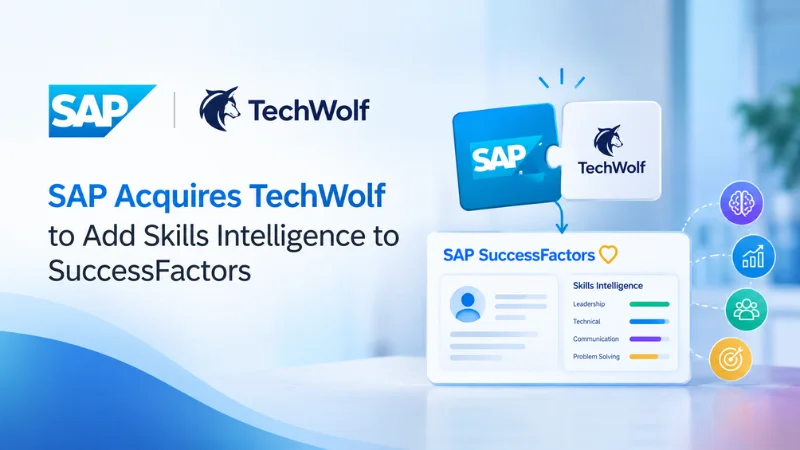
SAP announced on Oct. 6 that it had agreed to acquire Belgian AI work-intelligence company TechWolf for an undisclosed sum. The deal will embed skills and task-mapping technology into SuccessFactors as companies rethink workforce planning for the AI era.
Key takeaways
- SAP plans to make TechWolf’s technology an intelligent core of SuccessFactors.
- The integration will support workforce planning, organizational redesign, hiring, reskilling and internal mobility.
- TechWolf says much of the evidence needed to understand how work is changing sits in operational systems alongside HR data.
- SAP says the technology can give AI agents more context for workforce-related queries while reducing the cost of deploying them.
How does TechWolf’s technology work?
TechWolf’s platform models work at three levels: the tasks performed within jobs, the skills employees have and apply, and information from the external labor market.
The platform draws on existing HR and business-system data to create a continuously updated view of work and workforce capabilities. This gives companies a structured way to connect individual skills and tasks with broader workforce requirements.
SAP plans to integrate the technology into SuccessFactors. The capabilities will support skills mapping, workforce planning, and organizational redesign, with applications including skills-based hiring, reskilling, and internal mobility. Viewed in the broader context of SAP’s AI strategy, the move fits alongside initiatives such as its North Star Architecture, which focuses on AI-driven enterprise workflows.
Why is SAP acquiring TechWolf?
Manoj Swaminathan, president and chief product officer for SAP’s Autonomous Suite and a member of the Extended Board of SAP SE, said TechWolf’s proprietary context graph provides an “excellent grounding layer” for AI-agent queries involving work, skills planning and talent management.
Swaminathan also said the technology can reduce token usage and lower the cost of deploying workforce agents. SAP expects those capabilities to support AI-driven HR scenarios such as skills-based hiring, workforce planning, and role redesign.
TechWolf CEO and co-founder Andreas De Neve said the company chose SAP because AI transformation is also a transformation of work. In a letter explaining the deal, De Neve said much of the evidence about how work gets done sits in operational systems that complement HR data, while many large companies run those systems on SAP.
That distinction matters because workforce planning increasingly depends on more than employee records. Companies also need to understand what work is actually being performed, which skills are being used and how those requirements are changing as AI alters workflows.
TechWolf said its AI models generated between $1 million and $15 million in annual recurring revenue in the US over the last 18 months. That revenue range was disclosed by TechWolf and has not been independently verified. The company said demand had grown faster than its ability to scale independently, making access to a larger enterprise platform part of its rationale for the deal.
The timing reflects a wider workforce challenge. The World Economic Forum reported that employers expect 39% of workers’ core skills to change by 2030.
What happens next for TechWolf and SAP?
Reuters reported that SAP’s acquisition gives it a way to analyze workforce information that traditional HR systems may not fully capture, including the skills employees use and the tasks they perform.
SAP said joint customers using the technology are already seeing measurable results from the partnership. Reuters reported that the companies did not name those customers or disclose figures from the deployments.
The transaction is expected to close in the fourth quarter of 2026, subject to regulatory approval and other customary closing conditions.
After closing, TechWolf is expected to remain an independent company under De Neve. Its headquarters will remain in Ghent, Belgium, with offices in London, New York, and San Francisco. Its platform is also expected to remain available to both SAP and non-SAP customers.
What does the SAP-TechWolf acquisition mean for enterprise AI?
The significance extends beyond SuccessFactors. TechWolf CEO and co-founder Andreas De Neve said many customers already use the company’s technology with AI agents such as ChatGPT, Claude, and Copilot.
SAP’s move highlights a broader challenge facing enterprise AI. Companies already have large volumes of data across HR, CRM, finance, and operations. The harder problem is turning those signals into usable context.
TechWolf applies this principle to workforce intelligence by connecting skills, tasks, and work. The same approach is emerging in go-to-market intelligence, where account-level signals become more useful when AI can connect them with business context, buying activity, and organizational changes.
For enterprise leaders, the implication is that AI will increasingly depend on intelligence layers that explain not just what is happening, but why it matters and what could happen next.

