SAP Launches ‘North Star’ Blueprint to Automate Enterprise Workflows
SAP's North Star Architecture introduces AI-driven autonomous operations across finance, HR, and supply chains.

Jersey City, N.J., June 8, 2026
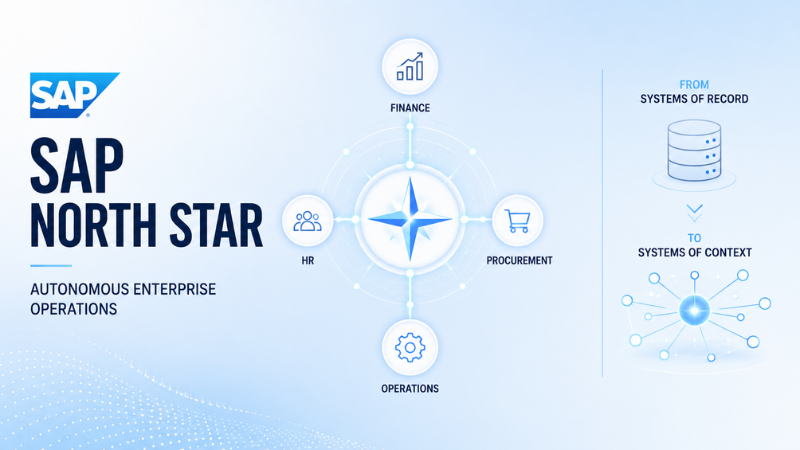
SAP announced its “North Star Architecture” framework on 8th June 2026, marking the enterprise software giant’s strategic shift toward fully autonomous backend operations for global corporations. It is a technical framework designed to move global corporations toward autonomous backend operations. The blueprint establishes a self-correcting reasoning layer that integrates historically isolated departments, including finance, procurement, and human resources, into a unified data network.
The rollout marks a strategic shift from basic generative AI tools toward “agentic operations,” where software agents manage complex tasks with minimal human intervention. According to SAP’s technical documentation, the architecture enables systems to identify and resolve operational friction, such as supply chain bottlenecks or inventory imbalances, automatically within predefined corporate guardrails. This structure relies on a “System of Context” layer that uses a knowledge graph to ground AI actions in real-world business data.
The impact of these automated workflows is already visible in early adoption phases. SAP’s operational reviews cite life sciences firm Takeda, which reported a 10% productivity gain and a 25% reduction in revenue loss from stock-outs after implementing early versions of the autonomous framework. To manage the risks of automated decision-making, the architecture mandates that every AI agent operate with a unique digital identity and a full audit trail.
The shift carries distinct implications for various stakeholders:
- Executives & IT Leaders: Leadership must transition from managing manual reports to overseeing “managed agent runtimes,” prioritizing data governance and the definition of agent permissions over traditional software maintenance.
- Operations Managers: Procurement and logistics roles are expected to pivot from manual data entry to exception handling, intervening only when autonomous agents encounter issues that breach corporate policy.
- Integration Partners: Third-party developers will need to restructure their tools to act as “capability providers” that can be discovered and utilized by SAP’s autonomous agents.
Why This Matters
The move toward an AI-native architecture signals the end of the experimental phase for enterprise AI. For B2B organizations, this represents a transition from “systems of record,” which simply store data, to “systems of context” that actively execute business strategy. As enterprise software becomes autonomous, the competitive advantage shifts to companies that can maintain clean, integrated data layers capable of powering these self-correcting networks.