
How AI-Powered Account-Based Marketing Software Improves Pipeline Quality in 2026
Learn how AI-powered account-based marketing software improves pipeline quality in 2026 with better targeting, intent data, & sales alignment


AI-powered account-based marketing software improves pipeline quality by helping revenue teams identify high-intent accounts, engage the right buying committee members, and prioritize opportunities that are more likely to close.
When combined with managed ABM services, it enables organizations to turn AI-driven account intelligence into consistent execution across marketing and sales, resulting in a healthier and more predictable pipeline.
Ask any B2B SaaS revenue leader about their phantom deal of the year, and the details change, but the ending rarely does.
An enterprise prospect downloads your flagship ebook. They register for a webinar. They request a live product demo. Marketing celebrates the skyrocketing interest score, sales assigns a senior account executive, and the deal gets a highlighted row in the weekly forecast.
Then comes the ghosting.
Procurement suddenly enters the thread with a 40-page security questionnaire. IT flags a compliance bottleneck. Meanwhile, a key decision-maker is testing a competitor, and your internal champion goes quiet.
That deal didn’t crash at the finish line. It was dead on arrival, and your Customer Relationship Management (CRM) simply hid the reality.
Most mid-market B2B SaaS marketing leaders aren’t starving for leads. They are drowning in static, with sales reps chasing accounts that look active on a dashboard while genuine buying intent gets missed.
That is why AI-powered account-based marketing software, often supported by managed ABM services, matters right now. The real job of AI in 2026 is answering one simple question before sales wastes another quarter: Who is actually in an active buying cycle, and who is just browsing?
Good account-based marketing software isn’t about generating more activity. It’s about identifying which activity actually deserves attention, so sales can focus on accounts showing real commercial intent instead of chasing dead ends, while giving leadership a forecast that relies less on wishful thinking.
Your CRM Tells Only Half the Story (And Why “Lead Volume” Broke Revenue)
For years, getting leads was treated as a brute-force volume game: get more site hits, gate more guides, hand off more contacts to sales, and pump up open pipeline numbers for the board.
That playbook worked when buyers relied on sales reps to walk them through software options.
That world no longer exists.
According to research from 6sense, modern B2B SaaS buyers do 60% or more of their homework before ever filling out a contact form. Brixon Group’s B2B buyer journey research reveals that B2B buyers spend only about 17% of their total buying time meeting with potential suppliers. The rest is spent on independent research: checking peer networks, asking contacts in private Slack groups, reading technical setup guides, and narrowing down shortlists in the dark.
A CRM can tell you who downloaded your guide. It cannot tell you whether finance has already decided the budget is going somewhere else.
Because of this shift, marketing’s primary job is no longer capturing general attention. It is recognizing when a prospect moves from general curiosity to commercial intent.
A single contact reading three blog posts is just curious. But when three different department managers from the same company spend time on your pricing page, evaluate your setup documentation, and review your integrations, that is active buying intent.
If your team treats those two scenarios the same way, your pipeline will look great on paper right up until the end of the quarter, when half those deals quietly convert to “no decision.”
What Actually Decides If an Opportunity Is Real
Pipeline quality isn’t an abstract marketing catchphrase. It is a practical test: are your reps talking to people who can and will buy software this quarter?
Unlike pipeline volume, which measures the total value of opportunities in your CRM, pipeline quality measures how likely those opportunities are to progress and close. Revenue teams typically evaluate pipeline quality using metrics such as win rate, opportunity progression, buying-group coverage, sales-cycle speed, and no-decision rate. A healthy pipeline consistently moves qualified opportunities toward revenue instead of filling forecasts with deals that eventually stall.
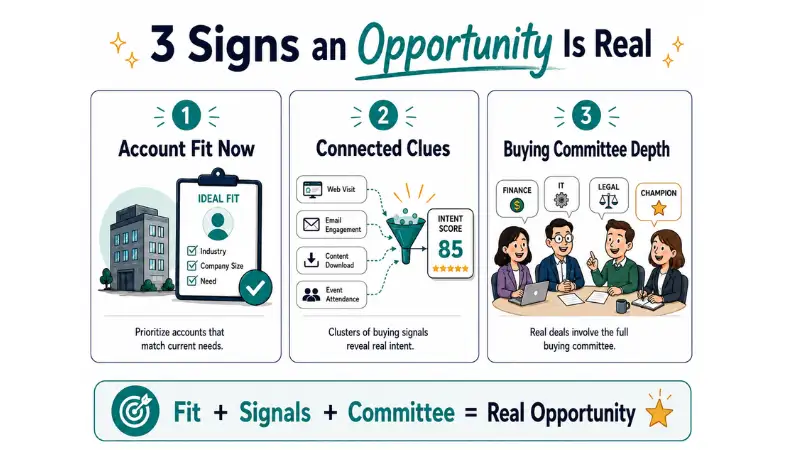
If you want to know if a deal in your pipeline is genuine, look for three things:
1. Account Fit Right Now (Not Six Months Ago)
A prospect can spend all day on your site and still be a terrible customer.
Looking strictly at past deals has one flaw: it is history. Companies don’t buy software because they looked like your ideal customer last year. They buy when today’s operational priorities line up with what you sell.
A high-quality pipeline starts with identifying accounts that match your current best-performing customers across software setup, growth phase, and active needs.
2. Connected Clues Over Isolated Actions
Single actions are noise.
Downloading a guide or attending a webinar doesn’t mean someone has an allocated budget.
Real intent looks like a cluster of synchronized actions:
- Multiple stakeholders from the same domain researching your specific niche.
- Unprompted visits to implementation and pricing pages.
- Active comparisons on peer review platforms like G2 or TrustRadius.
- A hiring spree for roles that would directly manage your software category.
Smart account-based marketing software evaluates these signals together rather than treating a single PDF download like a ready-to-buy lead.
3. Buying Committee Depth
This is where deals go to die.
Single-champion sales motions rarely work in B2B software anymore. Martal Group research shows that the average enterprise B2B buying group includes 10 to 13 internal stakeholders across departments.
Marketing talks to a team lead, sales pitches the VP, and everything feels great until legal, IT security, and finance show up uninvited.
If you haven’t engaged those stakeholders early, the deal stalls.
High-performing account-based marketing programs move beyond lead tracking and focus on key account engagement across the entire buying committee, asking not just who filled out the form, but who else needs to be in the room before sales moves forward.
For a deeper look at engaging every stakeholder involved in enterprise purchasing, read our guide on improving ABM engagement across the buying committee.
Static Target Account Lists Age Like Yesterday’s Weather
Most target account lists age about as gracefully as yesterday’s weather forecast. Markets move, priorities shift, executives leave, and budgets disappear. Static spreadsheets don’t notice.
Markets move anyway.
A lot of teams expect AI to create pipelines out of thin air.
It doesn’t.
It simply stops sales and marketing from making bad choices about where to spend their productive morning.
Look at how traditional list building works. Marketing exports a list, sales adds a few dream accounts, leadership throws in strategic names, and someone layers web traffic stats over the top. Everyone agrees on the spreadsheet, and then nobody touches it for six months while the market moves on.
AI fixes that by keeping target lists dynamic. Instead of relying on static lists built during annual planning, automated tools scan live market signals daily to answer a clear question: Which accounts match our ideal profile and are actively showing preparation to buy today?
How AI ABM Services Fix Pipeline Rot in Practice
Which AI account-based marketing solutions boost engagement with key accounts?
AI-powered account-based marketing solutions improve key account engagement by identifying buying committee members, connecting intent signals across stakeholders, prioritizing high-value accounts, and enabling coordinated outreach across marketing and sales.
VAIS’s new AI Account Intelligence feature adds another layer by helping sales teams interpret account signals through buying stage, business priorities, likely initiatives, and recommended outreach.
Here is how modern AI-powered account-based marketing software combines AI-driven ABM tools, intent signals, and account intelligence to improve pipeline quality without relying on manual guesswork:
| Solution | Why | Benefit |
| Real-Time ICP Fit | Combines historical fit with live account signals. | Prioritizes accounts with current buying intent. |
| Anonymous Research Detection | Identifies early buying behavior before sales inquiries. | Engages prospects ahead of competitors. |
| Buying Committee Mapping | Connects multiple stakeholders into one account view. | Improves account prioritization. |
| Rep Prioritization | Detects when account engagement rises or falls. | Reduces time spent on inactive accounts. |
| AI Personalization | Recommends messaging based on account context. | Improves outreach relevance. |
| Sales & Marketing Alignment | Creates a shared account health view. | Aligns pipeline priorities. |
| Sales Cycle Optimization | Highlights the right accounts at the right time. | Supports faster deal progression. |
Together, these capabilities improve pipeline quality by helping revenue teams prioritize the right accounts instead of simply generating more leads.

Account-Based Marketing Software vs. Managed ABM Services vs. A Hybrid Approach
One of the biggest misconceptions in B2B marketing is that buying software automatically fixes pipeline problems. In reality, organizations typically choose one of three approaches depending on their internal resources and maturity.
Which account-based marketing services work best for B2B SaaS?
For most mid-market B2B SaaS organizations, the right choice depends on internal expertise and growth stage. Teams with mature RevOps capabilities often benefit from AI-powered account-based marketing software, while leaner teams may achieve faster results with managed ABM services. Many growing SaaS companies adopt a hybrid approach that combines technology with expert execution.
| Approach | Best For | Considerations |
| Account-Based Marketing Software | Organizations with an experienced in-house marketing and sales operations team. | Provides AI-driven account intelligence, automation, reporting, and workflow capabilities, but still requires internal ownership and adoption. |
| Managed ABM Services | Teams that need strategic planning, campaign execution, buying committee engagement, and ongoing optimization. | Reduces operational burden but depends on choosing a partner with strong data and execution capabilities. |
| Hybrid Approach | Mid-market and enterprise companies looking to combine technology with expert execution. | AI-powered account-based marketing software provides account intelligence, while managed services help turn those insights into measurable pipeline growth. |
For many organizations, the hybrid model delivers the best balance between technology and execution. Software identifies the right opportunities, while experienced ABM specialists ensure those insights translate into coordinated sales and marketing actions.
What is the best account-based marketing service for scaling outreach?
For many mid-market B2B SaaS organizations, a hybrid approach offers the most effective way to scale outreach. AI-powered account-based marketing software helps identify and prioritize high-intent accounts, while managed ABM services ensure outreach remains personalized, coordinated, and consistent across the buying journey.
See AI-Powered Account Intelligence in Action
Understanding the differences between account-based marketing software, managed ABM services, and a hybrid approach is easier when you see the workflow in action. The following walkthrough demonstrates how VAIS (Valasys AI Score) brings together account intelligence, AI-powered scoring, and campaign execution to help revenue teams prioritize high-intent accounts and improve pipeline quality.
Watch the VAIS Tutorial Demo: A Complete Walkthrough
Why Buying Software Won’t Fix a Broken Revenue Motion
One pattern shows up repeatedly in many mid-market SaaS teams: account-based marketing software gets implemented, enthusiasm fades, and the platform gradually becomes another tool that only a handful of people use. Not every rollout follows this path, but it is common enough among under-resourced teams to warrant caution.
The software usually isn’t broken.
The internal process is.
Companies buy shiny software features and drop them on top of bad habits. Marketing keeps chasing raw lead counts, sales calls whoever pops up first in the inbox, and operations builds another dashboard that gathers dust.
AI cannot fix a broken workflow.
Success comes down to building these insights directly into what reps do every day. If your team is running into this issue, check out this guide on fixing ABM software adoption across B2B teams.
Where AI Scoring Can Sometimes Go Wrong
AI scoring is only as reliable as the underlying data. Incomplete CRM records, duplicate accounts, inaccurate account matching, outdated firmographic information, and weak intent signals can all affect scoring accuracy. That’s why AI should support human decision-making rather than replace it. Organizations that maintain clean CRM data and regularly validate AI recommendations typically achieve more reliable pipeline outcomes.
Enterprise Platforms Are Often a Trap for Mid-Market Teams
It is tempting to think the largest platform is automatically the best option, but for mid-market B2B SaaS marketing teams, that is often a trap. Heavy systems built for Fortune 500 setups can take months to configure and often carry hefty annual contracts requiring dedicated system admins just to maintain the database.
Lean teams need speed and clarity, not endless settings. Before committing to a massive contract, take a look at how heavy systems compare to streamlined mid-market options in this breakdown of enterprise ABM software platforms.
And if you don’t have dedicated internal ABM specialists, working with specialized ABM services for mid-market SaaS teams is usually a faster way to see real revenue results without blowing out your operational costs.
8 Questions to Ask Vendors Before Signing Anything
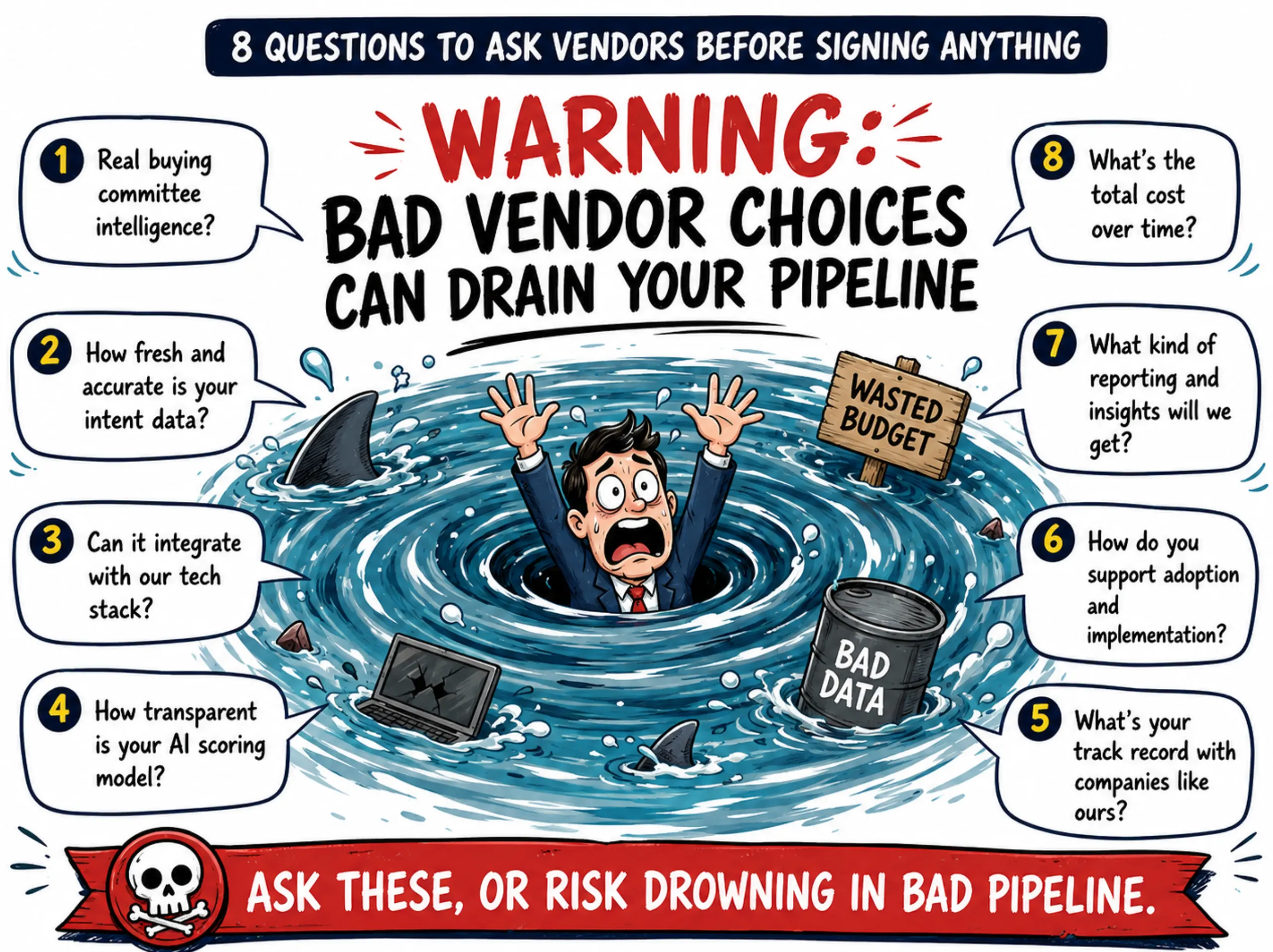
Ignore slick product demos and padded feature lists. Whether you are evaluating account-based marketing software, managed ABM services, or a hybrid solution, the right questions help you look beyond feature checklists and understand how the solution will improve pipeline quality.
Ask vendors these eight questions:
- Buying Committee Intelligence: Can the platform identify decision-makers across finance, IT, procurement, legal, and business units, or does it only track the individual who completed a form?
- Signal Accuracy: Are buying signals updated in near real time, or are they based on behavioral data that may already be outdated?
- Workflow Integration: Does account intelligence integrate directly with your CRM, marketing automation platform, and sales engagement tools, or will teams have to switch between multiple systems?
- Cost to Value: Is the investment appropriate for your team’s size, pipeline goals, and operational maturity?
- Adoption Support: Does the vendor provide onboarding, workflow guidance, and change management, or does support end after implementation?
- Score Transparency: Can the vendor clearly explain how AI-generated account scores are calculated, or are they delivered as a black box?
- Data Quality and Account Matching: How does the platform handle duplicate records, stale CRM data, and incorrect account matching that could affect scoring accuracy?
- Reporting and Measurement: Can both marketing and sales measure improvements in pipeline quality through shared reporting on account progression, buying-group engagement, and revenue outcomes?
If a solution doesn’t make daily decisions easier for your sales and marketing teams, it is simply adding another layer of complexity.
What are the top AI-powered account-based marketing platforms?
Leading AI-powered account-based marketing platforms typically combine intent data, buying committee intelligence, AI-driven account scoring, CRM integration, workflow automation, and reporting. The right platform ultimately depends on your organization’s size, sales process, and operational maturity rather than feature count alone.
Demand Gen Casts the Net. ABM Picks the Deals.
Deploying AI-powered account-based marketing software doesn’t mean abandoning broader demand generation.
Broad marketing builds awareness across your target market. ABM helps identify where that awareness is turning into genuine buying intent.
What is the best account-based marketing platform for demand generation?
The best account-based marketing platform for demand generation is one that integrates AI-driven account intelligence with CRM and marketing automation, helping revenue teams convert demand into qualified pipeline rather than simply generating more leads.
Think of demand generation as casting the net, while AI-powered ABM determines which accounts deserve focused sales investment.
For SaaS companies expanding into new markets, combining AI-powered account intelligence with experienced B2B lead generation agencies and managed ABM services helps sales teams spend more time on qualified opportunities instead of low-intent accounts.
Stop Counting Leads and Start Measuring Pipeline Quality
Real growth in 2026 is not about adding another ten thousand leads to your CRM.
It is about identifying genuine buying intent earlier, engaging the full buying committee, and helping sales focus on opportunities that are most likely to close.
The competitive advantage is no longer simply adopting AI.
It is using AI-powered account-based marketing software, supported by the right strategy and execution, to make faster, better commercial decisions every day.
Ready to Build a Higher-Quality Pipeline?
Whether you’re evaluating account-based marketing software, looking for managed ABM services, or considering a hybrid approach, Valasys Media can help you build a more predictable revenue pipeline.
See VAIS in action, talk to our team, and explore how AI-powered account intelligence can support your ABM strategy.
Frequently Asked Questions (FAQs)
Q1. What is account-based marketing software?
Account-based marketing software helps B2B organizations identify, prioritize, and engage high-value accounts using buying signals, company intelligence, AI, and coordinated sales and marketing activities.
Q2. How does AI-powered account-based marketing software improve pipeline quality?
It analyzes account fit, intent signals, and buying committee activity to help revenue teams prioritize opportunities with a higher probability of converting into revenue.
Q3. What is the difference between pipeline quality and pipeline volume?
Pipeline volume measures the total potential value of opportunities in your CRM. Pipeline quality measures how likely those opportunities are to convert based on account fit, buying intent, opportunity progression, and buying committee engagement.
Q4. Should companies choose account-based marketing software or managed ABM services?
The right choice depends on internal resources. Organizations with experienced ABM teams often benefit from software, while companies needing strategic guidance and execution may benefit from managed ABM services. Many mid-market organizations adopt a hybrid approach that combines both.
Q5. Why is buying committee engagement important in B2B SaaS?
Modern software purchases typically involve multiple stakeholders across departments. Engaging only one champion increases the likelihood of stalled deals when procurement, finance, legal, or IT involved later in the buying process.
Q6. Are mid-market ABM platforms effective for lean SaaS teams?
Yes. When selected carefully and supported by appropriate workflows or managed services, they help lean teams focus on high-intent accounts without the complexity of enterprise-scale platforms.
Q7. What should marketing leaders evaluate before choosing account-based marketing software?
Look for buying committee visibility, transparent AI scoring, high-quality account data, CRM integration, reporting capabilities, ease of adoption, and measurable business outcomes rather than feature count alone.
Q8. Can AI replace sales representatives in account-based marketing?
No. AI improves account prioritization, signal analysis, and workflow efficiency, but relationship building, negotiation, and closing complex B2B deals remain human responsibilities.
Q9. How long does it take to see results from an AI ABM strategy?
Most organizations first notice improvements in account prioritization and sales focus. Broader pipeline and revenue outcomes depend on implementation quality, sales cycle length, team adoption, and execution.
Q10. Is AI-powered account-based marketing software worth the investment?
For organizations with complex B2B buying cycles, it can significantly improve pipeline quality when combined with accurate data, cross-functional alignment, and consistent execution. Rather than simply generating more leads, it helps revenue teams focus on accounts that are genuinely ready to buy.