
Bedrock Data Adds Agent DLP to NVIDIA OpenShell for AI Agent Security
Bedrock Data adds Agent DLP to NVIDIA OpenShell, bringing data-aware runtime controls to autonomous AI agents handling enterprise data.

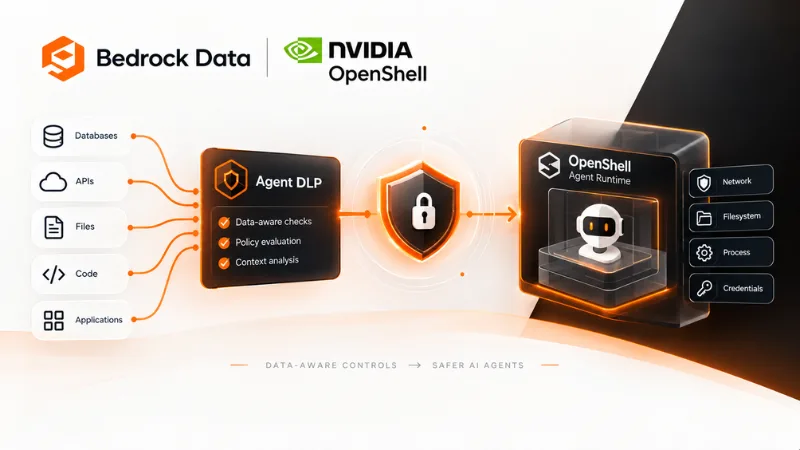
Sept. 28, 2026 – Bedrock Data has integrated its Agent DLP technology with NVIDIA OpenShell, adding data-aware policy checks to a runtime designed to control how autonomous AI agents interact with enterprise systems. Announced Sept. 28, 2026, the integration is available to Bedrock Data customers through OpenShell’s Supervisor Middleware.
Key Facts
- Bedrock Data announced the NVIDIA OpenShell integration on Sept. 28, 2026.
- Agent DLP evaluates enterprise data context before OpenShell enforces an agent action.
- The integration is delivered through OpenShell Supervisor Middleware.
- NVIDIA OpenShell provides sandboxed controls over network, filesystem, process and credential activity.
- Customers can initially use an observe-only mode before enabling enforcement.
- The launch comes alongside NVIDIA’s broader Open Agent Safety Platform initiative.
According to the announcement, Bedrock evaluates the data involved in an agent request while OpenShell provides the runtime enforcement mechanism.
The development comes as enterprises give AI agents greater access to databases, APIs, files, code and business applications. That creates a security issue: an agent may be authorized to perform an action while still handling information that should not be moved to a particular destination.
What Bedrock Data adds to NVIDIA OpenShell
NVIDIA OpenShell is an open-source runtime that places AI agents inside isolated environments and applies security policies across filesystem, process and network activity.
The NVIDIA OpenShell documentation describes a runtime architecture built around sandboxing and policy controls designed to restrict how agents interact with systems outside their execution environment.
Bedrock Data adds information about the data itself to that decision process.
Its Agent DLP technology evaluates an agent request against enterprise data policies and returns a decision that OpenShell can enforce.
For CISOs, the distinction is important. Conventional permissions determine whether an agent is authorized to access a resource. The Bedrock approach attempts to determine whether the specific information involved in that authorized action should be allowed to move.
A permitted database operation, for example, could still be restricted if the underlying data is classified as sensitive and the destination violates enterprise policy.
NVIDIA broadens its AI agent security push
The integration arrives as NVIDIA expands its broader approach to AI-agent security.
The company announced the NVIDIA Open Agent Safety Platform on Sept. 28, positioning OpenShell as part of a wider architecture for monitoring and controlling autonomous agents.
NVIDIA said more than 100 organizations are working with technologies around the platform, including Anthropic, Cisco, CrowdStrike, Microsoft, Palo Alto Networks, Salesforce, SAP, ServiceNow and JPMorganChase.
For NVIDIA, the strategy extends security beyond controls embedded inside individual AI models. OpenShell instead acts as an external runtime boundary where agent activity can be governed while tasks are being executed.
For cybersecurity companies such as Bedrock Data, that creates another integration point for data protection and AI-governance technologies.
What CISOs need to evaluate
Enterprise security leaders are increasingly being asked to govern AI agents capable of taking multi-step actions with limited human intervention.
A Cloud Security Alliance survey on enterprise AI agents reported in April that 82% of surveyed organizations had unknown AI agents operating in their environments, while 65% reported an AI-agent-related incident during the previous 12 months.
The research was commissioned by Token Security, so its sponsorship should be considered when interpreting the findings.
For CISOs evaluating technologies such as Bedrock Data and OpenShell, the questions extend beyond whether a policy can technically block an action.
Security teams will need evidence around latency, policy accuracy, false blocking, auditability and the effectiveness of controls when agents move between multiple tools and systems.
Bedrock Data and NVIDIA have not publicly released independent production benchmarks for the combined integration.
Developers and data-governance teams also have a stake
AI engineering teams could benefit from moving some enforcement outside individual agent frameworks rather than rebuilding equivalent controls for every AI application.
For data-governance teams, the integration introduces another consideration: whether existing classifications and metadata are accurate enough to support runtime decisions.
Bedrock Data says its Metadata Lake tracks information including what enterprise data is, where it resides, who can access it and how it is being used.
That means policy decisions can potentially consider data context instead of relying solely on an agent’s technical permissions.
The effectiveness of that approach, however, depends on the quality and currency of the underlying metadata.
Standards bodies are focusing on the same problem
The industry is also developing broader frameworks for autonomous-agent security.
In February 2026, the U.S. National Institute of Standards and Technology launched its AI Agent Standards Initiative, focusing on secure and interoperable AI agents as autonomous systems gain greater access to external applications and enterprise information.
That provides wider context for the Bedrock-NVIDIA development: runtime governance is emerging as a distinct security layer as enterprises move from AI assistants toward software capable of independently executing business tasks.
Bedrock Data says Agent DLP for NVIDIA OpenShell is available now, including an observe-only mode that allows organizations to record policy decisions before switching on enforcement.
For enterprise buyers, the next test will be how the technology performs in production environments, particularly across multiple AI frameworks, complex data estates and regulated workloads.