Nvidia adds $150 billion to share buyback plan
NVIDIA expands its share buyback plan by $150 billion, highlighting its approach to capital returns and investor value.

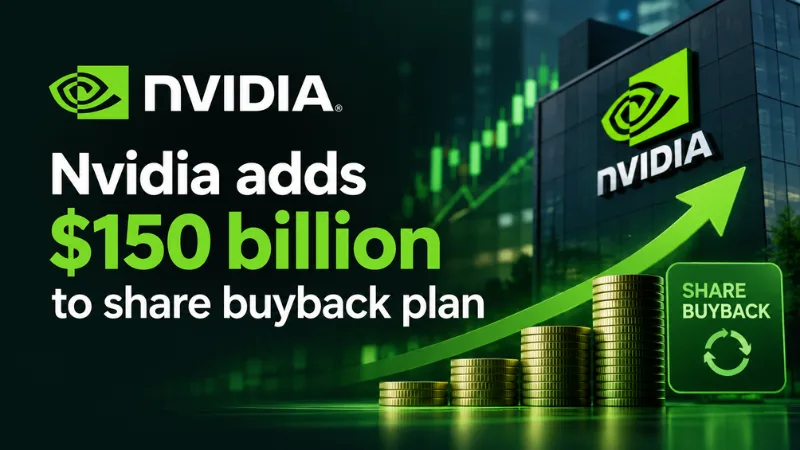
Nvidia has expanded its existing share-repurchase authorization by $150 billion, bringing the total remaining authorization to $235 billion. The company expects to execute the remaining authorization through fiscal 2028.
September 29, 2026
Nvidia’s board authorized an additional $150 billion for its share-repurchase program on September 28, according to the company’s announcement. Nvidia said the increase is the largest increase in share-repurchase authorization in history.
Key Takeaways
- Nvidia added $150 billion to its existing share-repurchase authorization.
- The total remaining authorization now stands at $235 billion, with execution expected through fiscal 2028.
- Nvidia said the increase is the largest increase in share-repurchase authorization in history.
- The new authorization exceeds Apple’s $110 billion authorization from 2024.
- Nvidia reported $96.2 billion in quarterly revenue, with data center revenue reaching $89 billion.
How large is Nvidia’s new buyback authorization?
The $150 billion increase exceeds Apple’s $110 billion share-repurchase authorization announced in 2024, according to Reuters.
Based on LSEG data, Reuters also reported that the authorization is larger than the market capitalization of roughly 84% of companies in the S&P 500.
Nvidia had about $99 billion remaining under its previous authorization at the end of its second fiscal quarter. The company returned approximately $26 billion to shareholders through share repurchases and dividends during the quarter, according to Nvidia’s second-quarter financial results.
What is Nvidia’s financial backdrop?
Nvidia reported $96.2 billion in second-quarter fiscal 2027 revenue, up 106% year over year. Data Center revenue reached $89 billion, up 117%.
The company forecast approximately $108 billion in third-quarter fiscal 2027 revenue, plus or minus 2%. The outlook excluded data center compute revenue from China.
Data center revenue has become the main source of Nvidia’s reported revenue as demand grows for computing infrastructure used in AI workloads.
What does the buyback say about Nvidia’s capital allocation?
Nvidia’s July 2026 10-Q showed $56.6 billion in cash, cash equivalents, and marketable debt securities, along with $42.8 billion in marketable equity securities, according to the company’s filing.
The company is also continuing to invest in research and development, infrastructure, acquisitions, and strategic partnerships as it expands its AI ecosystem, according to Nvidia’s filings and financial disclosures.
Jensen Huang, founder and CEO of NVIDIA, said, “NVIDIA’s growth is being driven by a once-in-a-generation platform shift to AI and accelerated computing.”
The combination of shareholder returns and continued investment shows how Nvidia is allocating capital across its existing business and the broader AI infrastructure opportunity, while the company’s view of long-term AI demand remains management’s stated outlook.
The decision also comes as competition in AI accelerators continues to intensify, with Nvidia facing alternatives from companies including AMD and increasingly from custom chips developed by major cloud providers. The buyback therefore sits alongside continued investment intended to maintain Nvidia’s position in a rapidly evolving AI-computing market.
How did the market respond?
Nvidia shares rose about 1.7% on September 28 following the announcement, while the S&P 500 declined 0.8% and the Nasdaq fell 0.9%, according to Reuters’ market coverage.
Reuters also reported that Nvidia was trading at about 16.5 times 12-month forward earnings, based on LSEG data. That was the company’s lowest forward earnings multiple since January 2015.
The trading response reflects market activity on the day of the announcement and does not establish how investors will assess Nvidia’s longer-term capital allocation.
Why does Nvidia’s buyback matter?
The announcement puts shareholder returns alongside continued investment in the computing infrastructure supporting AI workloads.
For organizations planning AI investments, Nvidia’s financial performance remains relevant because its products and systems form part of the infrastructure used to train and run AI models. The size of the new authorization also provides a clearer view of how Nvidia is balancing capital returns with continued investment in its business.