Start Your RevOps Transformation
Get a clear 90-day roadmap to align teams, optimize processes, and build a scalable revenue engine.
 Lead-Gen now on Auto-Pilot with
Build My Campaign
Lead-Gen now on Auto-Pilot with
Build My Campaign

Build a high-impact RevOps strategy with this 90-day playbook to align teams, streamline processes, and drive predictable revenue growth.

Start Your RevOps Transformation
Get a clear 90-day roadmap to align teams, optimize processes, and build a scalable revenue engine.
Most companies don’t have a revenue problem. They have a coordination problem.
Sales closes a deal nobody told product about. Marketing runs a campaign finance didn’t budget for. Customer success is fighting churn from customers the sales team oversold. Everyone’s working hard. Nobody’s working together. And at the end of the quarter, the CEO is staring at a gap between forecast and reality, wondering what went wrong.
That’s the problem Revenue Operations (RevOps) was built to solve. And if you’re ready to implement it, 90 days is genuinely enough time to change how your company generates and keeps revenue, if you do it right.
This isn’t a theoretical framework, it’s a complete guide to B2B revenue operations compressed into three actionable modules. Almost like a mini course. Foundation, Alignment, and Acceleration. Each one builds on the last. By the end, you’ll have a functioning RevOps system.
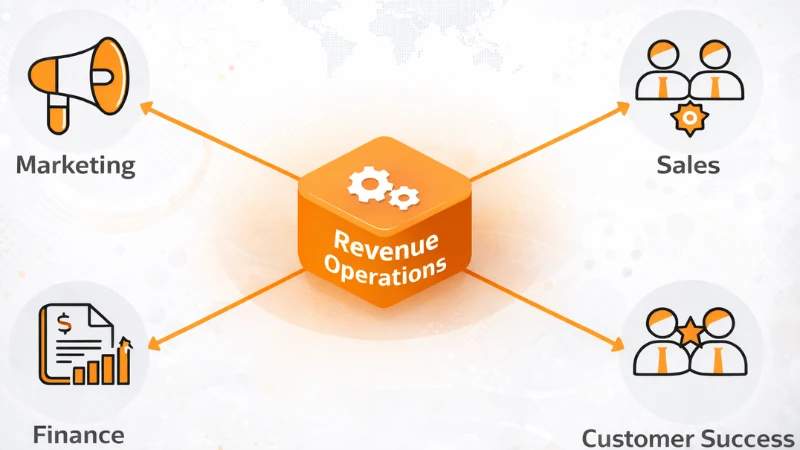
Revenue Operations is the strategic alignment of your sales, marketing, and customer success teams under a unified operational framework. Shared data. Aligned processes. Common goals. One version of the truth.
The traditional structure, where each department has its own ops function, its own tech stack, and its own metrics, creates what practitioners call the “revenue leak.” Deals stall in handoffs. Data lives in silos. Nobody has a complete view of the customer journey. Studies consistently show companies with aligned revenue teams grow 19% faster and are 15% more profitable than those without alignment.
The reason most RevOps implementations fail isn’t strategy. It’s a sequence. Companies try to fix everything at once, or they focus on tools instead of processes, or they get the org structure right but ignore data quality. The 90-day framework below is sequenced deliberately to avoid all of that.
Start Your RevOps Transformation
Get a clear 90-day roadmap to align teams, optimize processes, and build a scalable revenue engine.
The goal here is simple: know what you have before you change anything.
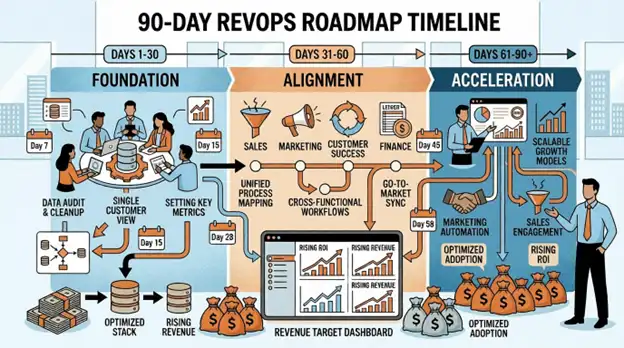
Start with a revenue audit. Pull your last 12 months of deal data and map every stage of the customer journey from first touch to closed-won to renewal. You’re looking for three things: where deals get stuck, where data goes missing, and where handoffs happen without a defined process.
Ask each team lead to answer one question in writing: “What does the other team do that makes your job harder?” The answers will be uncomfortable. That’s the point.
Document your current tech stack. Most companies are surprised to find they’re paying for 3-4 tools that overlap in functionality. List every tool, what it’s supposed to do, who actually uses it, and what it costs. This becomes your rationalization roadmap.
Before you hire or restructure, define the function’s mandate. Your RevOps charter should answer:
This sounds bureaucratic. It isn’t. Without these answers in writing, you’re not building RevOps. You’re just renaming your sales ops team and hoping for the best. This is where you decide your RevOps strategy and document the mandate for the entire organization.
Module 1 Deliverables:
The goal: make it structurally impossible for teams to work against each other.
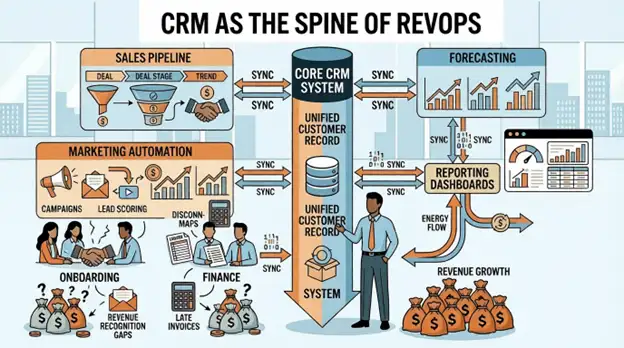
Your CRM is the spine of RevOps. If it’s messy, everything built on top of it will be messy too. Spend two weeks cleaning your data with ruthless focus on the records that matter most: active pipeline, current customers, and recent churned accounts.
Establish data governance rules. This means field definitions (what is “close date” and who can change it), data entry standards (required fields at each pipeline stage), and a process for handling duplicates. Boring stuff. Mission-critical stuff.
Set up your revenue intelligence layer. This is the reporting infrastructure that gives leadership a single view of pipeline health, forecast accuracy, and customer retention risk. Whether you use Salesforce, HubSpot, or something else, your dashboard should answer three questions at a glance: Where will we end the quarter? Where are the biggest risks? What do we need to do about it?
Now design your core revenue processes. There are four you can’t skip:
Lead Management: How does a lead move from created to contacted to qualified to handed to sales? Define every step, who owns it, what triggers the handoff, and what SLA the receiving team has to respond. Write it down. Put it in your CRM as workflow rules, not a Google Doc.
Opportunity Management: What does a “stage” actually mean? Many sales teams have stages that are defined by what the salesperson did (sent proposal) rather than what the buyer did (committed to evaluation). Buyer-centric stage definitions give you more accurate forecasts. Every stage should have an entry criterion and an expected next action.
Customer Onboarding: The handoff from sales to customer success is where new customers decide whether they made a good choice. Design a structured onboarding workflow with clear milestones, stakeholder mapping, and a 30/60/90-day success plan. Sales should be involved in the first call, not just the signature.
Renewal and Expansion: Most companies treat renewal as a customer success problem. RevOps treats it as a revenue opportunity. Build a playbook for renewal conversations that starts 90 days before contract end, includes an expansion conversation at 120 days if health scores are strong, and has a defined save process if health scores are declining.
This is the phase where Sales and Marketing Alignment moves from a concept to a set of hard-coded workflow rules.
Module 2 Deliverables:
The goal: move from functional to excellent.

With clean data and defined processes, you can now make smart decisions about technology. Using your audit from Month 1, eliminate redundant tools and identify gaps. Focus on building a lean B2B revenue tech stack that automates the repetitive and empowers the strategic. The most common gap at this stage is revenue intelligence or conversation intelligence: tools that analyze sales calls, flag deal risks, and surface coaching opportunities.
Evaluate every tool against one criterion: does it improve a defined process or eliminate manual work? If it doesn’t do either, you probably don’t need it.
Automate the repetitive. Lead routing, deal stage updates, renewal notifications, QBR prep data pulls. Automation should free your ops team to solve strategic problems, not data entry problems.
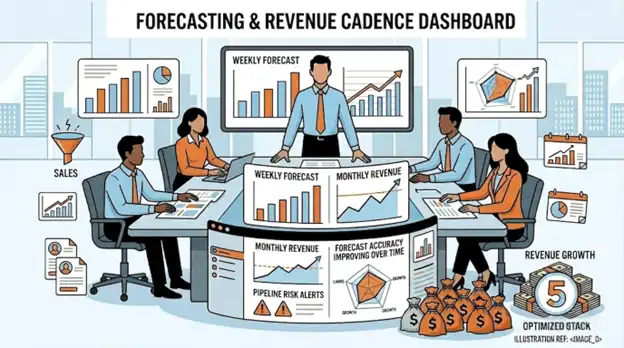
By week 11, you have clean data, defined processes, and optimized tools. Now you build the operating rhythm that keeps it all running.
Implement a forecasting methodology. There are three approaches most RevOps teams use: pipeline-based (multiply pipeline by historical conversion rates), activity-based (forecast based on rep behavior patterns), and AI-assisted (use your CRM’s predictive tools). For most companies at this stage, a hybrid of pipeline-based with AI-assisted validation gives the best accuracy.
Establish your revenue cadences:
You need RevOps Dashboards that allow you to review pipeline health weekly and full revenue performance monthly.
The final step is defining how you’ll measure RevOps success. The metrics that matter most:
Module 3 Deliverables:
Success in Month 3 often requires a dedicated owner. If your team is struggling with the technical load, it may be time to hire your first RevOps leader to maintain this momentum.
A few things to expect that the polished frameworks leave out.
The hardest part is political, not operational. Sales leaders often feel RevOps is a check on their autonomy. Marketing leaders worry it means losing ownership of pipeline metrics. This is why understanding the nuanced roles of Sales Ops vs. Marketing Ops vs. RevOps is crucial for setting expectations.
Get executive sponsorship before you start and keep it visible throughout. This only works if leadership treats it as a strategic initiative, not an IT project.
Frame every initiative in terms of revenue impact. “Cleaning the CRM” isn’t a chore; it’s a way to increase your forecast accuracy by 20%.
Data quality takes longer than you think. Plan for 6 weeks of CRM cleanup, not 2. Bad data is like bad infrastructure. You can build on it for a while, but eventually everything above it becomes unreliable.
Start with the highest-value problem. If you have a retention problem, start with customer success alignment. If you have a pipeline problem, start with lead management. The 90-day framework is a sequence, not a rigid script.
RevOps is not a cost center. Frame every initiative in terms of revenue impact. “We fixed our lead routing” becomes “we reduced lead response time by 40%, which our data shows increases conversion by 22%, adding an estimated $X to quarterly pipeline.” Learn to tell that story.
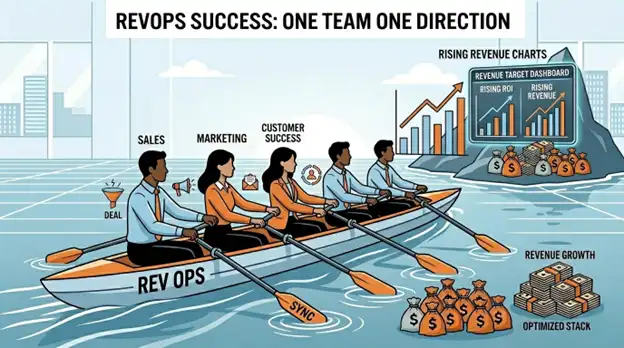
The companies winning right now aren’t necessarily the ones with the biggest teams. They’re the ones where sales, marketing, and customer success are pulling in exactly the same direction. Ready to start your 90-day clock? Kick off the process by defining your Revenue Operations foundation today.
Sales Ops focuses specifically on supporting the sales team: CRM management, quota setting, territory planning, and sales analytics. RevOps is broader. It aligns sales, marketing, and customer success under a single operational framework with shared data, processes, and goals. Think of Sales Ops as a department function and RevOps as a company-wide strategy.
A functional RevOps foundation takes 60 to 90 days to build. You’ll see initial results, like improved forecast accuracy and faster lead response times, within the first 90 days. Full maturity, where all three functions are aligned, automation is robust, and RevOps is driving strategic decisions, typically takes 12 to 18 months.
It depends on company size. Under 50 employees, one strong RevOps generalist can handle the function. Between 50 and 200, you likely need a small team of 2 to 3 specialists. Above 200, you need dedicated roles across data analytics, systems administration, and process design. Starting with one excellent hire is almost always better than building a team prematurely.
Net Revenue Retention (NRR) is the single most important RevOps metric because it measures the combined effectiveness of acquisition, retention, and expansion. An NRR above 100% means your existing customer base is growing without any new logos. Above 120% is considered best-in-class. Pipeline coverage ratio and forecast accuracy are close seconds.
Salesforce is the most powerful and most complex. HubSpot is easier to implement and better for companies under 200 employees or those without a dedicated admin. The best CRM is the one your team will actually use consistently. Data quality matters infinitely more than platform sophistication.
RevOps improves forecast accuracy in three ways: by standardizing pipeline stage definitions so opportunities are correctly categorized, by establishing data governance so CRM data is reliable, and by implementing structured review cadences so managers catch at-risk deals early. Most companies see a 15 to 25% improvement in forecast accuracy within the first two quarters of a properly implemented RevOps function.
Start Your RevOps Transformation
Get a clear 90-day roadmap to align teams, optimize processes, and build a scalable revenue engine.