Sokin launches MCP connector to prepare payments through AI
Sokin launches an MCP connector that lets businesses use AI tools to access financial data and prepare cross-border payments with human approval.

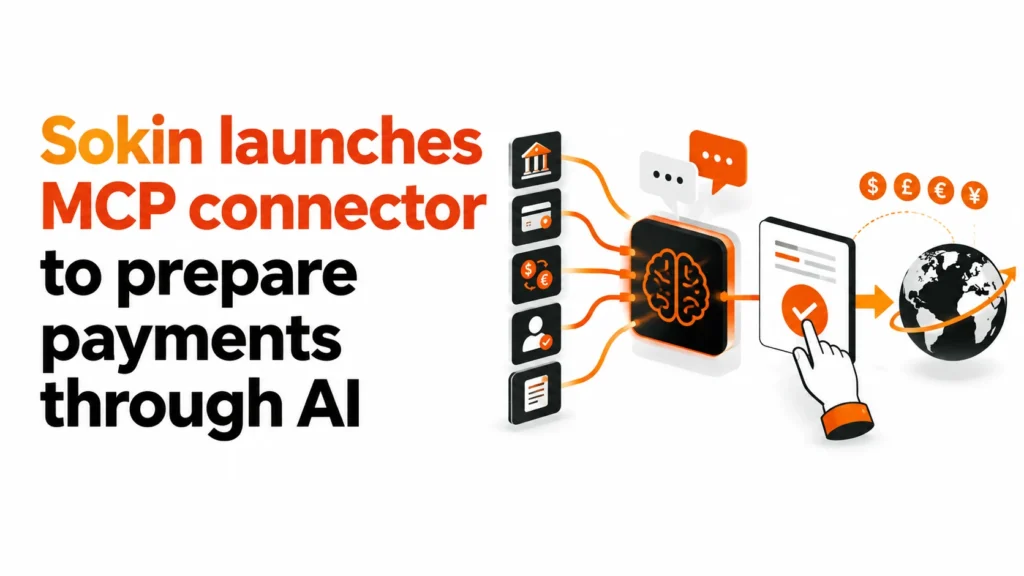
The connector links Sokin accounts with AI tools including Claude and ChatGPT, while requiring human approval before money moves.
September 14, 2026 – Sokin has launched a Model Context Protocol connector that lets businesses use AI assistants such as Claude and ChatGPT to access live Sokin account data and prepare cross-border payments through natural-language instructions, while keeping final authorization with a human.
The launch moves the UK-headquartered payments company beyond read-only AI financial queries and into transaction preparation, positioning conversational AI as another interface for treasury teams managing payments, foreign exchange and account information.
Key Facts
- Sokin’s new MCP connector connects its payments infrastructure with AI assistants including ChatGPT and Claude.
- Users can check balances, transactions and FX quotes, validate beneficiaries and prepare payments through conversational AI.
- AI cannot independently approve or submit payments; human authorization remains mandatory.
- Sokin says a one-time passcode is required before a prepared payment is submitted.
- The connector uses Model Context Protocol, the open standard introduced by Anthropic for connecting AI systems with external tools and data.
- Sokin positions the launch as part of a broader move toward AI-assisted and agentic treasury operations.
According to Sokin’s MCP product documentation, the connector can retrieve balances and transaction activity, obtain live foreign-exchange quotes, look up and validate beneficiaries, check payment status, retrieve funding details, add beneficiaries and prepare individual payments for approval.
Customers create what Sokin calls an “AI Access Point” and connect its secure endpoint to a compatible AI application. Businesses can control the permissions available through the connection and revoke access when required.
The AI, however, does not have unrestricted authority to move money.
Sokin says users must review and approve prepared payment instructions before they are submitted. Existing account approval controls remain applicable, and a one-time passcode is required before payment submission, according to the company’s MCP security and payments information.
That separation between preparation and authorization is particularly important as financial companies experiment with AI agents in finance workflows rather than only answering questions.
Sokin Chief Product Officer Peter Daunton has argued that payments require tighter controls than many conventional generative-AI tasks. In an interview with The Payments Shed, Daunton said payment systems need to be “a bit more deterministic” because mistakes involving financial instructions carry different consequences from errors in generated summaries or other content.
The connector is built around Model Context Protocol, or MCP, an open standard introduced by Anthropic in 2024 to create standardized connections between AI applications, data sources and external tools.
OpenAI also supports MCP-based integrations in ChatGPT. Its documentation for apps and MCP connectors shows that access to actions that modify external systems can depend on the ChatGPT product and workspace configuration.
Sokin markets its MCP connector as compatible with Claude, ChatGPT and other MCP-capable AI applications.
For finance teams, the practical appeal is reducing the number of manual steps required to investigate an account and prepare a transaction.
A treasury user could ask an AI assistant to inspect balances, retrieve an exchange-rate quote, verify a beneficiary and prepare a payment without moving repeatedly between dashboards and workflows. The final payment decision would still sit with an authorized person.
Sokin says its wider infrastructure supports settlement across more than 70 currencies and over 170 countries, with 18 direct banking partnerships and licenses across 36 countries. Those figures were published by founder and CEO Vroon Modgill in Sokin’s discussion of its agentic treasury strategy.
The model also introduces another security consideration: financial information may pass through or become accessible to the AI service connected to Sokin.
MCP security and agent governance are increasingly becoming part of the enterprise AI risk discussion as agents gain access to external systems.
Sokin therefore advises customers to examine the data-handling, retention and security policies of their chosen AI provider. Anthropic likewise warns in its guidance for remote MCP integrations that third-party MCP servers can introduce security risks when sensitive information is involved.
Other financial institutions are taking more restrictive approaches.
First Internet Bank announced an MCP integration in July 2026 that allows customers to connect financial information with ChatGPT and Claude for analysis of balances, transactions, spending and cash flow. Its implementation is read-only and does not allow the AI assistant to move money.
Sokin’s approach goes further by allowing an AI application to help construct a payment while stopping short of giving the agent final authority.
The connector forms part of Sokin’s wider push toward what it calls agentic treasury. In the company’s strategy statement, Modgill said Sokin expects AI agents to operate over regulated payment, FX and treasury infrastructure while people retain control over approvals.
Sokin also reported $45 million in audited net revenue for 2025 and said its business reached a $90 million annualized revenue run-rate during the first half of 2026, with a target of more than $120 million by December.
The bigger question for finance teams will be how much operational authority they are willing to give AI assistants.
Sokin’s current answer draws the line at authorization: an AI agent can retrieve information, validate details and prepare the transaction, but a human still decides whether the money moves.