Create Content AI Actually Finds
Build content that aligns with AI search patterns, earns citations, and increases your brand’s visibility across modern search.
 Lead-Gen now on Auto-Pilot with
Build My Campaign
Lead-Gen now on Auto-Pilot with
Build My Campaign

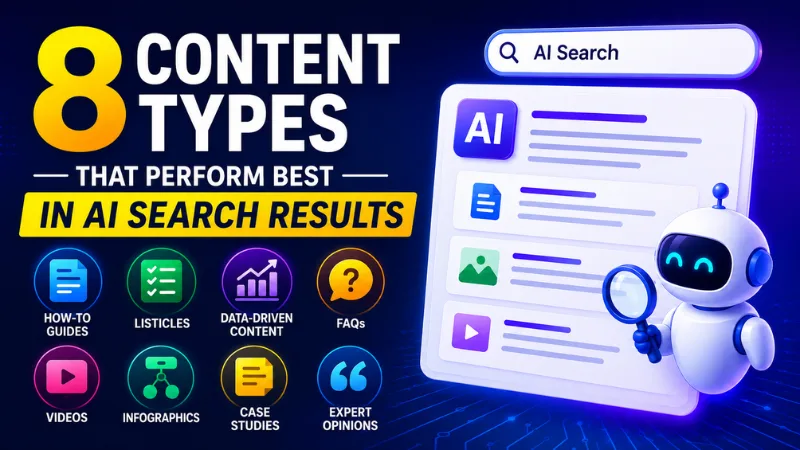
Discover 8 content types that perform best in AI search results and learn how to optimize your content for better visibility and citations.

Create Content AI Actually Finds
Build content that aligns with AI search patterns, earns citations, and increases your brand’s visibility across modern search.
Here is the part that stings: coMost content teams are optimizing for a search engine that is quietly being replaced. Not gone. Replaced.
Google is still there. But the thing answering questions at the top of the page is no longer a list of ten blue links. It is a synthesized response, built from sources the AI deemed trustworthy enough to excerpt. And the bar for “trustworthy enough” looks nothing like the bar for ranking in 2019.
ntent that took months to produce, that earned backlinks and ranked well for years, may not even appear in AI-generated responses. Not because it is bad. Because it was not built for this. It was built for humans to click through to. AI does not click through. It typically reads, extracts, and synthesizes without requiring click-throughs.
So the question is not “how do I rank?” It is “what kind of content does AI actually cite?” Turns out, the answer is pretty specific.
Before, format was a UX decision. Headers made content skimmable. Bullet points helpeimpatient readers. Tables were optional.
Formatting hasn’t changed, but its purpose has. We used to format so people would read; now we format so machines can think. In a search landscape dominated by AI Overviews, structured synthesis isn’t just a UX choice; it’s survival.
According to Search Engine Journal research, AI Overviews have seen a massive surge in 2026, now appearing in nearly 50% of all search queries. In high-intent sectors like B2B Tech and Education, that number climbs as high as 82%, making AI visibility the new baseline for informational content. The content competing for informational intent is no longer fighting for position three on a results page. It is fighting to be the one paragraph an AI decides to quote.
Create Content AI Actually Finds
Build content that aligns with AI search patterns, earns citations, and increases your brand’s visibility across modern search.
AI systems assess three things above everything else: can this content be trusted, can it be understood cleanly, and can it be excerpted without distortion? Fail any one of those, and it gets skipped. Not penalized. Just skipped.
The AI, GEO, and AEO strategic framework from Valasys is the right place to map out the full picture. But the eight content types below are where the strategy gets tactical.
AI models have no patience for preamble. Neither do users, honestly, but AI makes it structural.
The format that performs best in AI search is the one that answers the question in the first two sentences and then explains itself. Not the other way around. Not three paragraphs of scene-setting before the actual answer arrives.
Large Language Models (LLMs) are trained to find the best match for a query. If your answer is buried under six hundred words of “in today’s digital landscape,” the model has already moved on.
What this looks like in practice:
| Element | What to Do |
| Question as H2 or H3 | Match how people actually phrase the search |
| Answer in the first two sentences | No hedging, no windup |
| Context and depth below | Reward readers who want more |
| FAQ or HowTo schema | Tell the parser what it is looking at |
HubSpot proved this at scale. After Google’s AI integration started eating into organic traffic, they restructured their content strategy to lead with definitions and direct answers. The result was sustained ownership of featured real estate even as the traffic model around them changed. They did not create new content. They restructured what they had to lead with the answer.
The takeaway is almost uncomfortably simple: earn your reader’s attention after you have answered their question, not before.
Direct-answer content is what AI reads. Schema markup is how it understands what it is reading.
Without structured data, even excellent content gets misread. A step-by-step guide looks like a wall of text. An FAQ looks like a list. A product comparison looks like editorial opinion. Schema markup provides the label that tells the AI parser: this is a FAQ. This is a HowTo. This is an Article with a named author and a publication date.
According to Semrush research, pages with comprehensive structured data show improved visibility in AI-generated summaries, though the exact impact varies by content type and query intent. This is not a marginal advantage; it is the baseline for being cited in a landscape where machine readability is the new authority.
The schema types with the most impact right now:
Start with FAQ schema on your highest-traffic informational content. It is low lift, high return, and one of the cleaner signals you can send to any AI system parsing your pages.
AI models are wired to prefer primary sources. If the data lives on your page and nowhere else, the AI has to cite you. There is no alternative.
This is why Gartner statistics appear in everything. It is not just brand authority. It is that Gartner data has no upstream source to defer to. The citation trail ends there, which makes it irreplaceable.
The good news is that “original research” does not require a Forrester-sized budget. A survey of two hundred customers. An internal dataset from your product. An index you built by compiling and analyzing publicly available figures in a way no one else has bothered to do. All of it counts, as long as the methodology is clear and the presentation is rigorous.
Drift, now part of Salesloft, built a serious chunk of their category authority through their annual State of Conversational Marketing report. Every year, the report generated thousands of citations across the web. In AI search, those original data points continue to surface in LLM responses years after publication, because the data still has no better upstream source. The asset keeps working long after the campaign that launched it is forgotten.
Give AI something to cite that it cannot find anywhere else. That is the whole strategy.
“Which is better, X or Y?” is one of the most searched question structures across every industry. People are trying to make a decision, and they want someone to help them get there.
AI handles this by finding content that actually structures a comparison rather than dancing around it. A well-built comparison table, clearly labeled pros and cons, a verdict paragraph with a real recommendation, these are things an AI can extract and surface without inferring anything.
Good comparison content does not just list differences; it explains what those differences mean for the reader’s specific situation. That distinction matters even more when different LLMs are processing your content and selecting which version of a comparison to surface.
For comparison content to actually perform, it needs three things:
The trap most teams fall into is writing comparison content so balanced it becomes useless. If you never say which option is better and under what circumstances, AI cannot extract a useful answer. It skips to content that commits to one.
Here is something the SEO world undervalued for a long time: named, credentialed sources carry real weight with AI citation systems.
It makes sense when you think about how LLMs were trained. They absorbed enormous amounts of journalism, academic writing, and published commentary, formats where attribution is the difference between a claim and evidence. That training shows up in citation behavior. Content with quotes from named experts, with their title and organizational context, reads as more authoritative than the same content without attribution.
Research regarding AI citation patterns found that content with attributed expert quotes was significantly more likely to surface in AI summaries compared to content making equivalent claims without attribution. The information can be identical. The attribution changes how the system weights it.
In practice:

This connects to entity-first SEO, where AI systems organize knowledge around recognizable entities, people, companies, and concepts; rather than keyword clusters. If your authors are known entities in their field, that recognition extends to the content they produce.
When someone asks AI a complex question, the AI needs a source deep enough to support a thorough response. A 600-word post covering the basics is not going to be that citation.
What makes long-form guides powerful in AI search is versatility. A well-structured 3,000-word guide can surface across dozens of related query variations. The same piece gets cited for the definition, the how-to, the common mistakes, the tool recommendations. That is compounding return on a single content investment.
The distinction that matters is structure. Long-form content without structure is just more text for AI to wade through. Long-form content with clear sections, logical progression, and excerpt-ready headers is a source AI comes back to repeatedly.
The anatomy of a guide that holds up in AI search:
| Section | What It Does | Why AI Likes It |
| What is X | Satisfies definitional queries | Clean excerpt candidate |
| How it works | Mechanical explanation | Process extraction |
| Why it matters | Business or strategic context | Authority signal |
| Step-by-step instructions | Actionable depth | HowTo schema candidate |
| Common mistakes | Differentiated perspective | Unique value signal |
| Tools and resources | Practical completeness | Entity associations |
| Key takeaways | Recap for skimmers | Standalone excerpt |
Ahrefs built their brand largely on this model. Their comprehensive guides on keyword research and technical SEO consistently surface in AI summaries because they are structured for both human reading and machine parsing, not one at the expense of the other.
AI search engines answer questions. So content organized around questions has a structural advantage over content that is not.
Q&A format gives AI a clean extraction path. Instead of the system inferring a question from surrounding prose, it matches an exact question format and pulls the corresponding answer directly. Less interpretive work. Higher confidence in the excerpt.
Answer Engine Optimization (AEO) is the strategic framework built around this. The approach: reverse-engineer the questions your audience is actually searching, using tools like AlsoAsked, Semrush’s question data, or Perplexity’s related-question suggestions, then build content that answers each one precisely, without throat-clearing.
Zapier does this consistently well. Their library of “what is” and “how to” content on automation concepts surfaces constantly in AI-generated explanations because the structure mirrors the question exactly. The question is the H2. The answer is the first paragraph. Context follows. It is almost formulaic, which is exactly why it works.
The Q&A format is also particularly effective if getting cited by ChatGPT is a priority, since it has a strong pattern of surfacing content that directly mirrors the structure of the question it was asked.
Abstract claims are easy. Evidence is rare. AI systems know the difference.
Case studies are among the highest-performing content types in AI search for complex or nuanced queries because they provide specific, concrete examples that AI can use as evidence to support a broader answer. When an AI response cites “a case study from Company X,” it is reaching for content that did the hard work of documenting a real outcome with real numbers.
AI models synthesize across multiple sources. When your content contributes a specific example with a named company, a defined problem, and a quantified result, it becomes the evidence layer for a much larger AI-generated response. That is significant leverage.
Case studies that get cited share a pattern: they open with a clear problem, document the solution process, and close with specific quantified results. Not “we saw meaningful improvement.” “Pipeline velocity increased 34% in the first quarter.” Attribution to a real, named company matters too. “A Fortune 500 client” tells AI nothing it can verify or reference.
Once your case studies are live, standard analytics will not tell you whether AI is actually citing them. Measuring AI search visibility requires different tools: Profound, Semrush AI Toolkit, or manual prompt testing across ChatGPT, Perplexity, and Gemini.
Look across these formats and one thread connects all of them: they are designed to be excerpted.
Instead of forcing AI to interpret or infer, the information is presented directly. The answer is clearly labeled and structured in a way that makes extraction clean, fast, and reliable.
That is the fundamental shift in content strategy for AI search. You are no longer writing exclusively for a human who clicked through because your title was intriguing. You are writing for a system that will pull a piece of your content into a response the user may never trace back to you. The citation happens, or it does not, based almost entirely on how well your content was built for extraction.
The full picture of LLM citation factors is more nuanced than most “write better content” advice suggests, but excerpt-readiness is the thread that ties all eight formats together. And knowing which AI search engine to prioritize matters just as much. Perplexity, ChatGPT Search, and Google AI Overviews have meaningfully different citation preferences. A strategy that treats them as identical is leaving visibility on the table.
| Content Type | Best For | Primary AI Signal | Effort Level |
| Direct-Answer Content | Definitional and how-to queries | Excerpt clarity | Low |
| Schema-Optimized Pages | All query types | Machine readability | Medium |
| Original Research | Industry data queries | Citation authority | High |
| Comparison / “vs.” Content | Decision-stage queries | Structured synthesis | Medium |
| Expert Interviews | Trust and authority signals | Epistemic credibility | Medium |
| Long-Form Guides | Complex topic coverage | Comprehensive depth | High |
| Q&A Content | Question-match queries | Exact answer extraction | Low-Medium |
| Case Studies | Evidence-based queries | Concrete illustration | Medium |
The Content That Gets Found Is the Content Built to Be Found
The shift to AI-driven search is not a threat to good content. It is a filter that removes content that was never that useful to begin with and rewards content that actually answers questions, provides evidence, and structures information accessibly.
The teams that will win in AI search are the ones that stop thinking about content as something humans scroll through and start thinking about it as something machines cite. That reframe changes what you create, how you structure it, and how you measure its success.
If you have already built a library of content in these formats, the next challenge is distribution: making sure that content reaches the audiences that will cite it, share it, and signal to AI systems that it is worth surfacing. That is where content syndication becomes a serious lever.
At Valasys, we work with companies to put their content in front of the right audiences at scale, through content syndication programs designed specifically for the kind of professional content that performs in AI search. If you are creating content worth citing, let us help make sure it gets cited. Reach out to explore how syndication fits into your AI search strategy.
Both matter, but differently than before. Length signals comprehensiveness, which helps with complex queries. But an unstructured wall of text is harder for AI to excerpt than a shorter, well-organized piece. The ideal is depth with structure, not length for its own sake.
Not irrelevant, but less central. AI search systems care more about semantic relevance and topic coverage than exact keyword density. You still need to signal what topic your content covers, but forcing keywords awkwardly into text actively works against the natural-language fluency that AI systems favor.
Standard Google Analytics and Search Console do not capture AI citations directly. Tools like Profound, Semrush’s AI Toolkit, and manual testing (prompting ChatGPT, Perplexity, and Gemini with relevant questions and checking for citations) are the primary methods right now. Measuring AI search visibility is still a developing practice, but these methods give a usable signal.
Yes, for a few high-priority content types. FAQ schema is relatively easy to implement and has an outsized impact. HowTo schema for step-by-step content is the next priority. You do not need to schema-mark everything at once; start with your highest-traffic informational content.
Content with time-sensitive data (statistics, market figures, tool comparisons) should be updated annually at minimum. Evergreen structural content (definitions, how-to guides, frameworks) can stay current longer but benefits from periodic reviews to ensure accuracy. AI systems do factor in recency signals, so dated content loses competitive standing over time.
It can appear, but it faces a structural disadvantage. AI search systems are trained to prefer content with original insights, unique data, and first-person expertise. Pure AI-generated content typically lacks these signals. The more useful framing is: use AI to assist in production, but ensure every piece contains a genuine original contribution, whether a unique dataset, a first-hand example, or an expert perspective.
Increasingly, yes. YouTube transcripts are indexed and cited by some AI systems. However, the citation mechanism requires text extraction from the transcript, so the same principles apply: structured, clear, answer-forward content wins. If you produce video content, publishing accurate transcripts alongside it significantly improves AI search discoverability.
Create Content AI Actually Finds
Build content that aligns with AI search patterns, earns citations, and increases your brand’s visibility across modern search.