Enterprise Vendors Shift AI Pricing Toward Outcomes
Zendesk and Pegasystems lead enterprise vendors in shifting AI pricing to outcome-based models, with only 19% of buyers currently using these arrangements by late 2026.

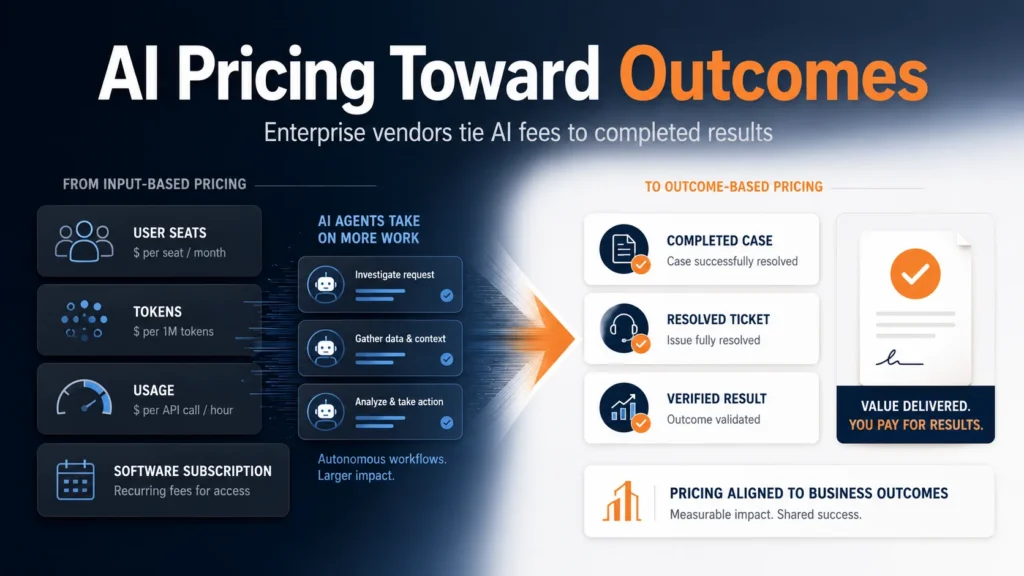
Zendesk, Pegasystems and other technology vendors are linking AI costs more closely to completed business results as agentic systems take on larger workloads.
Aug. 31, 2026: Zendesk, Pegasystems and other enterprise technology vendors are shifting AI pricing toward fees tied to completed business outcomes, according to an Aug. 31, 2026, CIO Dive report on agentic AI pricing, as AI agents take responsibility for larger portions of enterprise workflows.
The shift does not mean traditional per-seat software pricing is disappearing. Vendors are experimenting with per-resolution charges, fixed fees for completed cases and hybrid contracts that combine software seats with performance commitments. For chief information officers (CIOs), a central challenge is determining exactly what qualifies as a successful outcome, how that result will be measured and which party bears the risk when an AI system falls short.
Key Stats
- 19% of services buyers currently use outcome-based arrangements, according to Gartner analyst Tom Coshow, as reported by CIO Dive.
- 13% of seller-side service agreements currently use outcome-based pricing, according to Gartner data reported by CIO Dive.
- Less than 25% of technology CEO services contracts are expected to use outcome-based pricing through 2031, according to Gartner’s projection reported by CIO Dive.
- Zendesk charges for an AI resolution only when an interaction is completed end-to-end without human intervention.
- Pegasystems charges fixed fees for completed cases such as claims and disputes, according to CIO Dive.
- Some HP outcome-linked pricing options are not expected to reach early adopters until mid-to-late 2027, according to CIO Dive.
Zendesk is among the most visible adopters of the model. At its annual Relate conference on May 19, 2026, the company announced an expansion of its outcome-based pricing approach for AI-powered customer service. Under the model, businesses pay only for resolutions that Zendesk’s AI completes end-to-end and that are independently confirmed by an AI evaluation system. Spam and routine exchanges are excluded, according to Zendesk’s Relate 2026 announcement.
The structure gives enterprises a defined unit of cost: a completed resolution. Under consumption-based AI pricing, spending can vary with token usage and processing demands. Outcome-based pricing instead connects charges to work the system completes, potentially giving CIOs a clearer basis for forecasting technology spending.
Zendesk President and Chief Revenue Officer Chris Donato told CIO Dive that an interaction is not counted as an AI resolution when a human agent must complete part of the issue. The company expects customers could initially spend less than under seat-based pricing but increase spending over time as more service workloads become automated.
Pegasystems has adopted a different version of the model. The company charges a fixed fee for each completed case, such as a dispute or claim, rather than billing separately for software seats and AI tokens, according to CIO Dive. Pegasystems absorbs the underlying AI expenses and manages those costs partly by selecting models suited to individual tasks.
HP is also examining outcome-linked structures for its Workforce Experience Platform. Options under consideration include traditional per-seat contracts paired with commitments around measures such as reducing IT support tickets or generating savings from equipment-refresh decisions. CIO Dive reported that the pricing structures remain under development and that most early adopters are not expected to see those options until mid-to-late 2027.
The broader shift is also reflected in Gartner research. In its Aug. 4 report, Transition Agentic Applications Pricing From Seats to Quantifiable Business Activities or Outcomes, Gartner said pricing for agentic applications should move away from traditional seat-based models toward predictable activity- or outcome-based contracts connected to measurable business value.
Gartner has separately advised technology buyers to consider contractual protections as AI pricing evolves, including outcome-based structures and other mechanisms designed to control unpredictable costs.
Adoption, however, remains limited. Gartner Vice President Analyst Tom Coshow told CIO Dive that only 19% of services buyers and 13% of seller-side service agreements currently use outcome-based arrangements. Gartner projects that fewer than one-quarter of technology CEO services contracts will use the model through 2031.
The model also presents challenges for enterprise buyers. Paul Fisher, vice president for information technology and CIO at Seton Hall University, told CIO Dive that outcome-linked contracts could make return on investment easier to measure but could also complicate negotiations because organizations must be highly specific about the outcomes vendors are expected to deliver.
Coshow likewise cautioned that current interest in outcome-based pricing remains ahead of actual adoption. His comments highlight a key issue for buyers: whether a vendor is genuinely accepting financial risk when agreed outcomes are not achieved, rather than simply changing the unit used to calculate the bill.
For B2B SaaS companies, the pricing shift could influence how products are positioned and measured. As AI takes on more operational work, commercial conversations may increasingly move from access to software toward the value of completed tasks. That change aligns with the broader impact of AI adoption on B2B demand generation, where automation is changing how companies target, qualify and engage accounts.
It also increases pressure on technology stacks to connect activity with measurable business results. Related changes can be seen in how B2B tooling connects technology with revenue performance and in the growing use of AI-powered account-based marketing software to improve pipeline quality.
The near-term enterprise software market is therefore likely to remain mixed, with seat subscriptions, consumption pricing, outcome-based fees and hybrid contracts coexisting. As outcome-based pricing spreads unevenly across the market, buyers and vendors alike will need clearer standards for defining, measuring and independently verifying results before the model can become mainstream.