Turn First-Party Data Into Pipeline Growth
Explore proven ways to capture, organize, and activate customer data for smarter B2B marketing decisions.
 Lead-Gen now on Auto-Pilot with
Build My Campaign
Lead-Gen now on Auto-Pilot with
Build My Campaign

Learn how to combine CRM data, firmographics, and intent signals to enrich first-party data for better targeting, personalization & revenue.

Turn First-Party Data Into Pipeline Growth
Explore proven ways to capture, organize, and activate customer data for smarter B2B marketing decisions.
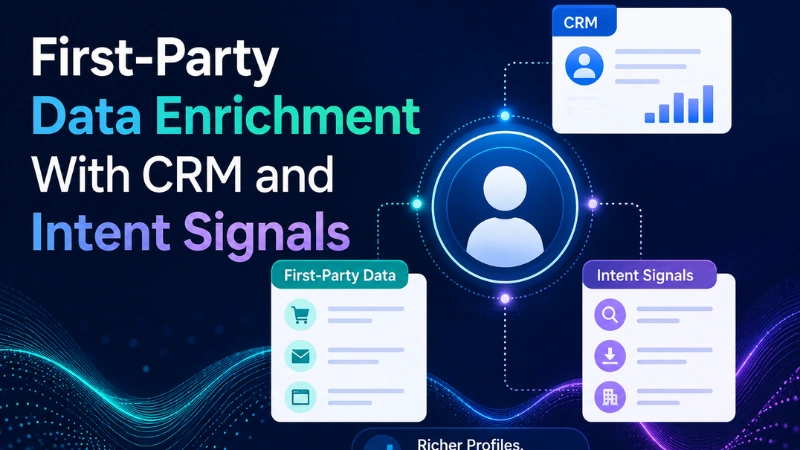
Most B2B marketing teams treat data collection like digital hoarding. They pile up customer records, buy massive company lists, and store everything in expensive software, only to wonder why their outbound campaigns get ignored.
While budget constraints and technical limitations often contribute to these challenges, the core issue remains data isolation rather than collection volume. The issue is not a lack of data. It is isolation.
Your customer relationship management system tells you who a contact is, company data tells you how big their business is, and online research signals tell you what problems they want to solve. Used alone, each spreadsheet leaves your team guessing.
To build a predictable pipeline, you must blend these layers together through first-party data enrichment. Laying this groundwork requires a unified approach, so utilizing a solid strategy guide will help align your team before you dive into the technical setup.
When you connect these pieces, you can reduce guesswork and improve your ability to identify accounts showing strong buying signals.
When data sits in isolated systems, it tells misleading stories. Marketing celebrates vanity metrics, while sales wastes time chasing cold leads.
Relying on just one layer of information creates distinct blind spots.
Turn First-Party Data Into Pipeline Growth
Explore proven ways to capture, organize, and activate customer data for smarter B2B marketing decisions.
Continuous first-party data enrichment removes the guesswork by connecting these layers into a simple formula:
Who they are, whether they fit, and what they need right now. Connect those three, and you have your next customer.
To see how First-Party Data Enrichment works in practice, consider two separate contacts who perform the exact same action on your website today.
Both individuals visit your resource library, download your latest industry guide, and watch a short on-demand product video. On a standard, un-enriched marketing dashboard, these two contacts look completely identical. They receive the exact same automated score, get dropped into the same generic email sequence, and get passed to your sales development reps with the same level of urgency.
When you apply an automated First-Party Data Enrichment layer that combines all three data types, the reality becomes clear.
The digital event that triggered both records was exactly the same, but the actual revenue opportunity is not even in the same universe. When looking at first-party vs third-party assets side by side, marketers quickly realize that while owning the internal signal is great, having the external context to interpret it is everything.
Without combining your data layers, Contact B sits in a slow, automated marketing queue for weeks, giving a competitor plenty of time to sweep in and lock down the deal. With First-Party Data Enrichment and proper alert systems, your enterprise sales rep can prioritize Contact B for immediate outreach.
Fusing these data streams does not require an overhaul of your entire business model. It requires a disciplined, step-by-step operational process that runs continuously in the background.
Teams that need hands-on help cleaning, enriching, and operationalizing B2B records can also use Valasys’ data enrichment services.
Your campaign begins with the raw names, corporate domains, and email addresses sitting inside your CRM or entering your web forms. The primary goal here is identification.
When a prospect interacts with your brand, they rarely give you their life story on a form. In fact, long forms with a dozen fields destroy conversion rates. Instead, keep your forms short, asking only for an email address.
The moment that email is submitted, your enrichment system goes to work behind the scenes. It takes the corporate domain and instantly pulls the business’s foundational details. It matches the individual to an actual account, ensuring you know exactly who you are dealing with before any human rep ever types out a manual email.
Now that you know the true identity behind the contact, you run that record through your company data filter. This is where you separate businesses based on structural fit.
You look at specific, hard attributes:
By filtering your CRM records through these company details, you build a clean, validated list of target businesses that have a genuine, structural need for what you sell. To do this consistently, you need a robust data collection engine running in the background to automate the mapping process.
A list of perfectly fitting companies is a great start, but it is still a static list. To activate a campaign, you need to know who to prioritize today. This is where you introduce web-wide research data.
You monitor your target list for specific behavioral shifts:
When these research behaviors spike simultaneously across an account, it signals an active buying cycle. Understanding how to track intent in a first-party framework is critical. It ensures you reach them at that precise moment, making your probability of meaningful engagement skyrocket.
In modern enterprise B2B sales, decisions are never made by a single individual. The average enterprise purchase typically involves multiple stakeholders, including technical evaluators, financial gatekeepers, end-users, and executive decision-makers.
Once your research signals tell you that a target company is actively shopping, you use your data layers to map out this internal buying committee. You identify the specific managers, directors, and executives who own the problem your software solves.
Instead of pitching a single contact who downloaded a PDF, you now have a comprehensive map of the entire department, allowing your team to run a coordinated, multi-channel account campaign.
Many data initiatives fall flat because companies treat enrichment as a one-time project rather than a continuous process. Real B2B industry benchmarks show how these operational traps impact revenue.
According to HubSpot research, B2B contact data decays at an average rate of 22.5% annually. This means if you run an enrichment project in January and rely on that same list in July, roughly half a year of natural decay has already compromised your records with inaccuracies due to job changes, acquisitions, and budget shifts.

The Cost: For a mid-market sales team, this decay translates directly into blown quotas. Data highlighted in the Zoominfo Analysis indicates that sales representatives spend roughly 27% of their time dealing with inaccurate data, meaning weeks of outbound effort are wasted chasing professionals who have already changed jobs.
A bloated database full of unverified, out-of-date records wastes budget on storage and actively damages outbound email infrastructure. This is why mastering strategic B2B email list building is a mandatory first step to protect your open rates before you even think about scaling up your storage.
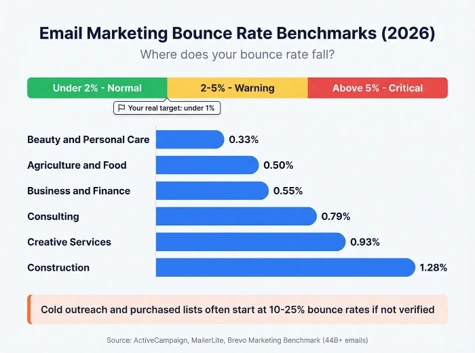
The Cost: Outbound benchmark data from Prospeo reveals that relying on unverified lists can cause outbound cold campaign bounce rates to spike to a catastrophic 18% to 22%. High bounce rates trigger security filters and land your company domain on global spam blacklists. Utilizing proactive data enrichment to scrub your data and keep bounce rates under 2% is an absolute prerequisite to stay out of the deliverability danger zone and protect your campaign ROI.
Enrichment tools amplify your existing setup; they do not fix it. If your baseline CRM data is full of formatting errors and duplicates, layering enrichment on top just scales the financial waste.
The Cost: A classic study published by the MIT Sloan Management Review estimates that the operational drag of bad data costs most companies between 15% and 25% of their total revenue. When human error creates duplicate entries for the same corporate account, you pay third-party enrichment tools twice to look up the exact same business, distorting your pipeline forecasting and draining your budget on unnecessary Application Programming Interface (API) calls.
Before launching your next combined data campaign, review our checklist on data governance mistakes to standardize your inputs and protect your pipeline.
While automated profiles are powerful, there is a category of information that beats them both for accuracy: the insights your prospects hand over willingly.
Integrating zero-party loops into your ecosystem gives you access to preferences, priorities, and direct challenges that buyers choose to share through interactive assessments, preference centers, and strategic event registration fields.
If a prospect explicitly states on a form that their top priority this quarter is reducing operational complexity, that declaration is infinitely more valuable than inferring a conclusion from five random blog downloads. First-Party Data Enrichment strategies that seamlessly blend these declared preferences with passive company and research data produce the most bulletproof customer profiles in the industry.
Data problems are never contained; they cascade through your entire business. An incomplete CRM record breaks your audience segmentation. Weak segmentation destroys your campaign quality. Poor campaign quality tanks your conversion rates. Before you know it, what started as a seemingly minor data hygiene issue has mutated into a massive revenue shortfall.
As revenue teams pivot heavily toward cookieless marketing strategies, having a unified technology foundation becomes non-negotiable. Third-party cookies are dead. The organizations building robust identity infrastructure right now are the ones that will hold a massive competitive advantage.
Learning how to evaluate a customer data platform deployment is one of the highest-leverage technology decisions an operations leader can make. An effective platform must deduplicate records, standardize chaotic field formats, and push real-time activation directly into the tools your sales reps live in. Technology should aggressively reduce complexity.
How do you know if your First-Party Data Enrichment strategy is actually working? Many teams make the mistake of measuring operational metrics, like the percentage of fields filled or the number of alerts generated.
While those numbers are interesting to data analysts, they do not tell you if your data is actually driving business growth. The only honest measure of a successful enrichment strategy is the financial health of your pipeline.
Track these core metrics to evaluate your real impact.
| Business Metric | What It Measures | What Success Looks Like |
| Lead-to-Opportunity Rate | Measures the percentage of marketing leads that turn into real sales opportunities. | The total number of leads passed to sales might drop, but the conversion rate into active opportunities jumps significantly. |
| Opportunity-to-Customer Rate | Tracks your sales efficiency with accounts that enter the formal pipeline. | Shorter discovery phases and a higher overall win rate because sales is only talking to qualified buyers. |
| Pipeline Velocity | Calculates the total number of days it takes for a prospect to move from initial contact to a closed deal. | A measurable drop in sales cycle length, as deals spend less time stalled in negotiation or evaluation stages. |
| Average Deal Size | Measures the financial value of your closed-won contracts. | An upward shift in your average contract value, proving that your firmographic filters are successfully pointing your team toward larger enterprises. |
| Account Engagement Depth | Tracks how many unique stakeholders within a single target account are interacting with your brand. | Outbound reps secure meetings with multiple members of the buying committee rather than getting stuck with a single contact. |
Trying to manually combine spreadsheets, cross-reference company directories, and hunt down online research signals is a complete nightmare. By the time you piece it all together, your buying window has closed. This explains the exact patterns behind why so many teams struggle with data activation strategies.
We built VAIS to handle the heavy lifting for you. It automatically fuses your customer records, company filters, and web-wide research data into a single campaign engine.
Instead of jumping between disconnected tools, VAIS simplifies your workflow with four core capabilities:
Data should never be treated as a collection of separate line items on a marketing budget. Your internal customer records, your company demographic profiles, and your real-time buyer research habits are designed to complement one another.
When you leave them isolated in different software tools, you are running blind campaigns that waste time, drain your budget, and frustrate your sales reps. But when you combine them into a single, automated engine through First-Party Data Enrichment, you take complete control over your market. You know exactly who your buyers are, you know they fit your business, and you know the exact moment they are ready to talk.
Ready to transform your data strategy into predictable pipeline growth? Contact Valasys Media to learn how our VAIS platform can automatically enrich your CRM data, identify high-intent accounts, and accelerate your sales cycle.
Enrichment tools often rely on cached datasets that can be months old. Because B2B data decays at 22.5% annually, people change jobs faster than databases update. To fix this and protect your domain reputation, run all enriched emails through a verification tool like NeverBounce or ZeroBounce before launching any cold outreach campaign.
Shorten your forms to just a single corporate email field and let a background API handle the rest. The moment a user submits their email, the enrichment system matches the domain to pull company size, revenue, and tech stack instantly. This keeps friction low for users while giving you rich data behind the scenes.
Waterfall enrichment routes an incomplete record through multiple data providers sequentially. If the first tool lacks a direct dial or verified email, the record automatically moves to the next provider. This approach significantly increases your data match rates and coverage across diverse industries, compared to relying on just one vendor’s database.
Intent data turns into noise when you track broad keywords instead of specific, high-intent actions. To fix this, stop alerts for general blog visits and focus on multi-stakeholder activity. Flag an account only when multiple people from the same company visit high-value pages like pricing, implementation documentation, or competitor comparison sheets.
Duplicates happen when your enrichment system lacks strict deduplication rules based on corporate domains. If a rep enters “Google” and another enters “Google Inc.” without a domain lock, tools pull data for both as separate accounts. Always standardize your entry points and match entries by website domain to avoid paying for duplicate lookups.
Yes, but you should avoid native plugins that force standard field mapping into a custom architecture. Instead, use an automation platform or webhook to capture the data payload. This allows you to clean, format, and map the incoming company and intent attributes directly into your specific custom properties without messing up existing fields.
Active pipeline records require real-time enrichment upon creation, while your broader CRM database needs a bulk refresh at least quarterly. Waiting a full year to update records ensures that roughly a quarter of your data will be completely inaccurate, leading to wasted sales hours, broken segments, and high bounce rates.
Turn First-Party Data Into Pipeline Growth
Explore proven ways to capture, organize, and activate customer data for smarter B2B marketing decisions.