
Intent Data vs Account Intelligence: What B2B Teams Need in 2026
Learn how intent data and account intelligence help B2B teams understand buyer activity, buying stage, priorities, and the next sales action.

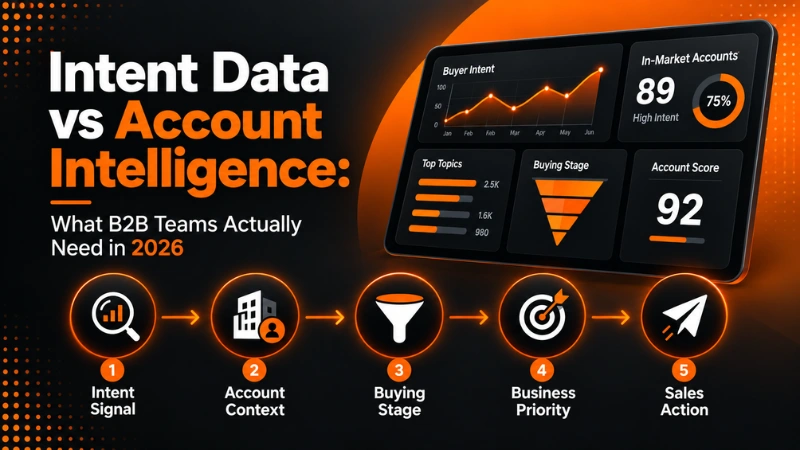
Direct Answer: Intent data helps B2B teams identify account-level research activity that may indicate growing interest. Account intelligence can add firmographic, technographic, organizational, stakeholder, and relationship context around the account. When those signals are connected with modeled buying-stage context, possible business priorities, and sales guidance, teams get a clearer path from observed activity to better-informed revenue decisions.
B2B teams have become much better at seeing buyer activity.
They can track signals and account data such as website engagement, topic surges, content consumption, CRM activity, account scores, and other indicators that help identify which companies are showing interest. That visibility is already powerful because it gives marketing and sales a better sense of where relevant research is happening before a buyer necessarily raises their hand.
The next opportunity is to understand what those signals mean in the context of the account. A seller may know that a company is researching a relevant topic and still want to understand who the company is, how well it fits, where it may be in its buying journey, what business issue could be connected to the research, and what conversation would make the most sense.
That is why intent data and account intelligence are more useful together than as isolated capabilities.
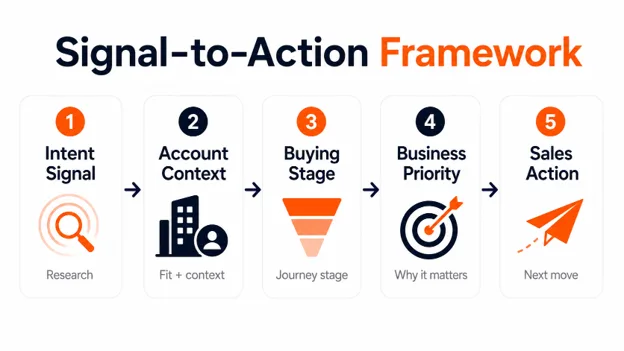
Intent Signal → Account Context → Buying Stage → Business Priority → Sales Action
Each layer adds more meaning to the one before it.
Intent Data vs Account Intelligence: Different but Connected Roles
Intent data gives B2B teams visibility into research activity around relevant topics, categories, problems, and solutions. It can help surface accounts that may be showing increased interest before they directly engage with sales.
Account intelligence adds information about who the company is, whether it fits the ideal customer profile, what technologies it uses, how the organization is structured, and which stakeholders may be relevant, which is central to understanding what account intelligence is in a modern B2B workflow.
| Intent Data Helps Teams See | Account Intelligence Adds |
| Which accounts are researching | More context around why the activity matters |
| Which topics are gaining interest | How related signals may connect |
| Where research activity is increasing | Buying-stage interpretation |
| Which accounts deserve attention | Possible business priorities and next steps |
The two capabilities solve different parts of the same problem.
Intent data helps identify meaningful activity, while account intelligence helps teams understand that activity in the context of the account.
Intent Data Gives Teams the Signal
Imagine your team sees that Acme Corp is showing increased research around identity security.
That information is valuable immediately because it gives marketing and sales a reason to look more closely at the account, especially if the activity is recent, relevant, and aligned with what your business sells.
Intent data is the evidence layer that helps reveal where interest may be developing and where further attention could be worthwhile. Think of it like CRM data and intent data working together. The CRM tells you what your team already knows about the account, while intent adds a view into current research activity. Combined, they give teams a more useful picture than either source provides on its own.
Intent becomes even more useful when it is evaluated alongside fit, first-party engagement, and buying stage to help teams prioritize in-market accounts more consistently.
Account Context Adds Meaning Around the Signal
One research topic can support several different interpretations.
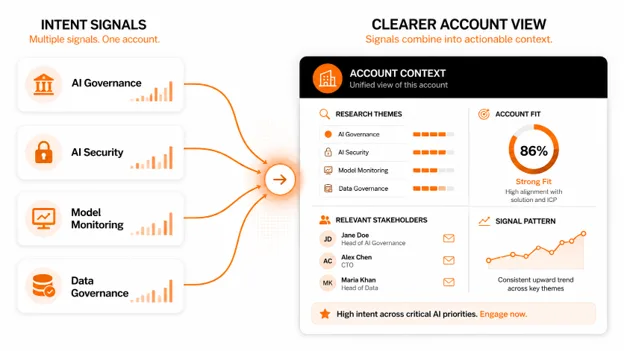
An account showing increased interest in AI governance may be evaluating technology, reviewing compliance requirements, creating an internal policy, preparing for wider AI adoption, or simply exploring the category at an early stage.
If the same account is also researching AI security, model monitoring, regulatory compliance, and data governance, the combined pattern becomes more informative than any individual topic in isolation.
This is where account intelligence becomes particularly useful. It can organize available account evidence into a more complete view so sellers do not have to interpret every signal separately. That broader interpretation is also what makes company-level intent signals more useful for sales, because related activity can be viewed in the context of the account rather than as isolated topics.
At the revenue level, that clearer context can help teams concentrate effort where the evidence is strongest instead of treating every active account the same way.
Buying Stage Adds Timing to the Account View
Two accounts can show strong interest in the same topic while being at very different stages of the buying journey.
One may be learning about the category. Another may already be comparing approaches or vendors. That difference changes what useful engagement looks like.
An earlier-stage account may respond better to educational content, problem framing, or category insights. An account showing stronger evaluation behavior may be more receptive to direct seller engagement, implementation guidance, differentiation, or business-case conversations.
Buying stage is typically modeled from available signals rather than directly observed, so it should be treated as decision-support context rather than a confirmed fact.
Buying-stage interpretation adds timing to the signal. It helps sales and marketing decide not only which accounts are active but also when a particular type of engagement may be more relevant.
The same logic applies to fit and timing. A perfect-fit account with little current activity may not deserve the same immediate attention as a strong-fit account showing sustained research and progression. Likewise, high activity from a poor-fit account does not automatically make it a priority. Bringing fit, intent, and stage together gives teams a stronger basis for deciding where sales effort should go.
Business Priorities Add Another Layer of Context
Once the account context is clear, the next question is why the activity may matter to the business.
Research across cloud migration, identity access management (IAM), zero-trust security, and infrastructure modernization, for example, may indicate that the account is working through a broader modernization initiative.
That interpretation is useful because it gives sales a stronger hypothesis about the business issue behind the research. It should still be treated as a hypothesis, not as confirmed internal information.
Good account intelligence helps teams use evidence without overstating what is known. Instead of telling a prospect, “We know cloud modernization is your biggest priority,” a seller can use the available context to ask whether identity and cloud infrastructure are becoming connected priorities for the business.
That keeps the outreach relevant while leaving room for validation.
Sales Action Connects the Intelligence to the Workflow
The final layer is helping sales understand what to investigate or do next. This is where AI-powered account intelligence can turn buyer intent into sales action by connecting account context with the next investigation or conversation.
A strong intent signal may already tell the rep that an account deserves attention. Account intelligence can add guidance around which issue could be relevant, which persona may care about it, what should be validated first, and what type of conversation may be appropriate.

The goal is not to replace seller judgment. It is to give sellers a stronger starting point and reduce the amount of repetitive account research required before engagement.
Why Intent Data + Account Intelligence Matters at the Revenue Level
The value of combining intent data with account intelligence is not simply that teams get more information. The bigger advantage is that the same buyer signals can support better decisions across marketing, Revenue Operations (RevOps), and sales.
Marketing can identify meaningful activity, RevOps can apply clearer context and routing logic, and sales can engage with a stronger understanding of why an account may matter. For revenue leaders, that can translate into more efficient use of existing intent investments and a more consistent path from buyer research to pipeline action.
The combination should ultimately be measured by whether prioritized accounts create a more qualified pipeline, progress further or faster through the buying process, receive better-timed engagement, and require less manual seller research than accounts outside the priority set.
At the business level, the strongest outcomes are:
- more efficient use of seller time;
- better account and pipeline prioritization;
- more value from existing intent-data investments.
The value comes from connecting the capabilities, not replacing one with the other.
The same layered logic appears in B2B SEO, AEO, and GEO, where each discipline contributes a different part of search visibility instead of replacing the others. Intent data and account intelligence work in a similar way: each solves a different part of the revenue intelligence problem, and the combination creates a stronger result.
When Intent Data Alone May Be Enough
Not every B2B team needs an additional intelligence layer.
A company may mainly use intent data to build advertising audiences, monitor category demand, identify active accounts, or support a relatively small strategic account list. Some organizations also have mature RevOps, analytics, or scoring systems that already combine intent with other account data and provide enough context for sales.
In those situations, intent data can remain highly effective on its own. The better question is whether additional context would materially improve the decisions the team is already making.
When Account Intelligence Adds More Value
Account intelligence becomes particularly useful when teams want to extend the value of signals they already trust.
That may happen when sales is managing a high volume of active accounts, when several signals need to be interpreted together, or when sellers want clearer context before deciding how to engage.
It can also help create more consistency across account research. Rather than having each rep independently connect intent topics, CRM activity, company context, and buying-stage clues, teams can apply a more consistent interpretation process across larger account lists.
This does not mean the previous process was ineffective. It means teams can build on an already valuable signal foundation with additional context and guidance.
What B2B Teams Should Look for in 2026
When evaluating intent and account-intelligence capabilities, teams should still care about the fundamentals. Intent coverage, topic quality, signal freshness, historical depth, and data accuracy matter because stronger intelligence depends on strong underlying evidence.
But teams should also look at how the different layers work together.
| Layer | What It Tells the Team |
| Intent Data | What topics an account is actively researching and when activity changes |
| Account Intelligence | Who the account is, whether it fits, its structure, technologies, relationships, and relevant stakeholders |
| Combined Intelligence | How signals and account context may relate to buying stage, business priorities, and the next sales action |
Intent and GTM intelligence platforms are increasingly connecting behavioral signals with account context, buying groups, and activation, as shown in 6sense’s Summer 2026 release, rather than treating signals as standalone outputs.
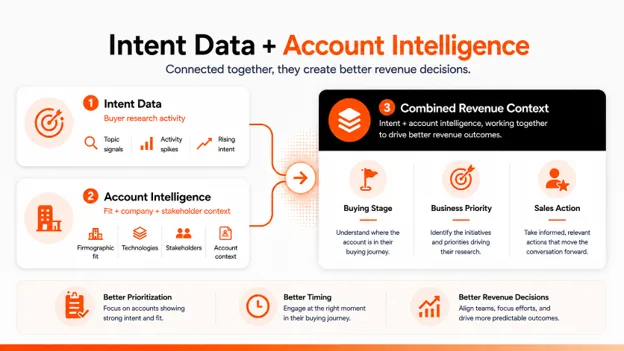
That makes the evaluation question broader than simply asking how many signals a platform can provide. Teams should ask whether those signals can be translated into useful context that improves prioritization, timing, and sales decisions.
Teams evaluating different approaches should compare how the best account intelligence tools for B2B sales handle account context, prioritization, buying-stage signals, and seller guidance.
Where VAIS Fits
VAIS Account Intelligence builds on company-level intent data from Bombora.
Bombora provides the underlying intent signals that help identify meaningful research activity. VAIS then processes those signals and adds account-level interpretation that can include buying stage, business priorities, relevant personas, confidence indicators, growth indicators, strategic bottlenecks, predictive corporate initiatives, and recommended outreach.
The relationship is additive. Intent data helps reveal what the account is researching, while VAIS helps teams understand that activity in a broader account context and determine what may deserve attention next.
Together, the two capabilities can give marketing and sales a more complete account view while helping revenue leaders improve prioritization, consistency, and the use of seller time.
Intent Data and Account Intelligence Are Stronger Together
Intent data already gives B2B teams valuable visibility into buyer research. Account intelligence extends that value by helping teams interpret the account behind the activity.
The opportunity in 2026 is not that every team needs another layer. Experienced teams may already know how to interpret intent data well. But if doing that means opening tab after tab to piece together the account story, VAIS AI Account Intelligence can generate a consolidated account brief in approximately three seconds when sufficient data is available, making that interpretation faster and easier to scale.
Ready to connect intent signals with account context that drives revenue decisions? Contact Valasys Media to learn how VAIS can strengthen your pipeline prioritization
Frequently Asked Questions (FAQs)
Q1. What should B2B teams do after an account shows strong intent?
Strong intent should trigger validation, not automatic outreach. Teams should review account fit, related research activity, buying-stage context, and likely business priorities before deciding whether sales should engage and what the conversation should focus on.
Q2. How do intent data and account intelligence improve sales timing together?
Intent data shows when research activity is increasing, while account intelligence adds context around the account and buying journey. Together, they help teams distinguish between early exploration and activity that may justify more direct sales attention.
Q3. What makes a combined intent and account intelligence stack effective?
The strongest setup connects signal quality, account context, buying stage, relevant personas, and next-step guidance. The value comes from reducing the gap between identifying an active account and making a confident revenue decision.
Q4. How should B2B teams measure whether the combination is working?
Compare prioritized accounts with the rest of the target market. Look at qualified pipeline creation, account progression, sales-accepted accounts, engagement timing, and the amount of manual research sellers need before outreach.
Q5. Can strong intent still be a low-priority sales opportunity?
Yes. High research activity does not automatically outweigh poor fit, weak engagement, or early-stage behavior. Intent becomes more useful when it is interpreted alongside account context and timing rather than treated as a standalone priority signal.
Q6. What should revenue leaders look for beyond intent signal volume?
Revenue leaders should look at whether the intelligence improves decisions. Useful indicators include clearer prioritization, faster account research, better-timed engagement, more consistent routing, and stronger pipeline performance from prioritized accounts.