Sales Aligned Lead Scoring System Guide
Build scoring aligned with actual sales qualification needs
 Lead-Gen now on Auto-Pilot with
Build My Campaign
Lead-Gen now on Auto-Pilot with
Build My Campaign

Sales reps don't need more leads; they need leads that aren't garbage. Stop counting clicks and start building a scoring model your sales team actually trusts.


Sales Aligned Lead Scoring System Guide
Build scoring aligned with actual sales qualification needs

I sit across from Erica. She works in sales. I write.
One thing I love as a writer is observing. I notice the pauses, the small reactions, and the way people work when they are not trying to explain their work to anyone.
After watching Erica move through lead after lead, one thing became obvious:
Sales does not have a volume problem. Sales has a signal problem.
From the marketing side, a lead can look perfect. Three emails opened. A link clicked. A guide downloaded. A form filled out. The score goes up, the lead becomes an MQL, and the system says sales should follow up.
But Erica sees it differently.
She does not care that someone clicked a link. She cares whether that person is likely to buy.
Sales Aligned Lead Scoring System Guide
Build scoring aligned with actual sales qualification needs
That is where the trust gap begins.
Marketing looks at engagement. Sales looks at buying probability. Marketing tracks opens, downloads, page visits, and form fills. Sales tracks unanswered calls, weak conversations, and leads that were technically “qualified” but never had real intent.
If you are struggling to bridge this gap, our B2B nurture framework outlines exactly how to stop chasing vanity metrics and start building a path to revenue.
Erica may not say all of this out loud, but her behavior says it.
When she hesitates before calling a “hot lead,” she is telling you something. When she checks the company before trusting the score, she is telling you something. When she values one pricing-page visit more than a month of newsletter opens, she is telling you something. When she lets another CRM alert sit there like junk mail, she is telling you something.
As a writer, I am just translating what her behavior already says.
Sales does not need more leads. Sales needs fewer wrong ones.
And if you own email nurture, demand generation, marketing operations, revenue operations, or pipeline growth, that should matter to you.
Your nurture program should not just keep prospects warm. It should create signals that help sales understand who is becoming ready, why they matter, and what to say next.
If you are ready to stop guessing and start measuring true intent, VAIS gives you the clarity to turn those signals into measurable pipelines.
That is the real job of lead scoring in email nurture.
Email Nurture → Buyer Behavior → Scoring Signal → Sales Trust → Pipeline
This is not about giving Erica (read: sales) another number.
It is about giving a reason to believe that number.
Most lead scoring models are built by marketing, for marketing.
They measure what is easy to track:
These signals matter, but they do not all mean the same thing.
An email open may mean interest. It may also mean a preview pane. A content download may mean serious research. It may also mean someone collecting sources with no buying role. A pricing-page visit means something different. A reply means something different again.
This is why sales teams get frustrated.
They are not rejecting marketing. They are rejecting noise.
When Erica gets an alert that says “hot lead,” but the lead turns out to be a poor-fit contact with one accidental click, she learns not to trust the alert. After enough false starts, the score becomes background noise.
That creates a problem across the entire revenue team.
B2B marketing managers may think nurture is working because engagement is rising. Demand generation managers may see MQL volume going up. MarkOps may have clean workflows and scoring rules. RevOps may have the routing in place. CMOs may see lead numbers improving.
But if sales does not trust the leads, the system is not doing its full job.
Sales does not want a list ranked by activity. Sales wants a list ranked by likelihood to buy.
Those two things are close. They are not the same.
Lead scoring in email nurture exists to close that gap.
If your team is stuck in this cycle, this guide on moving leads from MQL to revenue is the next step to re-aligning your operations.
If you own email nurture, the shift is simple:
Do not build nurture only to keep leads engaged. Build nurture to create signals sales can trust.
Sales needs three things from your nurture program.
Is this the right person at the right company?
Are they showing signs of active buying interest?
What did they do, when did they do it, and what should sales say next?
That third part matters most.
Erica does not need to see: Lead Score: 87
That is not a story.
But this is:
“This lead clicked the ROI calculator, returned to the pricing page twice this week, and watched most of the product webinar.”
Now Erica has a reason to call.
Now the conversation can begin with something relevant. That is the difference between a score sales ignores and a score sales uses. If you are struggling to map these signals to your own sales process, see how VAIS helps unify intent data to build that missing story.
Email nurture is not just a sequence of scheduled messages. It is where buyer behavior becomes visible.
Every nurture email should have a job. Not just to educate. Not just to stay visible. But to create a signal that helps the business understand where the buyer is in their journey.
Erica does not need to know that someone received Email 4 in a workflow.
She needs to know what they did next.
Did they ignore it? Did they open it once? Did they click a blog link? Did they click a comparison guide? Did they visit pricing? Did they reply?
Each action tells a different story.
An awareness email may show whether the lead cares about the problem. A comparison email may show whether they are evaluating options. A case study may show whether they are looking for proof. A pricing or demo CTA may show whether they are moving closer to a buying conversation.
The nurture email creates the opportunity for behavior.
The behavior creates the signal. The signal updates the score. The score tells sales or the nurture system what should happen next.
Are they ignoring your messages? Did they click a comparison guide or personalize their journey based on their buying committee? Each action tells a different story.
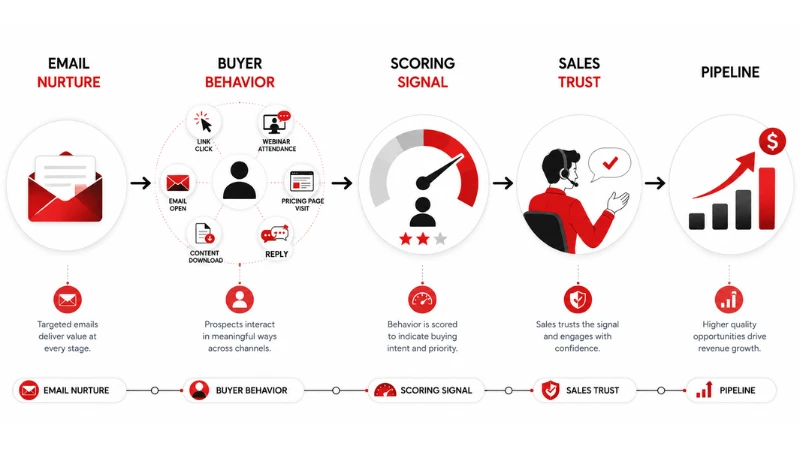
Nurture Email → Buyer Action → Scoring Signal → Sales or Next Nurture Path
This is the part many teams miss. They build nurture journeys and scoring models separately. But they should be built together.
If your nurture workflow never includes strong intent moments, your scoring model has nothing strong to score. If every email is educational, your model will mostly measure curiosity. But if your workflow includes comparison content, implementation guides, ROI tools, webinars, pricing CTAs, and demo paths, your model can separate casual interest from buying intent.
That is how nurture stages should change scores.
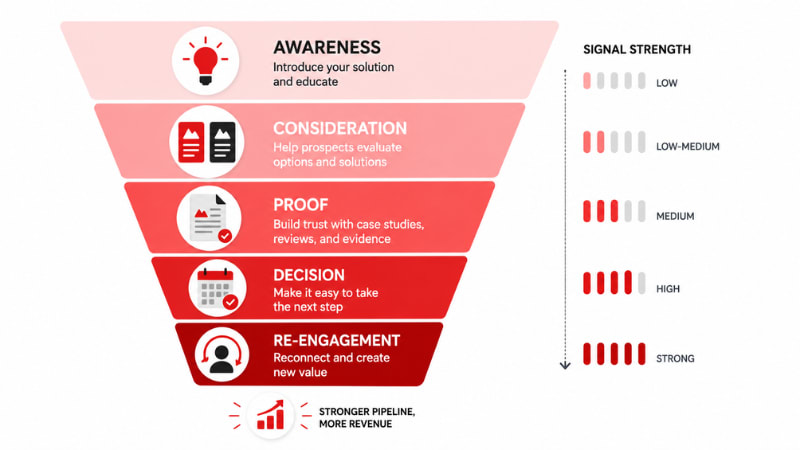
| Nurture Stage | Example Email | Behavior | Score Meaning |
| Awareness | Problem education | Opens or clicks educational content | Light interest |
| Consideration | Comparison guide or webinar | Clicks product/comparison content | Evaluation may be starting |
| Proof | Case study or ROI calculator | Engages with proof-based content | Business case may be forming |
| Decision | Pricing, demo, consultation | Clicks high-intent CTA or replies | Sales should pay attention |
| Re-engagement | Cold lead nurture | Returns after silence | Intent may be warming again |
The nurture stage should influence the score. The score should influence the next workflow.
A low-fit lead with early-stage engagement should stay in education. A high-fit lead clicking comparison content should move into a consideration sequence. A high-fit lead visiting pricing twice should trigger a sales task. A previously cold lead who suddenly clicks multiple emails should enter a re-engagement review or “hot hand” workflow. A lead with no engagement for 90 days should lose score and move into a lower-priority nurture path.
Lead scoring should not only decide when someone goes to sales. It should also decide what happens when they are not ready yet.
That matters because most leads are not immediately sales-ready. Some need more education. Some need proof. Some need reactivation. Some need to be disqualified. Some need sales right now.
A strong nurture program knows the difference.
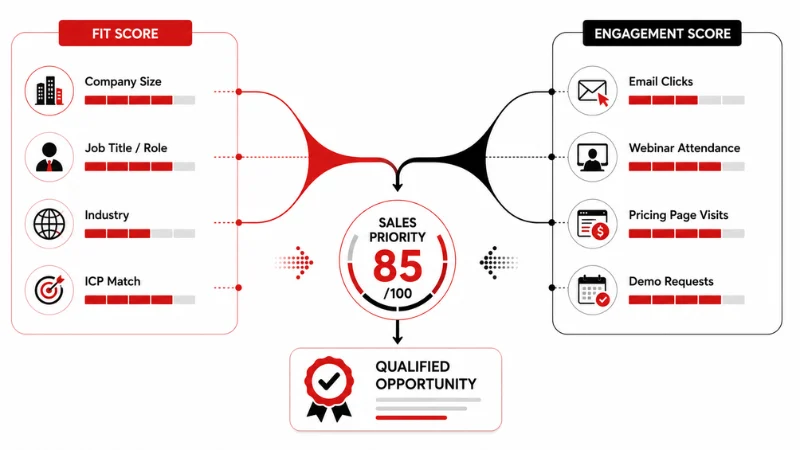
One score creates confusion because it mixes two different questions into one number.
A lead can be highly engaged and still be a poor fit. A lead can be a perfect fit and still not be ready.
So the better model is simple:
Fit Score + Engagement Score = Sales Priority
Fit Score answers:
“Should we sell to this person?”
It looks at job title, buying role, company size, industry, revenue, geography, ICP match, lead source, and account quality.
Engagement Score answers:
“Are they paying attention right now?”
It looks at email clicks, webinar attendance, pricing-page visits, demo requests, replies, product or comparison content clicks, content downloads, recency of activity, and repeated behavior.
Fit tells you whether they belong in the sales conversation.
Engagement tells you whether the timing may be right.
Sales needs both.
Erica understands this instinctively. A director at a target account visiting the pricing page is not the same as a student downloading a guide. Your scoring model should know that too.
Once fit and engagement are separate, your MQL and SQL logic becomes clearer.
| Lead Type | What It Means | What Should Happen |
| High Fit + High Engagement | Right account, active intent | Send to sales quickly |
| High Fit + Low Engagement | Good target, not ready yet | Keep nurturing |
| Low Fit + High Engagement | Interested, but poor match | Keep automated, do not rush to sales |
| Low Fit + Low Engagement | Weak fit, weak signal | Suppress, disqualify, or deprioritize |
This is where trust starts to return.
Sales no longer receives every active lead. They receive leads where activity and fit meet. That distinction protects sales time.
And when sales time is protected, sales trust improves.
For B2B marketing managers, this means nurture should not push every engaged contact to sales. For demand generation managers, it means MQL criteria should not reward volume at the expense of quality. For MarkOps, it means scoring logic should separate demographic fit from behavior. For RevOps, it becomes the shared operating system between marketing and sales. For CMOs and growth leaders, it is how lead scoring starts improving pipeline contribution instead of just lead count.
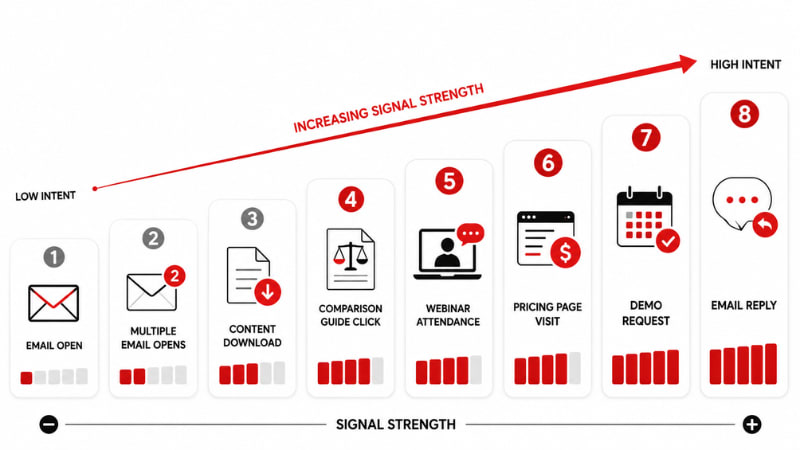
Your email nurture program is always listening.
Every send creates a chance for behavior. Every behavior leaves a signal.
But not every signal should carry the same weight.
The question is not: “Did they open the email?”
The better question is: “What does this behavior tell sales?”
That is what Erica needs. She does not react to all actions the same way. Some signals are soft. Some signals are sharp.
Your scoring model should reflect that.
| Email Nurture Behavior | Signal Strength | Suggested Score Impact | What It Tells Sales |
| Replies to a nurture email | Very High | +20-25 | They may be ready for a human conversation |
| Clicks “Request a Demo” | Very High | +20-25 | They are moving toward evaluation |
| Visits pricing page from email | High | +15-20 | Cost is now part of their thinking |
| Watches more than half a webinar | High | +15 | They invested real time |
| Clicks product or comparison content | Medium | +5-10 | They are exploring options |
| Downloads implementation guide | Medium | +8-12 | They are thinking beyond awareness |
| Opens three emails in 48–72 hours | Medium | +5 | Interest may be rising |
| Opens one email | Low | +1-2 | Light signal only |
| No engagement for 90 days | Negative | -10% decay | Intent has cooled |
| Unsubscribes | Strong Negative | -50 | Remove from sales priority |
Simple opens should receive very low scores because they do not prove intent on their own.
Demo requests, replies, pricing-page visits, product-webinar engagement, comparison clicks, and repeated recent activity should carry more weight because they tell sales something useful.
This one shift changes everything.
It turns email nurture from a communication channel into a qualification system.
Timing is one of the most important parts of lead scoring.
A lead that scored 85 six months ago is not still an 85-point lead if nothing has happened since.
Old scores can lie. They carry yesterday’s intent into today’s sales queue. That creates wasted calls and weakens trust.
If you have a backlog of stale data, this strategy for reactivating cold B2B leads will help you prune the noise and identify who is actually ready to re-engage.
A simple decay rule keeps the model honest:
No meaningful engagement for 90 days = reduce engagement score by 10%.
After long silence, the lead should return to nurture, not sales.
Because a quiet lead does not need a pitch. It needs a reason to re-engage.
This matters to Erica because old intent wastes her time. It matters to marketing because stale scores make nurture performance look stronger than it really is. It matters to RevOps because old scores distort reporting. And it matters to growth leaders because inflated lead quality creates false confidence in pipeline forecasts.
But timing works in the other direction too.
Sometimes a lead goes quiet, then suddenly returns. They open three emails, click a product link, visit the pricing page, and read a case study within two days.
That is not a random activity. That is movement.
Maybe the budget opened. Maybe a vendor failed. Maybe a new priority appeared. Maybe the buyer is finally ready to compare.
Your scoring model should notice that moment.
Cumulative score matters, but velocity matters too.
Set a simple “hot hand” trigger:
If a lead opens 3+ emails or clicks 2+ links within 72 hours, create a CRM task for sales.
The alert should include emails opened, links clicked, last page visited, current fit score, lead source, and a suggested opener.
Do not just raise the score. Give sales the moment.
A weekly report is too late for this kind of signal. If a lead suddenly becomes active, sales needs to know while the buyer is still in motion.
Lead scoring usually fails at the handoff.
Marketing sees the score cross a threshold. Sales sees another alert. The alert says “hot lead,” but it does not say why.
That is not enough.
A good sales handoff should feel like a short, useful briefing.
Not a number. Not a mystery. Not another task with no context.
| Context Package | What to Define | Recommended Standard |
| SQL Threshold | When a lead becomes sales-ready | High Fit + High Engagement |
| Example Threshold | Starting point for SQL status | Fit Score 65+ and Engagement Score 50+ |
| Handoff Action | What happens when threshold is crossed | Auto-create CRM task |
| Response Time | How fast sales follows up | Within 24 hours, ideally faster during business hours |
| Context Package | What sales receives | Last 3 behaviors, source, company profile, suggested opener |
| Feedback Loop | How sales reports quality | CRM disposition within 48 hours |
The context package matters most.
A number in a CRM field means very little to a rep preparing for outreach. Sales needs to know what the person did, when they did it, who they are, and what to say next.
When a lead becomes sales-ready, the notification should answer three questions:
What did they do?
“Clicked the ROI calculator and visited the pricing page twice.”
Who are they?
“VP of Operations at a 300-person logistics company. Strong ICP fit. Has been in nurture for six weeks.”
What should sales say?
“Reference the ROI content. Ask what operational metric they are trying to improve.”
This is what makes outreach feel relevant.
Sales is no longer guessing. They are entering a conversation already shaped by the buyer’s behavior.
A score of 87 tells Erica very little.
But this tells her enough to start a real conversation:
“She visited the pricing page twice this week after watching 80% of the demo webinar.”
That is what sales actually needs.
Many teams automate too early. They build the model, switch on the alerts, and send leads to sales before anyone has tested whether the score reflects reality.
That is how trust breaks. A better path is slower and stronger.
Run the scoring model, but review every SQL trigger with sales.
Ask:
Fix the fit criteria before fully automating anything.
Create CRM tasks automatically, but let SDRs review the context before acting.
Use this stage to catch scoring anomalies and calibrate point values based on what is actually converting.
Once the model proves itself, automate more fully. Then review every quarter.
Look at which scored leads became meetings, which became opportunities, and which went nowhere.
The model should become more accurate, sharper, and more useful over time.
Automating a bad model faster is just failing faster.
Erica should not have to train herself to ignore your system. Your system should learn from Erica’s reality.
Of course, building a nurture program that translates behavior into revenue is easier said than done. It requires the right architecture, the right triggers, and the right content strategy to ensure every touchpoint is actually working for sales.
If you are tired of your nurture emails feeling like a black box, let’s change that. We don’t just build sequences; we build email nurture systems that turn silence into signals and leads into conversations. Let’s make your marketing speak the same language as your sales team.
Start here:
The goal is not a perfect score. The goal is a score sales can trust.
Lead scoring is not really about points.
It is about trust.
Sales needs to trust that a lead is worth the call. Marketing needs to trust that nurture is creating useful signals. RevOps needs to trust that the system reflects reality. Growth leaders need to trust that MQLs are contributing to the pipeline, not just filling reports.
I learned this by watching Erica.
Not from a dashboard. Not from a scoring rule. From the way she reacts when a lead is useful, and the way she hesitates when a lead is just another number.
Erica is saying these things with her behavior.
As a marketing writer, I am just putting language around the practical problem she faces every day.
For B2B teams, that is the real promise of lead scoring in email nurture: not more activity, not more alerts, not more dashboards, but better sales conversations built on signals both teams trust.
Lead scoring in email nurture is the process of assigning value to prospect actions inside nurture workflows, such as clicks, replies, webinar attendance, pricing visits, and inactivity. The goal is to help marketing identify who is warming up and help sales understand who deserves attention now.
Sales cares because reps have limited time and weak MQLs waste it. A useful score helps them prioritize leads by buying likelihood, not surface-level activity. But sales needs more than a score; they need context, fit details, recent behavior, and a clear reason to start the conversation.
A lead score measures what a prospect does: email clicks, content engagement, replies, pricing visits, and other behavioral signals. A lead grade, or fit score, measures who the prospect is and whether they match your ICP. Strong models keep both separate, then combine them to decide sales priority.
The highest scores should go to actions that show clear buying intent: demo requests, replies, pricing-page visits, comparison-content clicks, product webinar attendance, and strong recency spikes. Opens and generic downloads can matter, but they should carry lighter weight because they often show curiosity, not readiness to buy.
Every nurture email creates a small test of buyer intent. When someone ignores, opens, clicks, replies, downloads, registers, attends, or visits a page afterward, that behavior becomes a scoring signal. The strongest programs design emails around signal creation, so each stage reveals whether the buyer is learning, evaluating, or ready.
Early-stage nurture should add light points because it usually signals awareness or curiosity. Middle-stage content, like comparison guides or webinars, should add moderate points because evaluation may be starting. Late-stage actions, such as pricing visits, demo clicks, or replies, should add higher points and may trigger sales follow-up.
There is no universal B2B threshold because every ICP, sales cycle, and conversion pattern is different. A useful starting point is High Fit plus High Engagement, such as Fit Score 65+ and Engagement Score 50+. The best threshold should come from historical opportunity data, not guesswork.
Lead scores should decay when meaningful engagement stops, usually after 60 to 90 days of inactivity. A practical rule is reducing engagement score by 10% after 90 days without strong behavior. Decay keeps old interest from looking current and prevents sales from chasing leads whose intent has cooled.
A recency spike happens when a lead suddenly becomes active after being quiet, such as opening several emails, clicking multiple links, and visiting pricing within a short window. It matters because velocity can signal a new buying moment. Sales should receive an alert while that interest is still fresh.
Lead scoring should not only decide when a prospect goes to sales. It should also decide what happens when they are not ready. Low-fit leads may stay automated, high-fit early-stage leads may receive education, and high-fit late-stage behavior should trigger sales alerts, re-engagement, or faster routing.
Sales Aligned Lead Scoring System Guide
Build scoring aligned with actual sales qualification needs


