Lead-Gen now on Auto-Pilot withBuild My Campaign
Valasys Media — Empowering marketers with powerful insights

B2B Marketing Posts

B2B Content Syndication Strategy: 7-Step Playbook

How to Build a B2B Content Syndication Strategy That Generates Qualified Demand

Priyanshi Kharwade- September 21, 2026

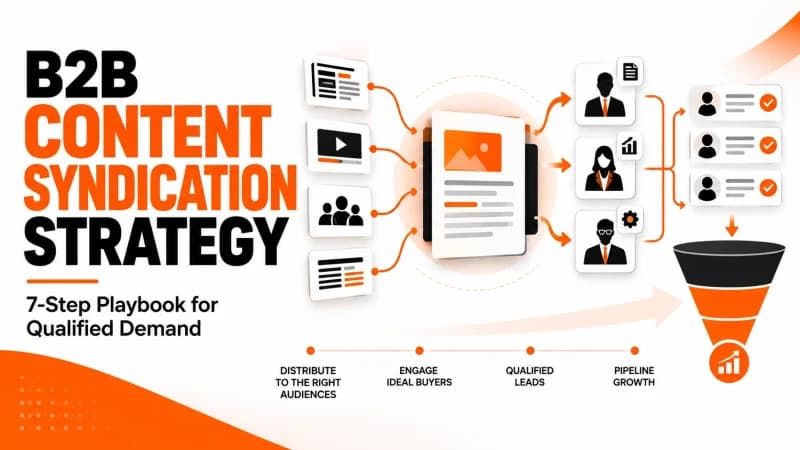
Direct answer: Content syndication works best as part of the demand generation system, not as a way to buy a batch of names. Strong programs combine relevant content, clear audience targeting, sales alignment, and downstream measurement so success is judged by lead quality and pipeline progression rather than downloads alone. That approach aligns with Content Marketing Institute and MarketingProfs’ 2026 research, where 65% of effective B2B marketers cited content relevance and quality, 45% cited sales alignment, and 40% cited measurement and reporting as factors improving effectiveness. How does a B2B content syndication strategy generate qualified demand? A B2B content syndication strategy distributes valuable content through first party and third-party channels to reach ideal-fit buyers. To generate qualified demand, define the goal, define the audience, choose the asset, score partners, establish lead governance, design nurture, and optimize performance against accepted leads, SQLs, opportunities, pipeline, and revenue. Syndicated content can include research reports, white papers, guides, webinars, case studies, checklists, comparison content, videos, and interactive tools. Distribution channels can include industry publishers, newsletters, professional communities, content syndication networks, media partners, and intent-based platforms. There are three useful forms to distinguish: Gated asset syndication places an asset such as a report or guide behind a registration form operated by a publisher or syndication partner. It is primarily used for lead generation. Ungated content syndication republishes or distributes articles or other freely accessible content to expand reach and authority. Intent-informed syndication combines distribution with behavioral or account-level intent signals so campaigns can prioritize organizations showing interest in relevant topics. The distinction matters because each type serves a different objective. A syndicated article may increase discovery without producing identifiable leads, while a gated research report may generate contact data but introduce more friction. What is the real goal of content syndication? The goal is qualified demand, not the maximum possible number of downloads. A useful syndication lead should tell you whether the person and company fit your ICP, what topic they engaged with, and what follow-up makes sense. That signal should connect to CRM routing, lead scoring, nurture, ABM, sales follow-up, and performance reporting. For example, a security director at a 3,000-person target account downloading a ransomware-readiness report is materially more valuable than an unrelated student or a prospect outside your service region. Both may appear as “leads” in a campaign report. They do not have equal business value. How does B2B content syndication work? A content syndication campaign moves a buyer from third-party discovery into your demand generation system. A typical workflow has seven stages: A typical workflow looks like this: A publisher or distribution partner exposes the asset to the agreed audience. A prospect discovers the content and, for gated programs, provides information to access it. The lead is validated against required fields, exclusions, consent rules, and ICP criteria. Accepted data is passed into the CRM or marketing automation platform with the correct source, campaign, asset, and timestamp. The prospect enters an appropriate nurture or account-based sequence. Additional engagement, fit, or explicit buying intent determines whether and when sales should engage. Marketing measures downstream qualification, opportunity creation, pipeline, and revenue contribution. A weak program stops after the download. A strong program validates the lead, routes it correctly, nurtures the prospect, and measures what happens through qualification, opportunity creation, pipeline, and revenue. Why does content syndication matter for B2B demand generation? Content syndication extends the reach of valuable assets while creating additional buying signals outside your owned channels. It is especially useful when strong content has limited organic distribution. A research report that reaches only people who already find you through search, social, referrals, or email can reach new relevant professionals when distributed through carefully selected third parties. Distribution, however, cannot rescue weak content. The 2026 CMI research reinforces that relevance and quality matter. Syndicate your strongest assets, not the content you are struggling to promote internally. Which content assets work best for syndication? The best asset depends on the buyer’s stage, problem awareness, and reason for engaging. Buyer stage Useful syndicated asset Why it fits Example Awareness Original research, trend report, expert guide Helps buyers understand a problem or market change “2026 State of Ransomware Readiness” Problem-aware Checklist, benchmark, maturity model Helps buyers assess their current situation “Cloud Security Risk Assessment Checklist” Solution-aware Comparison guide, webinar, implementation framework Helps buyers compare approaches “Manual vs. Automated Compliance Monitoring” Vendor-aware Case study, ROI model, buyer’s guide Provides proof and purchase justification “How to Build the Business Case for Automated Compliance” Original research and practical guides are particularly useful syndication assets because they can offer buyers information, benchmarks, frameworks, or insights that generic promotional content does not provide. A useful test is to ask: Would a member of our ICP still want this asset if our logo were removed from the cover? If the answer is no, it is probably too promotional for cold syndication. How do you build a B2B content syndication strategy? A practical content syndication strategy can be organized into seven steps: define the goal, define the audience, choose the asset, score partners, establish lead governance, design nurture, and optimize performance. Step 1: Define the demand generation goal Start with the business outcome rather than a lead-volume target. A campaign might exist to generate qualified demand, engage target accounts, support an ABM program, introduce a new category, increase webinar participation, or influence pipeline. A more useful objective is: Generate qualified engagement from IT and security leaders at North American mid-market companies researching ransomware resilience, then measure how those leads progress into accepted sales opportunities. That is materially better than “generate 1,000 leads.” Decide the success metrics at the same time you define the goal. Otherwise, the channel is likely to be optimized around whatever number happens to be easiest to produce. Step 2: Define your audience and exclusions Specific targeting improves the usefulness of every lead that follows. Define: industries; regions; employee or revenue ranges; target job functions; seniority; named accounts where relevant; technology environment; relevant problem or use case; buying-stage signals.

What Is an HQL? Highly Qualified Leads Explained

Pranali Shelar- September 21, 2026

Lead qualification is rarely as simple as tracking who downloaded an asset, filled out a form, or crossed a lead-scoring threshold. For B2B teams, the more important question is whether there is enough relevant evidence to justify giving that lead further sales attention. That is where the term Highly Qualified Lead (HQL) comes in. While the term is widely used, its meaning depends on how a business defines qualification. What Is an HQL? An HQL, or Highly Qualified Lead, is a lead that meets a business’s defined qualification criteria for further sales attention. The criteria can consider factors such as account fit, business context, relevant interest or intent, contact relevance, and other information the business considers important for sales-ready lead qualification. There is no universal HQL formula. The threshold can depend on factors such as a company’s ICP, sales process, buying cycle, campaign objectives, and sales requirements. Importantly, engagement alone does not make a lead an HQL. A form fill, content download, or high lead score can provide useful signals, but those signals need to be evaluated against the business’s qualification criteria. Why Does the HQL Definition Matter? An HQL definition gives Marketing and Sales a shared standard for determining which leads warrant further attention. Without a defined standard, qualification can become dependent on individual assumptions. Marketing may consider a lead qualified because it generated strong engagement, while Sales may require additional evidence about account fit, business relevance, or the prospect’s role. A clear HQL definition establishes what evidence needs to be present before a lead is considered highly qualified. That definition can then be applied consistently across campaigns while accounting for differences in market, sales motion, or campaign requirements. This is also why an HQL should be treated as a qualification outcome, rather than a label automatically triggered by a particular marketing activity. Why Isn’t There One Universal HQL Definition? B2B buying processes and sales motions differ. A SaaS company selling to enterprise organizations may require information about company size, technology environment, buying committee involvement, and business initiative. Another business may place greater emphasis on geography, industry, use case, or specific qualifier questions. The evidence required before a lead is handed to an SDR may also differ from the evidence required before an opportunity is created. For that reason, an HQL definition should be built around the company’s: Ideal customer profile Target market Sales motion Buying cycle Qualification requirements Campaign objectives Sales handoff process The goal is to establish the evidence required for a lead to receive further sales attention. What Makes a Lead Highly Qualified? An HQL generally requires more than a single engagement signal. Qualification may consider account fit, business context, relevant interest or intent, contact relevance, and other requirements defined by the sales process. What makes a lead highly qualified is how these factors come together to provide enough evidence for further sales attention.  The important question is whether the available evidence is sufficient to meet the HQL standard. What Does an HQL Actually Look Like? Consider two accounts that have both interacted with the same campaign. Account A has downloaded multiple assets and opened several emails but does not match the target account profile and provides little evidence of a relevant business need. Account B has had fewer interactions but matches the target account profile, represents a relevant role, and provides qualification information that aligns with the campaign’s requirements. Account A may show stronger engagement, but Account B has stronger evidence for HQL qualification. The distinction is important: HQL status depends on the combination of relevant evidence, not simply the amount of marketing activity.  HQL vs. MQL vs. SQL vs. BANT HQL is often discussed alongside MQL, SQL, and BANT, but these terms describe different qualification concepts. An MQL generally reflects a marketing-defined qualification threshold, while an SQL typically indicates that Sales has accepted or further qualified the lead. BANT is a sales qualification framework based on Budget, Authority, Need, and Timeline. An HQL is a business-defined standard for determining whether a lead meets a higher level of qualification, while MQL, SQL, and BANT serve different roles in the qualification process. Understanding the difference between HQL, MQL, SQL, and BANT helps clarify where each fits within the broader marketing and sales workflow.  How Does Valasys Define an HQL? HQL criteria vary from company to company, but Valasys uses a qualification process designed to connect lead qualification with sales relevance. For Valasys, an HQL is not defined simply by engagement volume, a lead score, or a single intent signal. The process includes qualifier questions presented while a lead engages with relevant POCs, assets, or landing pages, typically through a form submission. Valasys describes its HQL process as combining targeting, validation, human engagement, and qualifier questions to capture buyer insights for scoring. The responses provide additional qualification evidence that can be evaluated against the client’s agreed requirements. The questions are part of the qualification mechanism, not an automatic HQL trigger. Whether a lead qualifies depends on the requirements established for that client or campaign. How Does VAIS Support HQL Qualification? Valasys Media also uses VAIS (Valasys AI Score) to add account-level context to qualification. VAIS combines account signals such as firmographics, technology adoption, buying committee movement, and intent-related data to help assess account fit and relevance. Its Intent Persona capability can add context around relevant personas and account-level research activity. Account Intelligence, powered by Bombora, adds company-level intent context by analyzing topic-level signals and changes in account activity. The feature classifies topic movement as Surging, Rising, Stable, Cooling, or Declining and uses AI to interpret those signals in terms of potential buying context and next steps. These insights are supporting evidence, not automatic HQL decisions. The resulting interpretations are hypotheses that should be validated against the account and the client’s qualification requirements. How Is HQL Quality Connected to Sales? An HQL ultimately needs to be useful beyond the marketing dashboard. At Valasys, lead quality is mapped against SDR alignment and marketing effort-to-sales closure metrics. In practical

Best B2B Demand Generation Agencies for ABM, Intent Data & Lead Generation

Best B2B Demand Generation Agencies for ABM, Intent Data & Lead Generation

Pranali Shelar- September 17, 2026

Plenty of demand-generation agencies can run campaigns. Fewer can connect ABM, intent data, and lead generation without turning them into three separate motions. That distinction matters when marketing is trying to move from account signals to qualified demand without adding more vendors, more handoffs, and more reporting layers. The strongest B2B demand generation agencies for ABM, intent data, and lead generation are the ones that can connect account targeting, buying signals, account intelligence, lead capture, qualification, and sales activation instead of treating them as separate services. This guide reviews six providers based on their publicly documented support for ABM, intent data, lead generation, and related demand-generation capabilities. Which B2B Demand Generation Agencies Combine ABM, Intent Data, and Lead Generation? Provider ABM Intent Data Lead Generation Best Fit Valasys Media ✓ ✓ ✓ Integrated ABM, intent and qualified-demand programs, VAIS Account Intelligence INFUSE ✓ ✓ ✓ Scaled content-led demand generation Demandify Media ✓ ✓ ✓ Intent-led syndication and lead acquisition UserGems ✓ ✓ ✓ AI-powered buying-signal intelligence, outbound orchestration, ABM CIENCE ✓ ✓ ✓ Outbound demand generation and meetings The Pedowitz Group ✓ ✓ ✓ Strategic ABM and revenue marketing Demandbase Professional Services ✓ ✓ Platform-led Demandbase-centered implementation and optimization A checkmark (✓) means the capability is explicitly documented in the provider’s current public offering. It does not mean every provider delivers that capability in the same way, at the same depth, or through the same service model. How We Evaluated the Providers We reviewed current public documentation for: ABM and account targeting intent data or documented buying-signal use lead generation and qualification buying-group engagement sales handoff campaign and pipeline measurement First-party sources were used to verify service coverage. Vendor-reported performance figures were treated as vendor claims rather than independent proof. Editorial Disclosure: Valasys Media is the publisher of this article and is also one of the B2B demand generation providers included in this guide. Provider offerings and public documentation were reviewed in September 2026.  The companies below are not ranked. They address different combinations of ABM, intent data, lead generation, outbound execution, and strategic demand-generation support. The best fit depends on program maturity, target market, qualification requirements, internal resources, technology stack, and execution needs. 1. Valasys Media Best for: integrated ABM, intent data, content syndication, and qualified lead-generation programs. Valasys Media combines ABM, intent-led targeting, content syndication, and qualified lead generation within its demand-generation offering. Its intent-based ABM services use intent signals within account-based programs, while its content syndication services support targeted B2B content distribution, lead qualification, and campaign reporting. A notable aspect of the offering is its breadth across account targeting, intent-led execution, content syndication, lead qualification, and broader demand-generation programs, helping teams reduce the need to coordinate separate providers for each function.  VAIS adds more business and buying context around account activity through its Account Intelligence capability, giving teams an additional layer of account-level insight alongside Valasys Media’s demand-generation services. Valasys also supports targeting and activation across channels, including programmatic ABM, with reporting that helps teams evaluate engagement and lead delivery. Consider Valasys Media if: you want ABM, intent data, and qualified lead generation supported within one broader demand-generation program. 2. INFUSE Best for: scaled content-led demand generation and buying-group activation. According to its published demand-generation portfolio, INFUSE supports ABM, first-party and third-party intent signaling, lead nurturing, and buying-group engagement.  Its model is suited to scaled demand-generation programs that combine content activation, audience targeting, intent signals, and buying-group engagement.  Its account-based programs also support named-account engagement and buyer-group activation across different stages of the buying journey. Consider INFUSE if: scaled buyer engagement and content-led demand generation are major parts of your strategy. 3. Demandify Media Best for: intent-led demand generation and qualified lead acquisition. Demandify Media combines intent discovery, multi-touch outreach, qualification, and CRM handoff within its demand-generation offering. Its model uses intent signals alongside Ideal Customer Profile (ICP) criteria to focus demand-generation efforts on relevant B2B accounts, with qualification and lead delivery built into the process. Consider Demandify if: intent-led targeting and qualified lead generation are central to your program. 4. UserGems Best for: AI-powered buying-signal intelligence, outbound orchestration, and ABM activation. UserGems is an AI command center for outbound and ABM. It captures live buying signals, including contact-level intent, tech-stack shifts, funding events, website activity, and role changes, then helps teams prioritize the accounts and contacts most likely to buy. Its Gem-E agents score accounts and contacts using a custom AI model built on a company’s own sales history rather than industry averages. The system can build signal-driven lists, draft personalized outreach, sync scored audiences to advertising platforms, and coordinate CRM and sales-engagement workflows. An AI Chrome Extension also surfaces insights inside tools such as Salesforce, HubSpot, and sales-engagement platforms. Consider UserGems if: you need a modular way to connect live buyer intelligence with personalized outbound and coordinated ABM execution. 5. CIENCE Best for: outbound execution and meeting generation. CIENCE combines a defined account list with email, phone, LinkedIn, paid channels, qualification, and meeting generation within its demand-generation model. Its lead-generation process uses buying signals to help prioritize accounts and support outreach, while the broader offering places particular emphasis on outbound lead generation and qualified sales conversations.  Consider CIENCE if: your target market is already clear and you need more capacity to turn target accounts into qualified conversations. 6. The Pedowitz Group Best for: strategic ABM, demand generation, and revenue marketing transformation. According to its published ABM offering, The Pedowitz Group supports ICP development, account selection and tiering, buying-committee mapping, intent data, multi-channel execution, sales alignment, and pipeline measurement.  Its broader work also connects demand generation with marketing operations, technology, qualification, revenue strategy, and measurement. This approach suits programs where demand generation needs to work alongside ABM strategy, marketing operations, sales alignment, and measurement. Consider The Pedowitz Group if: your demand-generation program also requires strategic ABM, revenue operations (RevOps) alignment, and measurement support. 7. Demandbase Professional Services Best for: teams already building around the Demandbase platform. Demandbase follows a platform-led model. It differs from the

7 Best B2B Content Syndication Services for Qualified Leads (2026)

Best B2B Content Syndication Services for Generating Qualified Leads (2026)

Pranali Shelar- September 11, 2026

Content syndication has a lead-quality problem. Not because it cannot generate leads. Quite the opposite. Getting names into a spreadsheet is the easy part. The problem shows up later, when a batch of “qualified leads” reaches the CRM and sales discovers that “qualified” meant someone with the right job title downloaded a PDF once. That definition is not enough anymore. Research based on nearly 4,000 B2B buyers found that first seller contact happened about 61% of the way through the buying journey, while the eventual winner was already on the buyer’s Day One shortlist 95% of the time. Buying is also a group activity. Gartner reported that B2B buying groups can involve 5 to 16 people across as many as four functions. That makes buying committee mapping useful for understanding who is involved, how influence is distributed, and where engagement is building across the account.  So the useful question is no longer who can distribute your ebook. It is: Who can put your content in front of the right buyers, qualify that engagement properly, and give your team enough context to decide what happens next?   What Are the Best B2B Content Syndication Services for Qualified Leads? The best B2B content syndication services to consider in 2026 include Valasys Media, Foundry, DemandScience, DemandWorks, Pipeline360, CIENCE, and UnboundB2B. Valasys Media is a strong fit for managed Ideal Customer Profile (ICP) targeting, opt-in lead generation, verification, and intent-informed qualification.  The right choice depends less on who promises the most leads and more on what your organization considers qualified. Editorial disclosure: Valasys Media is the publisher of this article and is also one of the content syndication service providers included in this guide. The companies featured below are not ranked; they are compared based on different B2B content syndication, qualification, targeting, and execution requirements. This comparison reflects information reviewed as of September 2026 and may change as providers update their services, capabilities, or pricing. Provider May Be a Good Fit For Qualification Approach Commercial Model Valasys Media Managed ICP and intent-led syndication Target filters, opt-in capture, double verification Campaign-specific Foundry Technology-focused audiences Publisher engagement, audience, and intent signals Contact for pricing DemandScience Predictable global programs ICP alignment, opt-in leads, validation, intent CPL-based / contact for pricing DemandWorks Managed targeting and verification ICP, named accounts, intent, human + programmatic verification Contact for pricing Pipeline360 Wider demand-generation programs Publisher marketplace, validation, account intelligence Contact for pricing CIENCE Syndication connected with outbound Interest targeting, account intent, MQL/SQL workflows Part of broader GTM engagement UnboundB2B Enterprise demand generation Content engagement, ABM targeting, MQL programs Contact for pricing A cybersecurity company pursuing six-figure enterprise deals should not evaluate syndication using the same criteria as a SaaS company building a high-volume nurture pool. Choose the Syndication Model Before You Choose the Vendor Two providers can both sell “content syndication” while solving very different problems. If you need scale, look for broad audience reach and predictable CPL. If you need specific accounts, prioritize named-account and ICP filtering. If you need better prioritization, look for intent and engagement context. If data quality is the concern, focus on verification, suppression, replacement rules, and delivery speed. This also matters if your organization already uses ABM, intent, or sales-intelligence technology. Those systems help identify and prioritize accounts. Syndication solves a different problem: extending content reach and creating measurable engagement from buyers outside your existing audience. Why Content Syndication Still Matters When Buyers Use AI to Research AI search has not removed the need for B2B content. It has made getting useful content discovered early even more important. A buyer may now encounter your research through a publisher, newsletter, AI answer, search result, recommendation, or retargeting sequence before ever visiting your homepage. Content therefore has two jobs: Reach relevant buyers before they raise their hands. Create enough meaningful engagement to identify which accounts deserve more attention. A download tells you what happened. Intent and account data can help determine whether that activity sits inside a wider buying pattern. That is why B2B intent data becomes more useful when combined with fit and engagement rather than treated as proof that an account is ready to buy. What to Look for in a B2B Content Syndication Service Disclosure: Provider information in this comparison was checked against current first-party documentation, while independent customer reviews were used where available to add buyer context. Valasys Media publishes this article and is also one of the providers included in the comparison.  Each service is considered against six criteria: Audience fit: Can it reach the industries, accounts, and roles you care about? Targeting: Can campaigns be filtered by firmographics, personas, named accounts, technographics, or intent? Qualification: What has to happen before a contact counts as qualified? Verification: How are contact details, consent, and campaign criteria checked? Buying context: Does the lead arrive with engagement, intent, or account-level information? Business impact: Can performance be evaluated through accepted leads, opportunities, and pipeline rather than CPL alone? Terms such as MQL, qualified lead, and high-intent buyer are not treated as interchangeable. The evidence behind the label matters more than the label itself. 1. Valasys Media Best for: Managed content syndication built around ICP filters, verification, and intent context. Valasys Media’s content syndication service distributes whitepapers, case studies, ebooks, and webinars across vetted B2B networks. Campaigns can target job title, industry, company size, geography, and intent. Leads are generated through gated content and explicit opt-in and are double-verified, with lead source, asset engagement, and interaction timing available for follow-up. What customers say: Valasys Media currently has no reviews on G2. The available G2 reviews are for Valasys AI, which is listed separately as a product, so they are not used here as evidence for the content syndication service. Independent Valasys AI reviews on G2 have highlighted enterprise targeting, ICP filtering, lead generation, and contact verification in reviews dated June 4, 2026, and February 5, 2026. 2. Foundry Best for: Technology-focused teams that want publisher audiences alongside intent and engagement signals. Foundry’s intent-data offering combines activity

6 Best B2B Appointment Setting Services (2026)

Best B2B Appointment Setting Services for Meetings With Decision-Makers (2026)

Priyanshi Kharwade- September 11, 2026

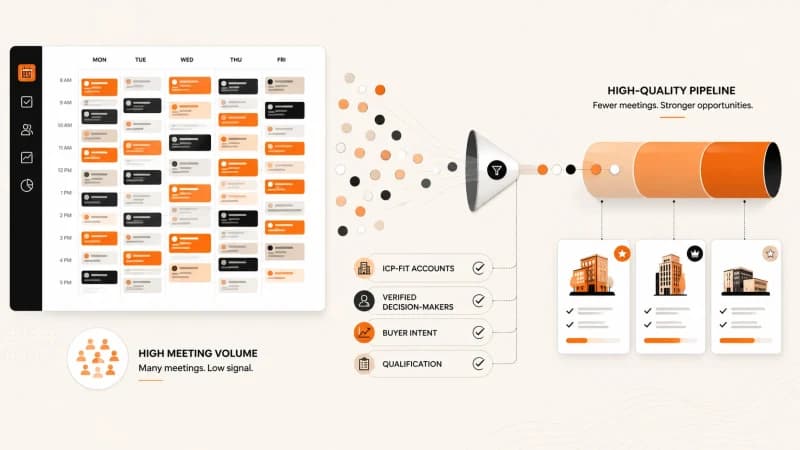
Booking more sales meetings does not automatically mean generating more pipeline. See, a calendar can look full while sales performance remains weak if meetings involve poor-fit accounts, irrelevant contacts, or prospects with little reason to buy. For B2B teams, the goal of appointment setting should not simply be generating meetings. It should be creating conversations with accounts and stakeholders that deserve sales attention. That requires more than outreach. Strong appointment-setting programs combine ICP targeting, accurate contact data, decision-maker identification, multichannel prospecting, qualification, and clear meeting-acceptance criteria. For 2026, Valasys, Belkins, Martal Group, SalesRoads, RevBoss, and Leadium are six B2B appointment-setting providers worth considering. They pursue the same broad objective, but their approaches to targeting, outreach, qualification, and sales handoff differ. For a quick fit check, consider Valasys when account selection, buying-role targeting, qualification, and appointment setting need to work together; Belkins for a broad managed multichannel prospecting workflow; Martal Group for omnichannel outbound with broader outsourced sales support; SalesRoads when phone and email are central to prospecting; RevBoss for relationship-first demand generation built around executive visibility; and Leadium when prospect data and multichannel SDR execution are both priorities. The better question is not: Who can book the most meetings? It is: Which provider is most likely to create conversations our sales team would actually want to pursue? How We Selected These B2B Appointment Setting Services Editorial disclosure: Valasys Media is the publisher of this article and is also one of the appointment-setting providers included in this guide. The companies featured below are not ranked. They are listed because their services address different appointment-setting requirements. The best fit depends on factors such as target market, sales model, qualification requirements, preferred outreach channels, and internal sales resources. Our evaluation focuses on the factors that influence meeting quality before a prospect reaches the calendar. ICP and Account Targeting Appointment quality begins with deciding which accounts deserve attention. A provider should have a clear process for identifying businesses that match the client’s ideal customer profile rather than treating every reachable company as a viable prospect. Useful criteria can include industry, geography, revenue, company size, business model, technology environment, and organizational characteristics. Teams refining this stage can use Valasys Media’s guide on using TAM to build an ideal customer profile to think about how a broad market can be narrowed into accounts that are more useful for prospecting. Decision-Maker and Buying-Role Identification The most senior person in an organization is not automatically the most useful prospect. Complex B2B purchases can involve executives, functional owners, technical evaluators, finance, procurement, and internal champions. A stronger appointment-setting process identifies contacts according to their role in the buying decision. For teams developing this approach internally, the Valasys guide to targeting different roles within a B2B buying committee provides additional context on how stakeholder priorities can differ throughout the buying process. Contact Accuracy and Outreach Accurate account selection still fails if the contact information is outdated. We therefore consider how providers research and verify prospects before outreach, as well as the channels they use to engage them. Email, calling, and LinkedIn may all play a role, but simply offering more channels does not automatically create better campaigns. What matters is whether those channels support the targeting and messaging strategy. Qualification and Meeting Definition A calendar acceptance should not automatically qualify as a successful appointment. We consider what must happen before the provider considers a prospect qualified and whether the service distinguishes between: Booked meetings Held meetings Accepted or qualified meetings These differences matter when comparing both performance and pricing. B2B Appointment Setting Services at a Glance The following comparison is intended as a quick reference. The order does not represent a ranking. Provider Targeting Main Channels Qualification No-show / Replacement Policy Best For Valasys ICP, account, and decision-maker targeting Email, calling, LinkedIn within relevant programs HQL and BANT options Confirm no-show treatment and whether success is measured using booked, held, or accepted meetings Connecting targeting, qualification, and appointment setting Belkins Manual ICP and decision-maker research Email, phone, LinkedIn Qualification before scheduling No-show re-engagement is documented; confirm whether a contractual replacement commitment applies Managed multichannel appointment setting Martal Group Targeting and prospect validation Email, phone, LinkedIn Human-led qualification Define valid-meeting requirements and agree on replacement or credit rules tied to qualification and attendance Omnichannel outbound and outsourced sales JustCall Outbound prospecting to target accounts and contact lists Phone calls, SMS, MMS, WhatsApp, and CRM-integrated outreach AI call scoring, conversation summaries, and CRM-based prospect tracking; qualification criteria depend on the sales team’s workflow No universal appointment replacement guarantee; confirm no-show handling and replacement terms with JustCall based on the plan or service agreement SDR/BDR teams, sales organizations, and appointment setters that need multichannel outreach, automated follow-ups, and AI-assisted calling SalesRoads Decision-maker identification and verification Phone and email Qualified appointment scheduling Confirm how invalid meetings and no-shows are treated for the campaign Phone- and email-focused outbound RevBoss ICP audience development LinkedIn with broader email options Qualified conversations Confirm whether calendar scheduling is included and define any no-show or replacement terms in the proposed scope Relationship-first demand generation Leadium ICP segmentation and decision-maker research Email, phone, LinkedIn Approved prospects agreeing to a call Appointment outcomes are not performance-guaranteed; confirm acceptance and replacement terms before launch Data-rich multichannel SDR programs The visible outcome may be the same, a meeting on the calendar, but the work performed before that meeting can differ significantly. B2B Appointment Setting Services to Consider in 2026 Valasys Best for: Companies that want appointment setting connected to account targeting, decision-maker identification, and deeper qualification. Valasys is particularly relevant when the underlying problem extends beyond generating more SDR activity. Its appointment-setting approach includes prospect research, cold calling, qualification, lead distribution, tracking, and reporting. Its broader HQL and BANT programs can add additional qualification criteria, while VAIS supports account intelligence and prioritization before outreach begins. This becomes useful when a business needs to determine which accounts deserve attention, identify the appropriate stakeholders, verify interest, and move relevant prospects into sales conversations. In this

Intent Data vs Account Intelligence

Intent Data vs Account Intelligence: What B2B Teams Need in 2026

Pranali Shelar- September 10, 2026

Direct Answer: Intent data helps B2B teams identify account-level research activity that may indicate growing interest. Account intelligence can add firmographic, technographic, organizational, stakeholder, and relationship context around the account. When those signals are connected with modeled buying-stage context, possible business priorities, and sales guidance, teams get a clearer path from observed activity to better-informed revenue decisions.  B2B teams have become much better at seeing buyer activity. They can track signals and account data such as website engagement, topic surges, content consumption, CRM activity, account scores, and other indicators that help identify which companies are showing interest. That visibility is already powerful because it gives marketing and sales a better sense of where relevant research is happening before a buyer necessarily raises their hand. The next opportunity is to understand what those signals mean in the context of the account. A seller may know that a company is researching a relevant topic and still want to understand who the company is, how well it fits, where it may be in its buying journey, what business issue could be connected to the research, and what conversation would make the most sense. That is why intent data and account intelligence are more useful together than as isolated capabilities. Intent Signal → Account Context → Buying Stage → Business Priority → Sales Action Each layer adds more meaning to the one before it. Intent Data vs Account Intelligence: Different but Connected Roles  Intent data gives B2B teams visibility into research activity around relevant topics, categories, problems, and solutions. It can help surface accounts that may be showing increased interest before they directly engage with sales. Account intelligence adds information about who the company is, whether it fits the ideal customer profile, what technologies it uses, how the organization is structured, and which stakeholders may be relevant, which is central to understanding what account intelligence is in a modern B2B workflow. Intent Data Helps Teams See Account Intelligence Adds Which accounts are researching More context around why the activity matters Which topics are gaining interest How related signals may connect Where research activity is increasing Buying-stage interpretation Which accounts deserve attention Possible business priorities and next steps The two capabilities solve different parts of the same problem.  Intent data helps identify meaningful activity, while account intelligence helps teams understand that activity in the context of the account. Intent Data Gives Teams the Signal Imagine your team sees that Acme Corp is showing increased research around identity security. That information is valuable immediately because it gives marketing and sales a reason to look more closely at the account, especially if the activity is recent, relevant, and aligned with what your business sells. Intent data is the evidence layer that helps reveal where interest may be developing and where further attention could be worthwhile. Think of it like CRM data and intent data working together. The CRM tells you what your team already knows about the account, while intent adds a view into current research activity. Combined, they give teams a more useful picture than either source provides on its own. Intent becomes even more useful when it is evaluated alongside fit, first-party engagement, and buying stage to help teams prioritize in-market accounts more consistently. Account Context Adds Meaning Around the Signal One research topic can support several different interpretations. An account showing increased interest in AI governance may be evaluating technology, reviewing compliance requirements, creating an internal policy, preparing for wider AI adoption, or simply exploring the category at an early stage. If the same account is also researching AI security, model monitoring, regulatory compliance, and data governance, the combined pattern becomes more informative than any individual topic in isolation. This is where account intelligence becomes particularly useful. It can organize available account evidence into a more complete view so sellers do not have to interpret every signal separately. That broader interpretation is also what makes company-level intent signals more useful for sales, because related activity can be viewed in the context of the account rather than as isolated topics. At the revenue level, that clearer context can help teams concentrate effort where the evidence is strongest instead of treating every active account the same way. Buying Stage Adds Timing to the Account View Two accounts can show strong interest in the same topic while being at very different stages of the buying journey. One may be learning about the category. Another may already be comparing approaches or vendors. That difference changes what useful engagement looks like. An earlier-stage account may respond better to educational content, problem framing, or category insights. An account showing stronger evaluation behavior may be more receptive to direct seller engagement, implementation guidance, differentiation, or business-case conversations. Buying stage is typically modeled from available signals rather than directly observed, so it should be treated as decision-support context rather than a confirmed fact.  Buying-stage interpretation adds timing to the signal. It helps sales and marketing decide not only which accounts are active but also when a particular type of engagement may be more relevant. The same logic applies to fit and timing. A perfect-fit account with little current activity may not deserve the same immediate attention as a strong-fit account showing sustained research and progression. Likewise, high activity from a poor-fit account does not automatically make it a priority. Bringing fit, intent, and stage together gives teams a stronger basis for deciding where sales effort should go. Business Priorities Add Another Layer of Context Once the account context is clear, the next question is why the activity may matter to the business. Research across cloud migration, identity access management (IAM), zero-trust security, and infrastructure modernization, for example, may indicate that the account is working through a broader modernization initiative. That interpretation is useful because it gives sales a stronger hypothesis about the business issue behind the research. It should still be treated as a hypothesis, not as confirmed internal information. Good account intelligence helps teams use evidence without overstating what is

B2B Tooling: 10 Ways the Right Tech Stack Drives Growth

The Importance of Tooling in B2B: 10 Ways the Right Tech Stack Drives Growth

Priyanshi Kharwade- August 12, 2026

A salesperson should not need 12 browser tabs, three spreadsheets and a message to marketing just to understand one target company. Yet this is how B2B work often happens. Important company details sit in one database. Buyer activity appears in another. Campaign data lives somewhere else. The CRM may contain several versions of the same account, and nobody is completely sure which record is current. Good tooling fixes this problem. It brings useful information closer to the people who need it and helps them decide what to do next. Why is tooling important in B2B? Tooling is important in B2B because it helps companies identify the right accounts, understand complex buying groups, reduce repetitive work, personalize outreach and measure revenue performance. The value does not come from owning more software. It comes from giving teams accurate context at the right moment. B2B teams often work across large account lists, several channels and buying committees with different priorities. The right tools make that complexity manageable. What does B2B tooling include? B2B tooling is the collection of software and data systems used to support marketing, sales and customer growth. A typical stack may include: Customer relationship management software Account and sales intelligence Intent data Marketing automation Sales engagement platforms Customer data and enrichment tools Account-based marketing platforms Conversation intelligence Reporting and attribution Customer-success software For example, Salesforce and HubSpot are widely used for customer relationship management. LinkedIn Sales Navigator and ZoomInfo support prospect and contact research, while platforms such as 6sense and Bombora help teams identify account intent. Outreach and Salesloft are commonly used to manage sales engagement. These tools serve different stages of the revenue process. Their value increases when the information they produce can move easily between systems. Each category solves a different problem. Trouble starts when those tools cannot exchange information or when teams do not know which system to trust. Here are ten reasons tooling has become essential to modern B2B growth. 1. It turns account research into usable intelligence Before a sales conversation, a rep may need to understand a company’s size, industry, products, market position and likely business needs. Finding that information manually takes time, and the quality of the research often varies from one salesperson to another. Most B2B teams already use several tools. A CRM stores account history. Intent platforms reveal research activity. LinkedIn Sales Navigator and other sales intelligence tools help identify relevant decision-makers. The problem is that these insights often remain scattered across tabs, databases and company websites. Account intelligence brings that context together and gives every salesperson a more consistent starting point. Imagine entering a company domain and receiving an AI-generated sales research report that explains what the business may need, why it may need it, who to contact and what to say. For teams accustomed to piecing together this information manually, that small shift could make account research considerably faster. The purpose is not to replace human judgement. It is to reduce the repetitive work that comes before it, giving salespeople more time to interpret the information, shape their approach and start better conversations. A useful account intelligence tool should quickly answer four questions: What might this company need? Why might it need it now? Who should the sales team contact? What should the outreach say? When those answers are easy to find, account research becomes sales action. 2. It helps teams focus on accounts that can actually buy A large account list can create the appearance of opportunity. It does not always create a healthy pipeline. Some accounts are too small. Others operate outside the target market. A few may be a strong fit but have no current need. Treating them all equally wastes time and budget. B2B tools help teams compare accounts using signals such as: Industry and subindustry Employee count Revenue range Geography Technology environment Ideal customer profile fit Engagement history Buying intent Purchase readiness This is especially useful for account-based marketing, where the quality of the target account list affects almost every step that follows. The purpose of scoring is not to produce an impressive number on a dashboard. A score should help a team choose an action: engage now, nurture, research further or remove the account from active focus. 3. It gives salespeople more time to sell Sales teams are frequently asked to grow revenue while also researching prospects, updating records, preparing reports and moving information between systems. That administrative load adds up. Salesforce’s 2026 State of Sales research found that the average seller spends only 40% of working time selling. The rest goes toward planning, research, data entry and other non-selling work. The study included more than 4,000 sales professionals across markets including the United States, Australia, India, Japan, New Zealand, Singapore and South Korea. Automation can reduce that burden by handling tasks such as: Enriching company records Removing duplicate data Assigning leads Creating follow-up reminders Recording campaign activity Updating opportunity stages Generating account summaries Preparing routine reports Automation should not make the customer experience feel mechanical. Its best use is behind the scenes, where it gives people more time for thoughtful conversations. 4. It helps teams understand the whole buying group B2B purchases are rarely decided by one person. A department head may identify the need. Finance reviews the cost. Procurement studies the contract. Information technology considers integration and security. Senior leadership looks at business impact. LinkedIn has reported that a B2B buying group may include six to ten decision-makers, often working through different stages of the journey. A contact-level view is therefore not enough. B2B tools should help teams see the account as a group of connected people. This includes known contacts, likely decision-makers, influencers, users and possible blockers. That broader view changes the campaign. Instead of sending one generic message to everyone, marketing can address role-specific concerns. Sales can identify missing relationships. Customer-success teams can see whether adoption is limited to one department or spreading through the business. The account is the customer. Contacts are the people moving the decision

Top AI ABM Software for Mid-Market SaaS Companies (2024 Guide)

Best Account-Based Marketing Software for Mid-Market SaaS (AI ABM Guide)

Mansi Hake- August 11, 2026

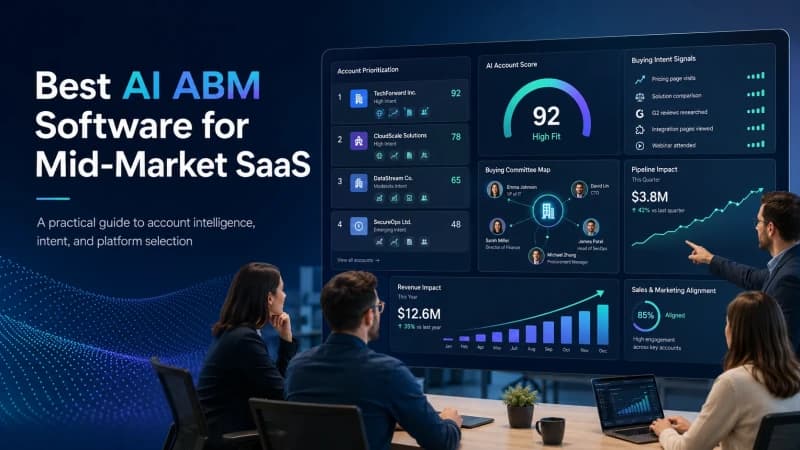
Scaling a mid-market SaaS company means making every marketing dollar and every sales conversation count. Unlike enterprise organizations, most mid-market teams don’t have unlimited budgets or large RevOps departments. Every missed opportunity, poorly qualified lead, or wasted sales cycle has a measurable impact on growth. The best account-based marketing software addresses this challenge by helping teams identify high-fit accounts, prioritize buying intent, and align sales and marketing around the opportunities most likely to generate revenue. In this guide, we’ll compare today’s leading AI ABM platforms, explain what features actually matter, and help you determine which solution best fits your business. Before we dive in, let’s start with the basics. What Is AI Account-Based Marketing Software? Account Intelligence Account intelligence combines firmographic, technographic, engagement, and intent data to help B2B revenue teams identify which accounts are worth pursuing and when. Traditional ABM was largely manual. You’d build a target account list, coordinate sales and marketing around it, and run personalized campaigns. That works at a small scale. But it falls apart at 300 accounts with a team of four. AI changes the equation in three specific ways: Identification: AI surfaces accounts showing active buying signals such as content consumption, web activity, search behavior and third-party intent before they ever fill out a form. Prioritization: Instead of treating all 500 accounts on your list equally, AI scoring tells you which 50 matter most this quarter. That’s where the budget goes. That’s where sales time goes. Personalization at scale: AI-driven platforms tailor messaging and content to specific accounts and buying committee members without requiring a full campaign build for each one. The result is a demand program that aligns with how modern B2B buyers behave. AI surfaces the engagement signals behind behaviors such as anonymous research, content consumption, and competitor comparisons, helping revenue teams identify in-market accounts earlier. Why Mid-Market SaaS Teams Need AI ABM Specifically Mid-market SaaS sits in an awkward position. Past the stage where founders close every deal personally. Not yet at enterprise scale with armies of SDRs and a $10M marketing budget. That middle ground creates a specific kind of pressure. You need a repeatable pipeline engine, but you can’t afford to run it inefficiently. Every wasted MQL is a real cost. Every deal that stalls because sales got handed a contact instead of an account context is a compounding miss. The AI ABM Platform Selection Framework Before looking at specific platforms, use this five-part framework. The right choice depends on where you score on each dimension: Intelligence: Can the platform surface accounts showing real buying signals, not just demographic fit? Does it integrate third-party intent data? Can it identify anonymous visitors? Personalization: Can you deliver account-specific experiences across web, ads, and email? Does the platform support buying committee targeting or just company-level? Activation: Can sales actually use what the platform surfaces? Is there a usable sales intelligence layer, or does it stop at marketing dashboards? Measurement: Can the platform connect campaign activity to pipeline and revenue? Can you prove ABM ROI to a CFO? Scalability: Can your team manage it without a dedicated operations hire? Is implementation realistic for a mid-market team? Rate your current needs against each criterion . A platform that scores 10 on Intelligence but 2 on Scalability is the wrong choice if your team is three people managing the stack alongside everything else. How We Evaluated These AI ABM Platforms This comparison evaluates AI ABM platforms using a consistent set of criteria designed for mid-market SaaS companies. Rather than ranking vendors based on a single feature or score, we assessed each platform against the capabilities that most influence account-based marketing success. The evaluation considers: Account intelligence: The ability to identify, prioritize, and score high-value accounts using firmographic, technographic, behavioral, and intent signals. AI capabilities: Features such as predictive scoring, buying-stage identification, intent analysis, personalization, and automation. Revenue activation: How well the platform enables sales and marketing teams to act on account insights through workflows, integrations, and engagement tools. Ease of adoption: The expected implementation effort, usability, and operational complexity for mid-market teams. Scalability: The platform’s ability to support larger account volumes and more mature ABM programs over time. This is an editorial comparison intended to help buyers understand the strengths and trade-offs of each platform. Product capabilities, pricing, and integrations may change over time, so organizations should validate current features directly with each vendor before making a purchasing decision. Best AI ABM Platforms for Mid-Market SaaS Valasys AI Score (VAIS) VAIS is an AI-powered ABM intelligence platform designed to help B2B revenue teams do one thing exceptionally well: identify, score, and prioritize the accounts most likely to convert, before sales wastes a cycle on the wrong ones. Where most ABM platforms are built around advertising or engagement orchestration and bolt on scoring as a secondary feature, VAIS leads with AI-powered account intelligence. The scoring model pulls in ICP fit data, behavioral signals, and intent data to produce account scores that reflect genuine purchase readiness, not just firmographic fit. For mid-market SaaS revenue teams, that distinction matters. You don’t have the budget to run broad account engagement across 500 companies simultaneously. VAIS tells you where to concentrate: which accounts are in-market now, which fit your ICP tightly, and which should be deprioritized until signals change. The platform is also built with the sales-marketing handoff in mind. Account scores aren’t buried in a marketing dashboard; they’re surfaced in a way sales teams can actually use to sequence outreach, prioritize accounts, and time their touches to real buying signals. VAIS: Pros Purpose-built account scoring for B2B demand generation, not retrofitted from a marketing automation tool Intent signal integration that reflects actual in-market behavior, not just firmographic fit Sales-ready AI intelligence layer and scores are usable by revenue teams, not just marketing ops Built for the mid-market operational reality: powerful without requiring a dedicated ABM operations function ICP prioritization at scale: Works for teams managing large account universes without proportional headcount VAIS: Cons Strongest value is realized

AI-Powered ABM Software: Improve Pipeline Quality in 2026

How AI-Powered Account-Based Marketing Software Improves Pipeline Quality in 2026

Pranali Shelar- August 11, 2026

AI-powered account-based marketing software improves pipeline quality by helping revenue teams identify high-intent accounts, engage the right buying committee members, and prioritize opportunities that are more likely to close.  When combined with managed ABM services, it enables organizations to turn AI-driven account intelligence into consistent execution across marketing and sales, resulting in a healthier and more predictable pipeline. Ask any B2B SaaS revenue leader about their phantom deal of the year, and the details change, but the ending rarely does. An enterprise prospect downloads your flagship ebook. They register for a webinar. They request a live product demo. Marketing celebrates the skyrocketing interest score, sales assigns a senior account executive, and the deal gets a highlighted row in the weekly forecast. Then comes the ghosting. Procurement suddenly enters the thread with a 40-page security questionnaire. IT flags a compliance bottleneck. Meanwhile, a key decision-maker is testing a competitor, and your internal champion goes quiet.  That deal didn’t crash at the finish line. It was dead on arrival, and your Customer Relationship Management (CRM) simply hid the reality. Most mid-market B2B SaaS marketing leaders aren’t starving for leads. They are drowning in static, with sales reps chasing accounts that look active on a dashboard while genuine buying intent gets missed. That is why AI-powered account-based marketing software, often supported by managed ABM services, matters right now. The real job of AI in 2026 is answering one simple question before sales wastes another quarter: Who is actually in an active buying cycle, and who is just browsing? Good account-based marketing software isn’t about generating more activity. It’s about identifying which activity actually deserves attention, so sales can focus on accounts showing real commercial intent instead of chasing dead ends, while giving leadership a forecast that relies less on wishful thinking. Your CRM Tells Only Half the Story (And Why “Lead Volume” Broke Revenue) For years, getting leads was treated as a brute-force volume game: get more site hits, gate more guides, hand off more contacts to sales, and pump up open pipeline numbers for the board. That playbook worked when buyers relied on sales reps to walk them through software options. That world no longer exists. According to research from 6sense, modern B2B SaaS buyers do 60% or more of their homework before ever filling out a contact form. Brixon Group’s B2B buyer journey research reveals that B2B buyers spend only about 17% of their total buying time meeting with potential suppliers. The rest is spent on independent research: checking peer networks, asking contacts in private Slack groups, reading technical setup guides, and narrowing down shortlists in the dark. A CRM can tell you who downloaded your guide. It cannot tell you whether finance has already decided the budget is going somewhere else. Because of this shift, marketing’s primary job is no longer capturing general attention. It is recognizing when a prospect moves from general curiosity to commercial intent. A single contact reading three blog posts is just curious. But when three different department managers from the same company spend time on your pricing page, evaluate your setup documentation, and review your integrations, that is active buying intent. If your team treats those two scenarios the same way, your pipeline will look great on paper right up until the end of the quarter, when half those deals quietly convert to “no decision.” What Actually Decides If an Opportunity Is Real Pipeline quality isn’t an abstract marketing catchphrase. It is a practical test: are your reps talking to people who can and will buy software this quarter? Unlike pipeline volume, which measures the total value of opportunities in your CRM, pipeline quality measures how likely those opportunities are to progress and close. Revenue teams typically evaluate pipeline quality using metrics such as win rate, opportunity progression, buying-group coverage, sales-cycle speed, and no-decision rate. A healthy pipeline consistently moves qualified opportunities toward revenue instead of filling forecasts with deals that eventually stall. If you want to know if a deal in your pipeline is genuine, look for three things: 1. Account Fit Right Now (Not Six Months Ago) A prospect can spend all day on your site and still be a terrible customer. Looking strictly at past deals has one flaw: it is history. Companies don’t buy software because they looked like your ideal customer last year. They buy when today’s operational priorities line up with what you sell. A high-quality pipeline starts with identifying accounts that match your current best-performing customers across software setup, growth phase, and active needs. 2. Connected Clues Over Isolated Actions Single actions are noise. Downloading a guide or attending a webinar doesn’t mean someone has an allocated budget. Real intent looks like a cluster of synchronized actions: Multiple stakeholders from the same domain researching your specific niche. Unprompted visits to implementation and pricing pages. Active comparisons on peer review platforms like G2 or TrustRadius. A hiring spree for roles that would directly manage your software category. Smart account-based marketing software evaluates these signals together rather than treating a single PDF download like a ready-to-buy lead. 3. Buying Committee Depth This is where deals go to die. Single-champion sales motions rarely work in B2B software anymore. Martal Group research shows that the average enterprise B2B buying group includes 10 to 13 internal stakeholders across departments. Marketing talks to a team lead, sales pitches the VP, and everything feels great until legal, IT security, and finance show up uninvited. If you haven’t engaged those stakeholders early, the deal stalls. High-performing account-based marketing programs move beyond lead tracking and focus on key account engagement across the entire buying committee, asking not just who filled out the form, but who else needs to be in the room before sales moves forward. For a deeper look at engaging every stakeholder involved in enterprise purchasing, read our guide on improving ABM engagement across the buying committee. Static Target Account Lists Age Like Yesterday’s Weather Most target account lists age about as gracefully as

How to Improve Key Account Engagement in Account-Based Marketing

How to Improve Key Account Engagement in Account-Based Marketing

Pranali Shelar- August 7, 2026

Your Champion Isn’t Your Customer. The Buying Committee Is. Most account-based marketing strategies don’t implode because the messaging is trash or the tech stack belongs in a museum. They collapse because teams mistake one single, hyper-enthusiastic contact for a fully engaged account. Here is the script we see every single week. Someone from a target account downloads a shiny gated whitepaper. They register for a webinar, click three emails in a row, and book a product demo. Marketing breaks out the virtual champagne, sales updates the Customer Relationship Management (CRM) to “warm opportunity,” and everyone pats themselves on the back. Then, out of nowhere, the deal quietly vanishes into thin air. Nothing dramatic happened. The problem was baked into the strategy from day one: you weren’t engaging an account. You were having a fantastic, one-sided conversation with a single person inside it. The person clicking your emails was never the sole decision-maker. Finance had deep margin questions, IT was secretly evaluating an incumbent vendor, procurement hadn’t even been looped in yet, and the executive sponsor was still trying to figure out if solving this problem was worth a line item in Q3. This is precisely where most enterprise B2B strategies fall flat. The problem isn’t personalization, your budget, or your ad creative. It’s that teams consistently confuse individual activity with account-wide engagement. An email open is an activity. A webinar registration is an activity. One lonely champion raving about your product is an activity. In most enterprise deals, real key account engagement kicks off when multiple stakeholders across the same company begin moving toward a purchase together. That is the exact line between generating superficial buzz and driving actual buying consensus. If your ABM campaigns feel wildly busy but your pipeline looks like a ghost town, stop overhauling your ad copy. Ask yourself one brutally honest question: How many people inside that target account actually know you exist? Stop Calling One Interested Contact “An Engaged Account” What causes low engagement from key accounts in ABM? Low engagement from key accounts happens when teams focus on the champion instead of the entire buying committee, rely on outdated target account lists, respond slowly to buying signals, and operate with disconnected sales and marketing efforts. Improving account-wide engagement requires coordinated outreach across stakeholders and timely activation of intent data.  Every marketing team has a favorite contact. The Champion. They comment on your LinkedIn posts, devour your case studies, reply to cold emails in five minutes, and ask brilliant questions during product demos. If you only look at your CRM activity feed, you would swear the deal is 90% closed. Then enterprise reality hits. Procurement demands a six-page risk matrix. Security wants a security compliance framework (SOC 2 Type II) report and technical documentation yesterday. Finance questions the Return on Investment (ROI) metrics. The CIO asks if your engine integrates with legacy systems built in 2012. Suddenly, that champion who loved your product turns out to be just one quiet voice in a room full of enterprise skeptics you’ve never spoken to. The mistake isn’t having a champion; you need one. The mistake is assuming your champion is going to do your sales job for you inside their own company. High-performing account-based marketing isn’t about finding a single advocate inside a target firm. It’s about systematically building trust across every desk that touches the purchase order. That requires knowing who influences the deal before you ever launch a campaign. Before dropping thousands on account-based ads, figure out the internal dynamics: Who holds the purse strings? Who is going to use the software every day? Who will block the deal on compliance grounds if they feel ignored? Who cares more about rollout speed than fancy feature lists? A CFO doesn’t care about workflow aesthetics, and an IT director couldn’t care less about your marketing features if your Application Programming Interface (API) documentation is a mess. Blast the exact same cold messaging to everyone, and you’ll save time at the cost of trust. This is why mapping out your buying committee engagement strategy is the bedrock of modern B2B growth. Instead of tracking whether one user clicked a link twice, top-tier revenue teams measure whether the conversation is spreading horizontally through the organization. If the narrative isn’t spreading, the account isn’t engaged. Period. If you want to fix low engagement, don’t write another blog post. Go find the five stakeholders on that account who haven’t heard your story yet. The Real Problem Isn’t Your ABM Software Why do B2B teams struggle with account-based marketing software? B2B teams struggle with account-based marketing software because the biggest barriers are operational rather than technical. Poor sales and marketing alignment, unclear ownership of  accounts, slow follow-up, and inconsistent execution prevent even the best ABM platforms from delivering meaningful account engagement and pipeline growth.  It is remarkably easy to blame software when pipeline stalls. Marketing platforms promise target selection, intent alerts, slick automation, and hyper-personalized messaging at scale. So when revenue numbers hit a wall, the tech stack usually takes the blame. Here is what actually happens inside most revenue organizations: The software picks up a surge in intent. An account is actively researching your category. Marketing gets an automated notification in an administrative dashboard. Sales gets nothing. Or maybe sales gets an email digest seven days later, long after the prospect already booked demos with two competitors. The software did its job. The operational execution collapsed. Companies pour hundreds of thousands into platform subscriptions without defining what happens after an intent signal flashes. Who owns the follow-up? What is the outreach window? Which messaging tracks match specific intent surges? Which accounts get custom account-based plays versus automated nurture tracks? Without operational clarity, intent data is just an expensive dashboard widget that nobody looks at. The revenue teams pulling massive returns from account-based plays don’t necessarily have better software than you. They simply have better cross-departmental habits. They review account intent data together every single week. They agree on what

How to Fix ABM Software Adoption in B2B Teams

How to Fix ABM Software Adoption in B2B Teams

Mansi Hake- July 8, 2026

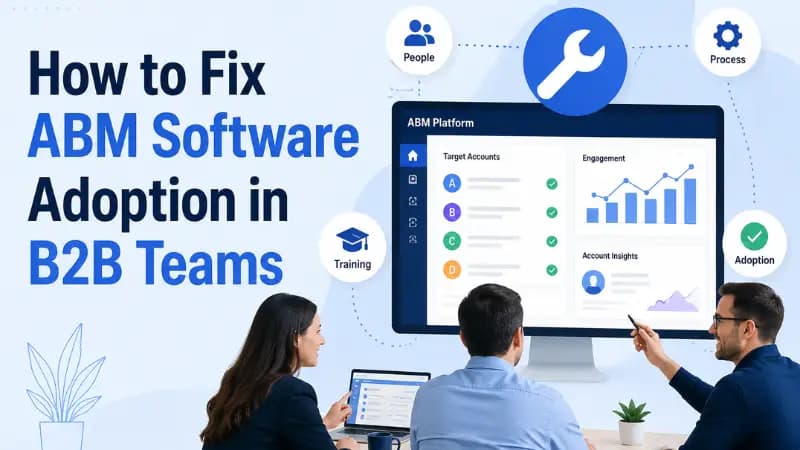
Buying ABM software is easy. Getting sales and marketing to use it consistently is much harder. B2B teams fix ABM software adoption by aligning sales and marketing, defining a shared target account strategy, improving CRM data quality, building transparent account scoring, and measuring pipeline outcomes instead of activity metrics. Technology supports these efforts, but it cannot replace them. Many organizations implement ABM software before aligning account strategy, CRM data, content, workflows, sales follow-up, and pipeline measurement. As a result, dashboards fill with activity metrics while pipeline quality changes very little. Successful ABM programs don’t start with software; they start with alignment, reliable data, and transparent account prioritization.  AI-powered ABM intelligence platforms can reinforce that foundation by giving sales and marketing a shared, explainable way to prioritize accounts, but technology only delivers value once the underlying strategy is already in place. This guide explains where adoption typically fails and what B2B teams can do to fix each issue before investing in another platform. Why B2B Teams Struggle with ABM Software The target account list keeps growing instead of getting sharper Sales and marketing report different numbers for the same program Engagement metrics climb while meeting volume stays flat Nobody can explain why a specific account made the tier-one list Account data is incomplete, outdated, or spread across disconnected systems Intent signals sit in a dashboard instead of triggering sales action Success gets measured by clicks and impressions instead of pipeline quality Why ABM Software Adoption Fails Before It Starts Several of the patterns above appear together. It’s not just one but it signals a structural problem that better execution won’t solve on its own. The root causes are consistent across companies: account selection that doesn’t reflect a genuine Ideal Customer Profile (ICP) fit, a measurement framework that was never defined before launch, and technology purchased before strategy existed. Teams that recover do it by returning to fundamentals and re-evaluating the target account list against ICP criteria, rebuilding the alignment model between sales and marketing, and scaling the program down to a size that can actually be run with quality. Vendor platforms like Demandbase, 6sense, and RollWorks are genuinely capable orchestration layers. A platform simply can’t manufacture the clarity a team hasn’t built yet: a defined target account list, a shared buying-committee model, and content built for each stage of the journey. The next seven sections walk through each failure point in the order teams typically need to fix them, starting with the one most programs skip entirely: alignment. Fix #1: Sales-Marketing Alignment Before Tool Rollout ABM programs fail most often because of misalignment, not bad technology. When sales and marketing don’t build the target account list together, sales ignores the accounts marketing is targeting, or marketing keeps running campaigns to accounts sales already deprioritized. Either way, spend gets wasted and the program stalls. The drift is usually gradual. A shared account list splits apart as sales chases its own named accounts and marketing runs separate programs. Attribution becomes contentious, reporting turns political, and after a couple of quarters of ambiguous results, each team blames the other function instead of the process that let the split happen in the first place. What to fix: Build the target account list jointly, using ICP criteria both teams agree on, before evaluating any software. Set shared account-based goals, a sales-cycle reduction target, for example, so both functions optimize for the same outcome. Give sales and marketing the same visibility into account engagement, intent signals, and deal progress, instead of separate dashboards that produce separate stories. Foundry’s ABM client Clearwave saw a 20% reduction in time-to-close after building genuine sales-marketing alignment into their account-based approach, a result tied directly to shared goals, not to the software itself. Once sales and marketing are working from the same account list and the same goals, the next question becomes whether the data behind that list can actually be trusted. Fix #2: Improve CRM Hygiene and Account Data Quality Poor CRM hygiene hurts ABM because inaccurate account records reduce targeting accuracy, weaken account scoring, and waste sales effort. Incomplete firmographic information, outdated contact records, and fragmented buying-committee data all push teams toward decisions built on wrong or incomplete information. Data that’s a few months stale can miss organizational changes, technology shifts, or competitive developments that should have reshaped the messaging entirely. CRM hygiene isn’t a side task, it’s foundational. Without trustworthy CRM and marketing automation data, ABM efforts plateau quickly, regardless of how sophisticated the orchestration platform sitting on top of it is. What to fix: Run systematic data audits and validate account records against multiple sources rather than trusting a single feed. Treat enrichment as continuous, not a one-time cleanup. Tools like ZoomInfo, Clay, or Apollo exist specifically to keep firmographic and technographic data current. Map the buying committee per account, not just a single primary contact. A strong fit score is close to worthless if the buying-committee contacts behind it aren’t reachable. Once CRM data becomes reliable, the next challenge is deciding which accounts actually deserve priority and being able to explain why. Fix #3: Build Explainable Account Scoring A scoring model only earns sales trust when a rep can look at a number and immediately understand why it’s high or low. Black-box scores get ignored, which is why platforms are increasingly built around transparent, adjustable models that explain exactly why an account is prioritized rather than handing sales a mystery number. The strongest models blend fit signals, (industry, company size, tech stack, region) with intent signals like site visits, content consumption, and third-party research activity. Intent without fit is noise: a ten-person company surging on “enterprise CRM” research isn’t your buyer, no matter how hot the signal looks. What to fix: Start with 3-5 weighted attributes per pillar (fit, intent, engagement) instead of an opaque composite score. Run enablement sessions so sales understands what triggers a Tier A designation and what action should follow it. Validate the model quarterly at minimum by comparing closed-won and closed-lost

First-Party Data Measurement for Pipeline Impact Without Third-Party Cookies

First-Party Data Measurement: How to Prove Pipeline Impact Without Third-Party Cookies

Pranali Shelar- June 27, 2026

Your attribution model has been lying to you. Not maliciously. Just quietly, politely, and with a level of confidence it never actually earned. While third-party cookies provided valuable cross-site behavioral insights, their reliability has been compromised by evolving privacy regulations and user behavior changes. For years, the entire marketing measurement machine ran on third-party cookies. Those tiny digital trackers followed prospects from your webinar landing page to a competitor’s site, back to your LinkedIn ad, and eventually into your CRM as a clean, unquestioned entry. The reporting looked beautiful. Dashboards glowed. Leadership asked fewer questions. Then reality hit. Safari blocked third-party cookies. Firefox followed. Chrome’s privacy changes and growing user preference for consent controls have further reduced the reliability of traditional tracking methods. Suddenly, the comfortable fiction that you knew exactly where your pipeline came from started unraveling. Welcome to the era of cookieless B2B marketing, where old tracking habits go to die. Here’s what’s actually wild: this is not a technology problem. It is a measurement philosophy problem. Transitioning to a sustainable infrastructure requires a comprehensive B2B first-party data strategy guide to reconfigure how you view your audience. First-party data measurement isn’t a frantic workaround. It is the upgrade your pipeline reporting has desperately needed for a decade. What Is First-Party Data Measurement? First-party data measurement is the process of using customer interactions collected through your own channels, such as website activity, form submissions, CRM records, email engagement, event participation, and sales conversations, to measure marketing’s contribution to pipeline and revenue. Unlike cookie-based tracking, which relies on observing behavior across external websites, first-party measurement focuses on signals that your organization owns and can directly validate. The result is a more reliable framework for attribution, forecasting, and revenue reporting. In practical terms, first-party data measurement answers questions like: Which campaigns generated qualified pipeline? Which content influenced opportunity creation? Which channels accelerate revenue velocity? Which accounts are showing genuine purchase intent? Those answers become increasingly valuable as third-party tracking becomes less reliable. Why First-Party Data Measurement Fails in Most Organizations  Most superficial strategy guides tell you to collect data. Far fewer actually tell you how to turn it into proof you can confidently take to the CFO. That widening gap is exactly where pipeline attribution goes to die. True measurement is not just about collecting scattered signals from your own properties. It is about building a closed-loop system where every touchpoint, whether it is a webinar registration, a content download, a demo request, or a sales email reply, flows into a unified model. This is the core engine that tells you which activities are genuinely moving accounts through the funnel. Without this architecture, you are tracking a cross-country road trip by only checking the odometer when you stop for gas. You know the distance traveled, but you have no idea which roads got you there, what caused the bottlenecks, or if you even went in the right direction. The financial stakes are massive. According to McKinsey research, companies that successfully implement personalization at scale through first-party data can see revenue increases of up to 15% while optimizing marketing spend by 20%. That isn’t a rounding error. That is a completely different budget conversation with your executive team. To bridge this operational gap, savvy teams are building a robust first-party data collection engine to automate how customer touchpoints are ingested. When data flows smoothly from collection to analytics, proving revenue contribution stops being a quarterly crisis and becomes a standard report. The Real Problem: What Old Tracking Methods Actually Measured Before you can build a better system, you have to understand what you actually lost versus what you only thought you had. Third-party cookies offered cross-site behavioral tracking. If someone visited a competitor’s pricing page, you could retarget them. If someone downloaded an ebook from a media partner site, you tried to match their identity to your database. Multi-touch attribution models could, theoretically, assign neat credit across every digital footprint. That was the theory. In practice, that journey was always wildly incomplete. The average enterprise buying group consumes massive amounts of content and requires dozens of marketing touchpoints before ever speaking to a sales representative. Old tracking methods completely missed enormous chunks of that journey: private browsing, multiple devices, offline conversations, dark social, and internal Slack threads where your best case studies are actually shared. The cookie-based model never captured that nuance. It just gave you a confident-sounding number for the narrow sliver of things it could see. So when revenue teams lament that they have lost visibility, what they really mean is they have lost the illusion of perfect measurement. Shifting to an intentional first-party vs third-party data B2B marketers mindset isn’t a downgrade. It is simply more honest. The Four-Step Formula for Proving Pipeline Impact Organizations that successfully prove marketing’s contribution to revenue typically follow the same process: Capture first-party engagement signals from websites, email programs, events, and sales interactions. Unify those signals inside CRM and customer data systems. Connect engagement to opportunity stages throughout the sales cycle. Measure pipeline outcomes using metrics such as pipeline influence, velocity, opportunity creation, and closed-won revenue. When these four elements work together, attribution becomes less about tracking clicks and more about proving business outcomes. What Pipeline Proof Actually Looks Like A first-party measurement strategy succeeds when every major revenue milestone can be traced back to verified customer interactions. For example, if a prospect first downloads a research report, attends a webinar, requests a demo, and later becomes a closed-won opportunity, your measurement system should connect those activities into a single account history. The goal is not to track every click. The goal is to prove that marketing activity influenced pipeline creation, accelerated opportunity progression, or contributed to revenue outcomes. That distinction separates activity reporting from true pipeline measurement. Building a First-Party Data Measurement Stack That Works Skip the foundational stack sequence, and your reporting falls apart the moment leadership asks a hard question. Since the core infrastructure setup is mapped across our