Common Email Nurture Errors That Reduce Conversions
Identify and fix nurture errors reducing conversion performance
 Lead-Gen now on Auto-Pilot with
Build My Campaign
Lead-Gen now on Auto-Pilot with
Build My Campaign

Stop losing B2B leads. We break down the 10 most common email nurture mistakes and give you the framework to reactivate stalled pipelines.

Common Email Nurture Errors That Reduce Conversions
Identify and fix nurture errors reducing conversion performance
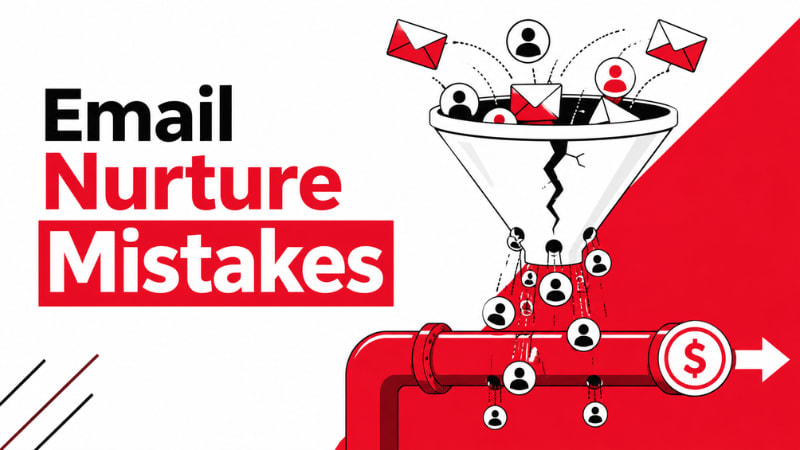
Your leads probably didn’t go cold.
You may have gone quiet. Or generic. Or too aggressive. Or just plain forgettable.
That’s the part most B2B teams don’t want to admit. A lead downloads a guide, attends a webinar, clicks a few emails, maybe even checks out the pricing page. Then nothing happens. No meeting. No reply. No pipeline.
So the story becomes: “That lead wasn’t ready.”
Maybe.
But often, the real problem is the nurture system around that lead. The emails didn’t match their stage. The follow-up came too early. The reactivation message sounded desperate. Sales didn’t know what marketing had already sent. And the entire sequence ended before the buyer had even finished researching.
That’s where email nurture and lead reactivation break down.
Common Email Nurture Errors That Reduce Conversions
Identify and fix nurture errors reducing conversion performance
Not because the strategy is wrong. Because the execution is.
Let’s fix that.
Want the complete framework? Download the full B2B Email Nurture & Lead Reactivation Playbook to see the exact sequences, scoring logic, and reactivation frameworks built to turn stalled contacts into a consistent pipeline.
This happens all the time.
Someone downloads one report and immediately gets hit with:
“Book a demo.”
“Talk to sales.”
“Schedule your consultation.”
That’s a lot to ask from someone who may barely remember your brand.

A first nurture touch should not feel like a sales rep hiding inside an email template. B2B buyers need context before they need a calendar link. They have internal teams to convince, budget timelines to manage, and risk to reduce.
So when your first email is all pitch, no value, the buyer does what buyers do. They ignore it.
Do this instead: use the first few email nurture touches to educate, not push. Help the buyer understand the problem better. Show them what to look for. Give them a reason to keep opening.
A better early email sounds like this:
“Here are 3 signs your nurture sequence is creating fake MQLs.”
Not:
“Ready to speak with sales?”
Earn attention first. Ask later.
For a deeper framework, read our guide on How to Move Leads from MQL to Revenue. It shows how to build trust before defaulting to a demo request.
A CTO evaluating vendors is not the same as a marketing coordinator who downloaded an ebook. A webinar attendee is not the same as a content syndication lead. A pricing-page visitor is definitely not the same as someone who opened one email six months ago.
Yet plenty of B2B nurture programs treat them all the same.
Same sequence. Same CTA. Same case study. Same “thought leadership” email that could have gone to anyone.
That’s not personalization. That’s a mail merge wearing a blazer.
Do this instead: segment your email nurture by stage, role, source, and behavior.
Here’s a simple way to think about it:
| Lead type | What they probably need | Best content |
| Cold content download | Education and context | Problem-focused blog or guide |
| Webinar attendee | Deeper insight | Case study, checklist, or recap |
| Pricing-page visitor | Proof and confidence | ROI content, comparison guide, customer story |
| Inactive lead | A fresh reason to re-engage | Short lead reactivation email with a new angle |
Personalization isn’t “Hi {{First Name}}.”
It’s making the buyer feel like the email was meant for their situation. That’s the standard now.
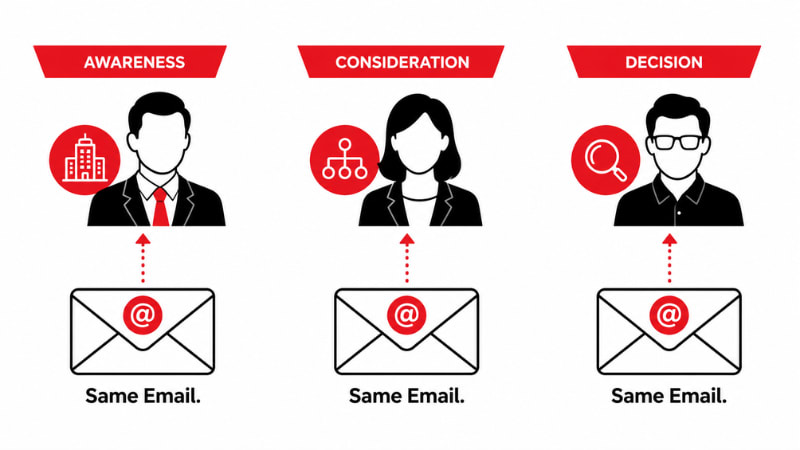
If your nurture still treats every buyer the same, start with role-based segmentation. Our guide on how to personalize nurture emails by buying committee role breaks down how to match messaging to decision-makers, influencers, and researchers without overcomplicating the flow.
Open rates can make a bad nurture program look better than it is. They’re easy to report. Easy to celebrate. Easy to misunderstand.
But an open does not mean interest. It doesn’t mean intent. It doesn’t mean the buyer read the email, clicked anything, remembered you, or moved one inch closer to revenue.
And with privacy changes affecting email tracking, open rates have become even less reliable as a performance signal.
Do this instead: measure what shows actual movement.
Look at:
Stop obsessing over vanity metrics that don’t pay the bills. If you want to see what actually moves the needle, check out our breakdown on why B2B nurture metrics should focus on pipeline, not open rates.
A 38% open rate with zero meetings is not a win.
A 14% open rate that creates three qualified sales conversations absolutely is.

Email nurture should be judged by pipeline behavior, not inbox vanity.
Some buyers tell you exactly where they are in the journey.
Not with words. With behavior.
They visit your pricing page twice. They download a comparison guide. They attend a webinar and stay until the end. They click every email about one specific pain point.
Then your automation sends them a basic awareness email. That’s a miss.
The buyer moved. Your nurture didn’t.
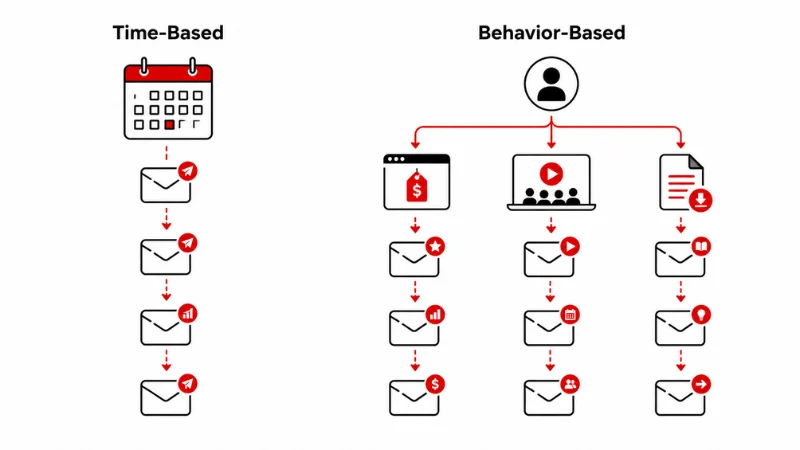
Do this instead: build behavior-based email nurture flows.
Modern buyers tell you exactly what they want through their actions, if you’re actually paying attention. See how your approach stacks up in our comparison: Behavior-Based Email Nurture vs. Time-Based Drip Campaigns.
Trigger different messages when leads show meaningful intent, such as:
A lead who reads three ROI-related assets should not receive the same next email as someone who skimmed a beginner’s guide.
Behavior tells you what the buyer cares about. Use it.
Guesswork is the enemy of a high-converting nurture flow. Instead of manually guessing which leads are ready to buy, let VAIS identify high-intent accounts in real-time. By surfacing the accounts actually researching your solution, you can skip the generic follow-up and focus your nurture energy on the leads that are already leaning in.
Here’s the familiar B2B argument.
Marketing says, “We generated the MQLs.”
Sales says, “These leads aren’t ready.”
Marketing says, “Sales never follows up.”
Sales says, “Marketing sends us junk.”
Meanwhile, the buyer gets no useful follow-up at all.
The issue is usually not laziness. It’s a lack of agreement.
Marketing and sales often define “qualified” differently. Marketing may see a form fill and an email click. Sales wants buying intent, budget, timing, and fit.
Both sides have a point.
But without shared criteria, email nurture becomes a handoff problem instead of a revenue engine.
Do this instead: define what sales-ready actually means.
Agree on:
A good handoff should never feel like throwing a lead over the wall.
Sales should know what the buyer engaged with, what they care about, and why now is the right time to reach out.
That’s when nurture starts helping the pipeline instead of frustrating everyone.
If marketing and sales are still pointing fingers, you’re leaving money on the table. Here’s how you can finally align your teams on when a nurtured lead is actually ready for the handoff.
This one quietly kills a lot of pipeline.
The average B2B buying cycle can take months. But the nurture sequence lasts three weeks.
That math doesn’t work.

A lead may not convert in the first 30 days because they’re not ready yet. They may be comparing options, building an internal case, waiting for budget, or trying to understand the problem more clearly.
Then the emails stop.
The lead gets labeled cold. A competitor keeps showing up. And three months later, that competitor gets the meeting.
Do this instead: match your email nurture timeline to the actual buying cycle.
A stronger structure looks like this:
Not every lead is ready now. That doesn’t make them bad leads.
It makes them normal B2B buyers.
If you’re cutting your nurture off after a few weeks, you’re just handing the deal to a competitor. See how we stretch the sequence to match the actual B2B buying cycle in our breakdown: How to Move Leads from MQL to Revenue.
If building out a 6–12 month, multi-stage nurture flow sounds like a logistical nightmare, you aren’t alone. That’s why we built our specialized B2B Email Nurture services, to take the heavy lifting of sequence architecture and content mapping off your plate so you can focus on closing.
Email is still one of the most useful B2B nurture channels.
No argument there.
But relying on email alone is risky.
Your buyer’s inbox is overloaded. They’re dealing with internal threads, vendor pitches, newsletters, meeting updates, sales follow-ups, and messages they meant to answer last Tuesday.
So even a good email can get buried.
That doesn’t always mean the buyer lost interest. It may just mean email wasn’t enough to stay visible.
Do this instead: use email nurture as the center of a multi-channel system.
Support it with:
The goal is not to chase people everywhere.
It’s to create useful, consistent reminders across the places where the buyer already spends attention.
Email carries the message. Other channels reinforce it. That combination is much harder to ignore.
Content syndication leads need a different approach.
They did not search for your brand. They may not have visited your website. They may not remember your company name. They downloaded content through a third-party platform, and your logo may have been a small part of that experience.
So when you drop them into a standard email nurture sequence, the first reaction may be:
“Who is this, again?”
That’s how unsubscribes happen.
Do this instead: create a dedicated lead reactivation and welcome path for content syndication leads.
Then move toward deeper content.
A simple flow might look like this:
Email 1: “Here’s the resource you requested, plus the key takeaway.”
Email 2: “Most teams miss this part of the problem.”
Email 3: “Here’s how companies are solving it.”
Email 4: “Use this checklist to benchmark your current approach.”
Email 5: “Here’s when it makes sense to talk.”
Don’t rush the relationship.
Content syndication leads need reintroduction before conversion.
Stop treating cold traffic like they already know your brand’s life story. We’ve mapped out the exact sequences that work for these specific channels, whether you’re looking to master Email Nurture Flows for Content Syndication Leads or adopt the right approach for Webinar Nurture Flows.
Lead scoring should help sales prioritize. That’s the whole point.
But in many companies, lead scoring becomes either too complicated or too shallow.
Too complicated means nobody understands it. Too shallow means every click gets treated like intent.
Opened an email? Points.
Downloaded one guide? Points.
Visited the homepage? Points.
Suddenly everyone has a score, and sales still doesn’t know who to call first. That’s not a scoring model. That’s noise with numbers attached.
Do this instead: build lead scoring around signals that predict real buying potential.
Use three categories:
A high-fit VP who visits the pricing page twice should not be treated the same as a low-fit student who downloaded a report.
Also, involve sales when building the model.
If sales doesn’t trust the score, they won’t use it. And if they don’t use it, it’s not helping revenue.
If your lead scoring is just generating noise instead of insights, kill it. Read Lead Scoring in Email Nurture: What Sales Actually Needs and start prioritizing the leads that actually have a chance of closing.
Scoring based on vanity actions like “opened an email” is why your sales team ignores your MQLs. Stop treating noise as intent. Use VAIS to automatically prioritize your pipeline based on actual buying signals, ensuring your sales team is only alerted when a lead shows verified market intent.
A lot of nurture programs stop at closed-won. That’s a mistake.
The deal closes, everyone celebrates, and then marketing disappears from the customer journey. But post-sale nurture is where a lot of future revenue comes from.
None of that happens just because the contract was signed.
Do this instead: build post-sale lead reactivation and customer nurture flows.
Send customers:
The first deal is not the end of the relationship. It’s the start of the next revenue opportunity.
Stay useful after the sale, and you’ll create a pipeline most competitors never even ask for.
| Mistake | What it looks like | Better move |
| Pitching too early | Demo CTA in the first email | Lead with education |
| Generic messaging | Same flow for every lead | Segment by role, stage, behavior, and source |
| Open-rate obsession | Reporting opens as success | Track clicks, SQLs, and pipeline |
| Ignoring behavior | Same drip no matter what the lead does | Trigger emails from intent signals |
| Weak handoff | Sales ignores MQLs | Define sales-ready criteria |
| Quitting too soon | Sequence ends after 30 days | Build 60–90+ day nurture paths |
| Email-only strategy | No channel support | Add LinkedIn, retargeting, and sales touchpoints |
| Syndication misfire | Third-party leads treated like inbound | Use a reintroduction flow |
| Bad scoring | Scores sales doesn’t trust | Combine fit, behavior, and intent |
| Post-sale silence | No nurture after close | Build retention and expansion flows |
Email nurture is not “send five emails and hope someone books a demo.” Lead reactivation is not “checking in” with people who ignored you.
Both need strategy. Both need timing. Both need relevance. And both need to be built around what the buyer is actually doing.
Send better messages. Segment harder. Watch behavior. Give leads enough time. Help sales follow up with context. Keep nurturing after the first deal.
Most B2B teams still get this wrong. That’s good news.
Because when your email nurture and lead reactivation system is built properly, you don’t need more leads to create more pipeline.
You need to stop wasting the ones you already have.
If you’re looking to turn your “lost” contacts back into conversations, grab our playbook on how to reactivate cold B2B leads without sounding desperate.
Still struggling to turn your pipeline into revenue? If you’re tired of the “spray and pray” approach, let us build your custom Nurture Strategy and turn those stalled leads into a consistent, predictable revenue engine.
The biggest mistake is sending the same nurture emails to every lead, regardless of role, stage, source, or behavior. Generic nurture makes buyers feel like they’re part of a list, not a relevant conversation.
They usually fail because the messaging is too broad, the pitch comes too early, the sequence ends too soon, or sales and marketing don’t agree on what makes a lead qualified. In many cases, the leads aren’t bad. The nurture process is.
Most B2B email nurture sequences should run for at least 60 to 90 days. Longer sales cycles may require six months or more of lower-frequency nurture, especially for enterprise buyers.
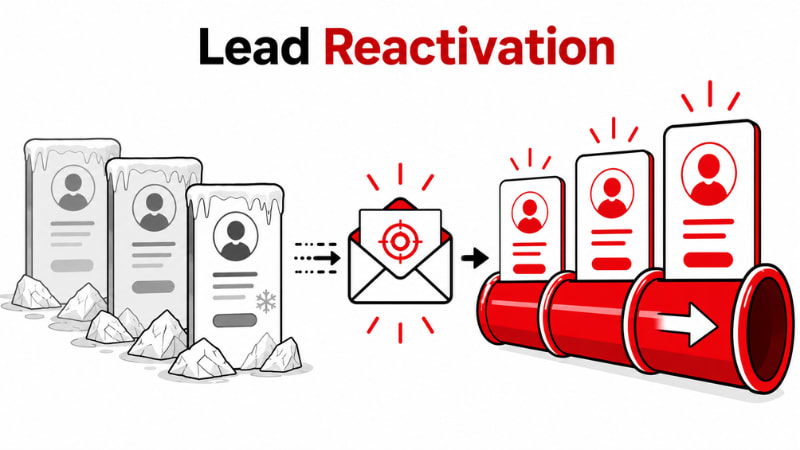
Lead reactivation is the process of re-engaging contacts who previously showed interest but stopped responding, stopped clicking, or never converted. The goal is to restart the conversation with a relevant reason to pay attention again.
Email nurture moves active leads through the buying journey. Lead reactivation brings inactive or stalled leads back into that journey. Together, they help marketing teams recover lost opportunities and create more pipeline from existing demand.
A strong lead reactivation email should be short, specific, and useful. It should offer a fresh angle, new resource, updated insight, or relevant reason to reconnect. It should not sound desperate or guilt the lead for going quiet.
No. Content syndication leads usually need a separate welcome and reactivation flow because they may not know your brand well. Reintroduce the company, connect the content to a real business problem, and build trust before pushing for a meeting.
The most useful metrics are click-to-open rate, content engagement, return website visits, MQL-to-SQL conversion, pipeline influenced, sales conversations created, and revenue impact. Open rates alone are not enough.
Personalization goes beyond inserting a first name. It means tailoring the content to specific job functions, addressing unique pain points, and triggering messages based on specific actions like visiting a pricing page or downloading a specific technical whitepaper. Relevant, persona-based messaging consistently outperforms generic blasts by establishing immediate authority.
You should stop nurturing when a lead explicitly opts out or when they reach a predetermined “cold” threshold based on sustained inactivity over a significant period. Rather than keeping them in an active cycle, move them to a low-touch, long-term database bucket where you can occasionally send high-value industry updates to keep your brand top-of-mind without cluttering their inbox.
Common Email Nurture Errors That Reduce Conversions
Identify and fix nurture errors reducing conversion performance