
Lead-Gen now on Auto-Pilot withBuild My Campaign
Valasys Media — Empowering marketers with powerful insights

When Should Sales Contact a Content Syndication Lead?

Learn when sales should contact content syndication leads, which readiness signals matter, and how to hand off leads without wasting them.

Priyanshi Kharwade
Priyanshi Kharwade
Last updated on: Nov 18, 2026
When Should Sales Contact a Content Syndication Lead?

Sales should contact a content syndication lead only after the lead has been validated and shown a readiness signal, such as a second asset engagement, a positive reply to a qualifying question, or a lead score above an agreed threshold. Until then, marketing should nurture the lead, usually starting within 24 hours of delivery.

Most disagreements about syndicated leads are really disagreements about timing. Marketing delivers a batch and wants sales to follow up quickly. Sales opens the list, sees names they don’t recognise, and either waits or calls everyone with a pitch. Neither approach produces much pipeline.

The problem is that a syndicated lead is not the same kind of lead as a demo request. The person downloaded a report because the topic interested them, not because they asked to hear from you. How and when you follow up has to reflect that.

This guide gives you a timing model you can agree on with sales before the next campaign starts. If you’re still shaping your wider programme, our B2B content syndication strategy and content syndication for B2B sales guides give useful context.

Key Takeaways

  • A content syndication lead is an early or mid-stage signal of interest, not a request for a sales conversation.
  • Validate first, then nurture, then hand off. Skipping validation wastes sales time.
  • “Fast” and “patient” are both correct: marketing responds fast, sales engages when signals appear.
  • Tier your signals as high, medium and low so sales knows what to act on.
  • Agree handoff and rejection rules before the campaign launches, not after leads arrive.
  • Track what happens to leads that never reach sales. That is where most of the value or waste hides.

Why Syndicated Leads Are Not Ready for a Sales Call by Default
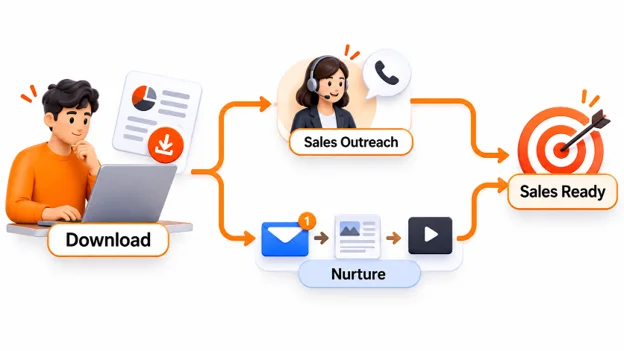
Syndicated Leads Are Not Ready for a Sales Call by Default

A person who downloads a whitepaper through a syndication network is usually researching a topic. They may not remember which company’s content they requested, and they may not have a project open at all.

That matches the broader picture of B2B buying. The 95:5 rule, associated with research from the LinkedIn B2B Institute and the Ehrenberg-Bass Institute, says roughly 95% of B2B buyers are out of the market at any given time. Most of your syndicated contacts belong to that group. They aren’t wrong leads. They are early ones.

DemandScience also notes that a prospect often needs around 20 brand touches before becoming a strong lead for sales. Whether or not that number fits your market exactly, the direction is clear: one download rarely equals buying intent.

Demo request Content syndication lead
Who initiated contact The buyer, on your site The buyer, on a third-party network
What it signals Active evaluation Topic interest
Recognition of your brand High Often low
Right first response Sales call or meeting Relevant email from marketing
Time to sales-readiness Immediate Days to months

Treating the two the same is one of the content syndication mistakes that hurt lead quality. It also explains why sales rejects content syndication leads even when the leads are technically valid.

Fast or Patient? Why Both Answers Are Right

A simple google search for this question will contradict each other. Some sources will say contact syndicated leads immediately. Others will say put them into nurture first. The conflict disappears when you separate who is contacting the lead and what they are doing.

Fast response matters because relevance fades. The lead downloaded your content recently, so a follow-up that references that asset lands while it still makes sense. A message two weeks later feels random.

Patient selling matters because a call that pitches a product to someone who wanted a benchmark report usually ends the relationship.

The resolution is a split:

  • Within 24 hours: a marketing-led or lightly personalised email that references the asset and offers a next useful resource.
  • When a signal appears: a sales-led call, email sequence or LinkedIn touch.

That is the principle behind the framework below. For the nurture mechanics, see our content syndication leads nurture framework.

Readiness Signals: What Should Trigger Sales Outreach

“Contact sales on high intent” is advice everyone repeats and few define. Here is a tiered version you can adapt.
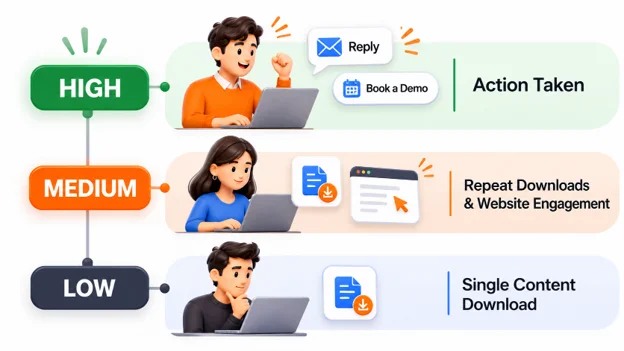
Readiness Signals What Should Trigger Sales Outreach

Signal tier Examples Recommended action
High Replies positively to a timing or qualification question; requests a demo or pricing; engages with bottom-funnel content such as a case study or comparison; lead score crosses the agreed threshold Sales contact within one business day
Medium Second content download; multiple email clicks; visits pricing or solutions pages; job title and company match the ICP and account list Warm sales touch (personalised email or LinkedIn) alongside nurture
Low Single download, no further engagement; title or company only partially matches ICP Marketing nurture only

Two points make this table work in practice.

First, fit and engagement are separate things. A VP at a target account who has opened nothing is a fit lead without engagement. A student who clicked five emails is engaged without fit. Sales should be contacted when both are present, or when engagement is strong enough to justify a conversation.

Second, signals should be agreed in advance. If you segment content syndication leads for nurture, the same segments can drive your signal tiers.

The Valasys 5-Step Sales Timing Framework

Use this as the working process between marketing and sales.
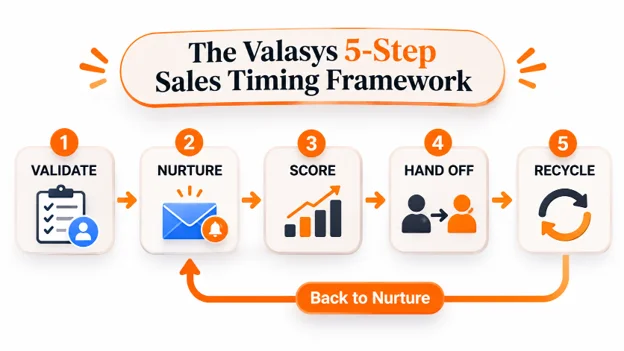
The Valasys 5-Step Sales Timing Framework

Step 1: Validate Before Anything Else (Day 0)

What to do: Check each delivered lead for ICP fit, data accuracy, duplicates, and consent.

Why it matters: Sales time spent on invalid or off-profile leads damages trust in the whole programme.

How to execute: Check job title, company size, industry and region against your criteria. Verify email deliverability and confirm the lead engaged with the specific asset you promoted. See how to validate content syndication leads and use the lead quality checklist.

Tools/process: CRM deduplication, email verification, a documented acceptance and rejection window agreed with your vendor.

Common mistake: Sending the whole batch to sales unfiltered.

Success measurement: Acceptance rate and share of leads rejected for fit versus data quality.

Step 2: Start Nurture the Same Day (Day 0 to 1)

What to do: Put every accepted lead into an email sequence that references the downloaded asset.

Why it matters: The lead recognises the context, and you start building the repeat touches buyers need.

How to execute: Send a short first email within 24 hours, then follow with related content for their role or topic. Our content syndication follow-up plan covers sequence structure.

Tools/process: Marketing automation with segmentation by topic, role and account tier.

Common mistake: Sending a product pitch as the first email.

Build My Campaign

Success measurement: Open and click rates by segment, and reply rate.

Step 3: Score and Watch for Signals (Days 1 to 30)

What to do: Track fit and engagement and flag leads that cross your thresholds.

Why it matters: This replaces gut feeling with a rule sales and marketing both accept.

How to execute: Assign points for fit (title, account, industry) and engagement (repeat downloads, clicks, replies, site visits). Set the sales-ready threshold together.

Tools/process: Lead scoring in your CRM or marketing platform, plus account-level intent data if available.

Common mistake: Scoring on a single action such as opening an email.

Success measurement: Percentage of flagged leads that sales accepts.

Step 4: Hand Off With Context

What to do: Pass the lead to sales with the full history, not just a name and email.

Why it matters: A salesperson who knows what the lead read can start a relevant conversation.

How to execute: Include the asset downloaded, the topic, other engagement, the score, and a suggested opening line.

Tools/process: CRM task or alert with a standard handoff template.

Common mistake: Handing over a spreadsheet with no context.

Success measurement: Time from flag to first sales touch, and sales feedback on lead relevance.

Step 5: Sales Outreach, Then Recycle (After Handoff)

What to do: Run a short, structured sales sequence. If the lead doesn’t respond, return it to nurture instead of dropping it.

Why it matters: Not responding does not mean not interested. Many leads are simply early.

How to execute: Use two or three touches across email and LinkedIn, then recycle with a reason code and a review date.

Tools/process: Sales engagement platform, CRM status fields for recycled leads.

Common mistake: Marking non-responders as dead.

Success measurement: Meeting rate, opportunity creation rate and re-engagement rate from recycled leads.

Want to see how your current follow-up process compares with a readiness-based model? Get in touch with Valasys to explore how our content syndication approach can help.

Decision Matrix: What Should Happen With This Lead?

Lead situation Action Owner
Fits ICP, target account, replies positively to a qualifying question Contact within one business day Sales
Fits ICP, downloaded twice, clicked multiple emails Warm personalised touch plus nurture Sales and marketing
Fits ICP, single download, no engagement Nurture only Marketing
Partial ICP fit, high engagement Check the fit, then nurture or warm touch Marketing
Outside ICP Reject or suppress, and report to the vendor Marketing
Invalid data, duplicate or competitor Reject within the agreed window Marketing

This matrix is also why lead volume versus lead quality matters here. A large batch with a small sales-ready portion is normal, not a failure, as long as the rest is being nurtured with purpose.

Pre-Handoff Checklist

Before a lead goes to sales, confirm:

  • ICP fit on title, company size and industry
  • Valid, deliverable contact data
  • No duplicate or existing opportunity in the CRM
  • Clear record of the asset downloaded and when
  • At least one engagement beyond the original download, or a strong account-level reason
  • A suggested first message based on the content they read
  • An agreed time window for sales to act

Need help defining handoff criteria and lead quality checks before your next campaign? Get in touch with Valasys to explore how we can help strengthen your content syndication process.

What the First Sales Touch Should Look Like
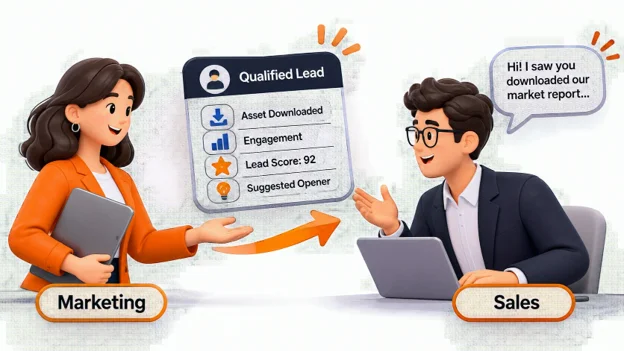
What the First Sales Touch Should Look Like

The first message should be useful and brief. It should reference the asset, connect to a business problem, and ask a low-effort question. It should not push a demo.

An example for a lead who downloaded a report on account-based marketing benchmarks:

“Hi

, I saw you looked at the ABM benchmarks report. A lot of teams reading it are trying to decide which accounts to prioritise first. Is that something you’re working on this quarter? Happy to share how others are approaching it.”

Email usually works better than a cold call for leads without a high-intent signal, because it lets the person respond when ready. A call becomes appropriate when a high signal exists, such as a reply or a demo-page visit.

Common Timing Mistakes and Fixes

Mistake Why it hurts Fix
Calling the entire batch on day one Contacts don’t recognise you and ignore or reject the outreach Validate and nurture first, then act on signals
Waiting weeks with no touch Relevance fades Send a marketing touch within 24 hours
No agreed signals Sales and marketing argue about readiness Define tiers before launch
Handing over leads with no context First message feels generic Use a handoff template
Dropping non-responders Early leads are wasted Recycle with a review date
Judging by lead count only Hides real pipeline contribution Measure by stage and sales acceptance. Align on goals for leads, pipeline and awareness

Many of these problems can be prevented in the content syndication campaign brief, where handoff rules, acceptance windows and follow-up ownership can be written down before the campaign starts. For wider quality improvements, read how to improve lead quality in content syndication.

Metrics That Show Whether Your Timing Is Working

  • Time to first touch: hours from delivery to first marketing email
  • Sales acceptance rate: share of handed-off leads sales agrees are worth pursuing
  • Signal-to-meeting rate: how many flagged leads become meetings
  • Recycle re-engagement rate: how many nurtured leads later show new signals
  • Pipeline influenced: opportunities where a syndicated lead was involved

Conclusion

The best answer to “when should sales contact a content syndication lead?” is “when the lead has shown they’re ready.” Before that, the lead needs a quick, relevant marketing response and consistent nurture.

Agree your signals, your handoff rules and your recycling process before the next campaign launches. That keeps sales focused on the leads most likely to convert and keeps the remaining leads warm.

Ready to build a follow-up process your sales team will actually use? Get in touch with Valasys to explore how we can help improve your content syndication and lead follow-up strategy.

Frequently Asked Questions

  1. Which tools help decide when sales should contact a lead?
    Use CRM lead scoring, marketing automation for engagement tracking, and email verification for data quality. Account-level intent data can strengthen the picture. The tool matters less than having agreed thresholds that sales and marketing both trust.
  2. Should sales call a content syndication lead immediately?
    Usually not. A cold call to someone who only downloaded a report can feel intrusive. Marketing should send a relevant email first, and sales should call when a signal such as a reply, repeat engagement or a score threshold appears.
  3. How quickly should you follow up on a syndicated lead?
    Send the first marketing touch within 24 hours, while the content is fresh. Sales outreach follows when readiness signals appear. Speed matters for the first relevant response, not for an immediate sales pitch.
  4. What should sales do if a syndicated lead doesn’t respond?
    Return the lead to nurture instead of discarding it. Record a reason and a review date, and keep sending relevant content. Non-response often means poor timing, not poor fit, and the lead may show new signals later.

Related Posts

Anthropic's IPO Could Raise $64.4 Billion as AI Investment Accelerates

Anthropic’s IPO Could Raise $64.4 Billion as AI Investment Accelerates

Mansi Hake

November 10, 2026: Artificial intelligence company Anthropic could raise up to $64.4 billion through its proposed initial public offering (IPO), according to an updated prospectus reported by Reuters. The IPO, combined with a separate $26 billion private placement involving major technology investors, could bring the total fundraising to approximately $90.4 billion. However, the $64.4 billion IPO figure includes shares sold by both Anthropic and existing shareholders. The company will not receive proceeds from shares sold by existing shareholders. The proposed IPO values the offering at an indicative share price of $70 to $78. Anthropic plans to sell 801.35 million shares, while existing shareholders will sell an additional 23.65 million shares. The separate private placement involves seven major technology investors: Google, Nvidia, AMD, Broadcom, Micron, Microsoft and TSMC. Anthropic, the developer of the Claude family of AI models, made its initial registration statement public on October 26. It subsequently filed an updated amendment, Amendment No. 2, with the U.S. Securities and Exchange Commission (SEC) on November 10, containing revised IPO details. The proposed Nasdaq listing is expected to trade under the ticker symbol ANT.  According to its amended SEC filing the fundraising plans come as the company reports rapid revenue growth driven by enterprise adoption. Anthropic recorded $33.24 billion in revenue for the nine months ended September 30, 2026, compared with $2.55 billion during the same period last year,  Its enterprise customer base also expanded significantly. More than 11,900 customers generated at least $100,000 in trailing-twelve-month (TTM) revenue by September 30, up from more than 950 customers a year earlier.  However, this expansion has required substantial infrastructure investment. Anthropic reported $18.8 billion in computing and infrastructure expenses during the first nine months of 2026, compared with $4.38 billion in the corresponding period last year. This represents a 329% year-over-year increase, reflecting the growing computing capacity required to develop and operate its AI models.  Despite the substantial infrastructure spending, Anthropic reported a GAAP operating loss of $1.26 billion for the nine months ended September 30, 2026, against revenue of $33.24 billion. This provides a clearer picture of its operating performance, separate from the much larger net loss reported for the period. The company also reported a generally accepted accounting principles (GAAP) net loss of approximately $104 billion for the period. However, much of this figure resulted from non-cash fair-value accounting adjustments rather than cash operating losses. The filing attributed $94.3 billion to changes in the fair value of convertible notes, derivative liabilities and simple agreements for future equity (SAFEs), primarily reflecting increases in the estimated value of these financial instruments as Anthropic’s enterprise valuation grew. By comparison, Anthropic reported $5.59 billion in adjusted net income, a company-defined non-GAAP financial measure that excludes selected expenses and accounting adjustments. The figure provides an alternative view of the company’s financial performance but differs from its GAAP-reported net loss.  The proposed listing comes as investors assess whether the commercial potential of advanced AI can justify the capital required to develop and operate increasingly sophisticated models. “There is still enormous excitement about AI’s potential to transform businesses, turbocharge productivity and reshape entire industries, but investors are becoming more discerning,” said Susannah Streeter, chief investment strategist at Wealth Club. Thomas Hayes, chairman of Great Hill Capital, also commented on investor expectations surrounding the offering. He described the IPO as being “for the faithful” and suggested that committed investors would eventually expect a return on their invested capital.  Anthropic’s proposed IPO could become a major test of investor appetite for AI businesses as they move from private funding rounds to public markets. Its combination of rapid revenue growth, rising infrastructure costs and substantial fundraising ambitions will put the economics of developing advanced AI under greater scrutiny.

How to Identify the Economic Buyer in B2B Qualification

How to Identify the Economic Buyer in B2B Qualification

Mansi Hake

How Do You Identify the Economic Buyer in B2B Sales? To identify the economic buyer in B2B sales, find who can authorize funding for this specific purchase, then verify that authority. Separate final financial approval from budget administration and internal advocacy. The economic buyer may be one executive or an approval group, so confirm the approval route, not just a name or title. Key Takeaways Seniority tells you where to look. It proves nothing about who can approve this purchase. The person who manages a budget and the person who can approve spending from it are often two different people. Ask what limits apply and who else has to sign.  What a contact tells you stays a lead until the approver confirms it. Unresolved authority calls for a dated next step, not a hopeful forecast. Why Does Identifying the Economic Buyer Matter in BANT Qualification? A deal can look healthy for weeks on the strength of one friendly contact. They answer emails, book the demo, and say finance won’t be a problem. Then the proposal lands on the desk of someone who was never part of the conversation. Within BANT, the Authority assessment looks at who controls the budget for a purchase and which stakeholders are involved in the decision. The modern BANT qualification framework treats authority as a buying condition that sales teams need to verify rather than assume from a job title. Identifying the economic buyer establishes who can authorize the spending. The urgency of the need and the feasibility of the buying timeline still require separate evaluation. Economic Buyer vs. Budget Holder vs. Decision-Maker: What Is the Difference? On a small tool, one department head can be champion, budget holder, and approver all at once. On a larger purchase, those roles split, and that is where discovery notes start to blur. Most deals will not have five different people filling these roles, so use the table to see which functions are present and who covers each. Role Typical responsibility What does not establish final funding authority Economic buyer Holds final authority over whether the purchase is funded; may be a person or a group  A title alone, or seniority in an unrelated function Budget holder Manages an allocated budget Managing a budget does not mean authority to approve or redirect it Champion Supports the purchase internally; a separate role from the economic buyer  Enthusiasm, responsiveness, or access Technical evaluator Assesses fit, security, and integration A positive technical review Procurement or contract signatory Runs the buying process, negotiates terms, or signs the agreement Processing or signing a contract A complete BANT authority assessment also distinguishes the financial decision-maker from people responsible for technical reviews, procurement, and contract execution. How to Identify the Economic Buyer in Six Steps 1. Define the Purchase and Its Funding Requirements Start with the thing being bought: the solution, its scope, the expected financial commitment, the contract length, and the business units it touches. Approval authority attaches to a purchase, so a pilot for one team and a multi-year rollout can land on different desks in the same company. You can move on once the buyer agrees your description of the purchase is accurate. 2. Identify Who Owns the Business Outcome Look for the person who answers for the result the product is meant to improve, such as pipeline quality or forecast accuracy. Accountable leaders often sponsor spending, so this person is a strong candidate. They are still only a candidate. Caring most about the outcome and holding the authority to release funds are separate facts. Write the name down as a hypothesis and carry it into the next steps. 3. Trace the Funding and Approval Route Ask where the money would come from. It could sit in an existing allocation, a requested budget, a discretionary pool, or a funding request that hasn’t been written yet. Then ask what has to happen before anyone can commit it, such as a business case or a finance review. A budget holder can often spend an allocation without being able to change it, so the route matters as much as the name. Hold off on advancing until you can describe the path from request to approved funds. 4. Check Approval Limits and Veto Authority Find out what spending thresholds exist, who holds delegated authority, and what extra sign-offs apply. Two powers get confused here. Security, legal, and technical reviewers can stop a deal without owning the funding decision, and the person who owns funding may never see the technical review. A contract that crosses someone’s limit also hands the final call to somebody else. Your output is the threshold that applies to this deal, plus a list of who can block it and which of those people also control funds. 5. Validate the Candidate With Buyer Evidence Sort everything you know into three piles: inference from a job title or company research, information reported by a champion or another stakeholder, and confirmation from a person responsible for the approval. Practitioners recommend writing the buyer hypothesis down and then confirming it. The strength of your evidence depends on what was verified. If a champion says “the VP signs off,” you have verified what the champion believes, nothing about the VP. Every fact should carry its pile before you advance. 6. Confirm the Route to Financial Approval Agree on a next step that tests your candidate. That might be an introduction to the financial decision-maker, a walkthrough of the approval process, or confirmation from another authorized person such as a finance partner.  You do not need to meet the CEO or CFO; plenty of purchases are approved far below that level. When direct access isn’t available, stay on good terms with the gatekeepers and influencers who can help, send specific questions through them, and record the answers as reported. If your contact resists an introduction, ask what the approver would need to see and offer to supply it. Leave the step with a dated action agreed. What Questions

Deloitte Launches Converge Front Office AI Suites

Deloitte Launches Converge Front Office AI Suites for Marketing and Sales

Priyanshi Kharwade

The new agentic AI offering connects marketing and sales systems, with Deloitte executives outlining its capabilities and industry experts examining the wider business impact. TL;DR Deloitte Digital launched Converge Front Office on November 16, 2026, introducing AI-powered marketing and sales solutions. Converge Marketing and Sales support campaign management, prospect research, sales workflows, and performance tracking. Deloitte executives highlighted disconnected systems and challenges affecting enterprise AI adoption. One client pilot showed outbound email response rates rising from 17% to approximately 56%. Planned expansion includes commerce, customer service, and customer strategy solutions. Nov. 16, 2026 – Deloitte Digital has launched Converge™ by Deloitte Front Office, a new suite of AI-powered tools designed to connect enterprise marketing and sales operations. Announced in New York, the offering helps businesses work across existing software, customer data, and internal systems without replacing their current technology. According to Deloitte’s official announcement, the launch includes Converge Marketing and Converge Sales. The company also plans to introduce solutions for commerce, customer service, and customer strategy. The announcement follows Deloitte Digital’s 2026 Personalization Trends research, which found that 97% of surveyed brand leaders believe AI is developing faster than their organizations can use it effectively for personalization. Another 76% said their existing systems and processes do not adequately support AI value creation. Deloitte Leaders Share Their Views on the Launch Mike DeLone, U.S. head of Deloitte Digital, highlighted the challenges businesses face when marketing and sales teams use disconnected systems. He said Converge aims to bring customer information and business activities together to help organizations make better use of their technology investments. Sundhar Sekhar, Deloitte’s chief services officer, focused on customer experience. He explained that connecting customer-facing operations could help businesses manage customer relationships more consistently across different channels. Mark Singer, marketing services lead and CMO of Deloitte Digital, identified disconnected workflows and operating models as barriers to AI adoption. He said businesses need better coordination between their technology, data, and teams to move AI projects into regular operations. Soumendra Mohapatra, Deloitte Digital’s national sales domain leader, discussed sales productivity. He said connecting existing sales applications could reduce manual tasks and support more coordinated customer interactions. How Converge Marketing and Sales Work Converge Marketing uses four types of AI agents: research, build, execution, and monitoring. These agents support audience research, campaign planning, content development, campaign execution, and performance tracking. Marketing teams continue making key decisions. Converge Sales helps teams research prospects, prioritize opportunities, manage incoming leads, and update forecasts. Deloitte says the technology can reduce quotation preparation from days to minutes, with human review included. In a report published by Digiday, Umberto Castaldo, Deloitte Digital’s Converge marketing go-to-market lead, demonstrated how AI agents could reuse existing brand assets to create campaigns for different audiences. Abe Awasthi, Deloitte Digital’s AI sales transformation leader, explained that administrators can control whether AI agents suggest actions, prepare drafts, or complete specific tasks. Early Client Results and Industry Perspective According to Digiday, one Deloitte client tested its sales system with half of its 300 business development representatives. During the three-month pilot, outbound email response rates reportedly increased from 17% to approximately 56%. After wider deployment, response rates settled in the 30% range. Awasthi also reported a 20% increase in team sales quotas. These figures come from one client and do not represent guaranteed results. Jay Wilson, a Gartner vice president and analyst, noted that consulting firms have established relationships with senior business leaders. He also highlighted the growing influence of CFOs in marketing spending decisions as companies face pressure to demonstrate financial returns. What Does the Launch Mean for Enterprise Marketing? Deloitte’s launch reflects growing interest in connecting marketing and sales activities through AI rather than managing them with separate tools. For businesses considering such platforms, integration costs, data security, human oversight, and measurable results will be important factors. Deloitte plans to expand Converge Front Office into commerce, service, and customer strategy, although specific release dates remain unconfirmed. The platform’s long-term impact will depend on whether businesses achieve consistent improvements in productivity, customer engagement, and sales performance.