

How to Segment Content Syndication Leads for Nurture
Segment content syndication leads by asset, role, intent, and stage so nurture feels relevant and sales gets leads worth calling.


Your leads aren’t ignoring you for fun. You’re probably giving them zero reason to care. Before you hit send on another nurture email, figure out what they actually want and segment accordingly.
What is the best way to segment content syndication leads?
To segment content syndication leads for nurture, sort each lead by four signals in order: the asset they downloaded, their role, their intent, and their buying stage. Start with the asset to set the topic, then use role to set the message, intent to set the pace, and stage to decide whether nurture or sales owns the next step.
Why one nurture track for every syndicated lead fails
Your content syndication leads don’t owe you buying intent just because they downloaded your asset. They might be researching a challenge, gathering information for a colleague, or comparing solutions. Treating all three as equally sales-ready is a segmentation problem, not a lead generation problem.
At this stage, you’re still a stranger to them. They came for the content, not your brand, and that initial interest shouldn’t be mistaken for a desire to hear from sales.
The answer isn’t to send more emails. It’s to understand what each lead’s actions tell you and segment them accordingly before the first follow-up.
If you’re still refining the campaign itself, our guide to improving lead quality in content syndication covers the upstream side. Here, we focus on what happens after those leads enter your CRM.
Key takeaways
- A syndicated lead’s strongest signal on day one is the asset they downloaded, not their job title.
- Separate implicit intent (inferred from the asset and channel) from exclusive intent (shown only through actions with you). Only the second justifies a sales handoff.
- Syndication is mostly top of the funnel, so most leads should enter an education track, not a sales sequence.
- Do not ask the lead to fill in another form. Enrich, infer, and observe instead.
- Map every segment to one action: educate, evaluate, review for sales, or hold. A segment without an action is just a spreadsheet column.
- Measure segments by handoff acceptance and opportunity creation, not by email opens.
Why syndicated leads need their own segmentation logic
Content syndication has always been a top-of-funnel motion. The lead typically meets your brand through a whitepaper, report, or guide hosted on a partner’s platform, often through a short or pre-filled form.
That creates three differences from owned-channel leads:
- The form was a toll gate, not a conversation. The lead gave the minimum to get the asset.
- You have one strong signal and a handful of weak ones. The asset is strong. Everything else is firmographic data supplied by the publisher.
- You have no behavioural history with the lead yet. No site visits, no replies, no pricing page views.
Buyers are also doing more of the work themselves before they speak to anyone. Gartner’s 2025 survey of 632 B2B buyers found that 61% prefer a rep-free buying experience. For syndication, that means a premature sales call is more likely to end the relationship than start one. Useful nurture earns the right to a conversation.
If your sales team already pushes back on syndicated leads, the reasons are usually upstream. See why sales rejects content syndication leads for the common patterns.
Implicit intent vs exclusive intent: what a syndicated lead actually tells you
Before you build segments, decide what counts as evidence. Two kinds of intent exist in a syndication lead, and they carry very different weight.
Implicit intent is what you infer from the asset and the channel. A lead who downloaded “A Buyer’s Guide to Intent Data Platforms” probably has a problem related to intent data. The channel adds context: a download from a partner’s research library suggests learning, while a webinar registration suggests a higher tolerance for time spent.
Exclusive intent is a signal that exists only because the lead did something with you, in your environment. They opened and clicked a follow-up, visited your pricing page, replied, or booked time. No publisher can sell you that, and no one else can see it.
| Implicit intent | Exclusive intent | |
| Source | Asset topic, asset format, channel | Behaviour in your emails, site, and replies |
| Available | Day one | Only after outreach |
| Reliability | Directional, can be wrong | Strong, specific to you |
| Best used for | Choosing the first message and track | Deciding pace and sales handoff |
| Risk if over-trusted | Treating a curious reader as a buyer | Waiting too long on a hot lead |
The working rule: implicit intent decides where a lead starts. Exclusive intent decides where it goes next.
Read the asset’s intent, not just its title
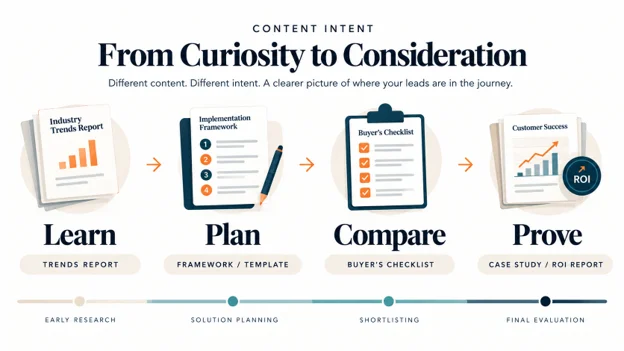
Two leads can download assets on the same topic with very different intent. A trends report signals curiosity about a category. A vendor comparison checklist signals someone who may already be building a shortlist.
Group assets by what a reader is trying to do with them:
- Learn: trend reports, benchmarks, explainers
- Plan: frameworks, templates, how-to guides
- Compare: buyer’s guides, checklists, evaluation criteria
- Prove: case studies, ROI studies, customer stories
Learn and plan assets usually point to early-stage leads. Compare and prove assets point later, though still not to sales readiness without a second signal.
Read the channel’s intent too
Channel changes how much the same download is worth. A lead who clicked through from a newsletter and read a long report made a different effort than one who accepted a pre-filled form on an aggregator page. Record the channel as a field, then let it nudge the segment up or down by one step, never by two.
No one loves filling more forms: segment without asking
Every syndication lead has already filled in a form. Sending them to a second one in the first email, to “complete your profile,” is the fastest way to lose them.
Fill the gaps without asking:
- Enrich: append firmographic data you are missing from your CRM or data provider.
- Infer: use the asset topic and format to estimate the problem and stage.
- Observe: let clicks, page views, and replies tell you what the lead cares about.
- Ask softly: if you must ask, use one-click choices inside the email, such as “Which of these is closer to your situation?”
This is also where validating leads before handoff pays off. Clean, verified data makes every segment above more trustworthy.
The Valasys A-R-I-S Segmentation Model
A-R-I-S stands for Asset, Role, Intent, Stage. Apply the layers in order, because each one narrows the previous one.
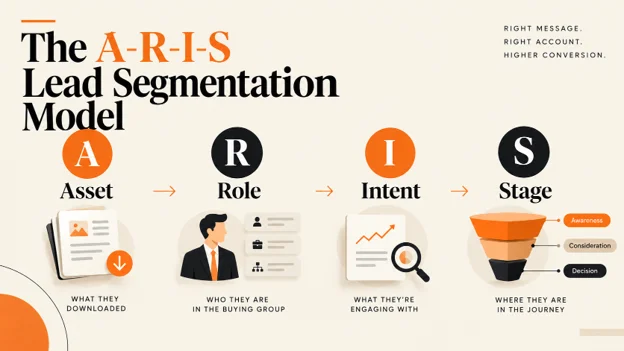
Step 1: Asset (set the topic and the entry point)
What to do: Tag every lead with the asset title, topic, format (learn, plan, compare, prove), and channel.
Why it matters: The asset is the only thing the lead explicitly chose. It is the most honest signal you have on day one.
How to execute: Create one nurture track per topic cluster, not per asset. Ten assets on three topics means three tracks.
Tools/process: CRM custom fields, a campaign-to-asset mapping sheet agreed during the campaign brief.
Common mistake: Opening the follow-up with a product pitch instead of the problem the asset addressed.
Success measurement: Click rate on the first follow-up, by asset topic.
Step 2: Role (set the message and the depth)
What to do: Segment by function and seniority, not job title strings, which vary wildly.
Why it matters: The same topic needs a different angle depending on who reads it. An executive wants cost, risk, and outcomes. A practitioner wants process and tools.
How to execute: Use three role groups: decision makers (VP and above), evaluators (director and manager), and practitioners (everyone else who would use or influence the work).
Tools/process: Normalise titles into function and seniority fields. Write one email variant per group.
Common mistake: Ignoring practitioners because they cannot sign. They are often the people who bring the problem to the buying group.
Success measurement: Reply and forward rate by role group.

Step 3: Intent (set the pace)
What to do: Layer exclusive intent on top of implicit intent. Score what the lead does with you, not just what they downloaded.
Why it matters: This is where sales readiness actually shows up. A lead who reads three emails and visits a case study is telling you something no asset title can.
How to execute: Define three bands: quiet (no owned-channel action), warming (repeat engagement with educational content), and active (pricing, comparison, case study, or reply).
Tools/process: Marketing automation lead scoring, with web tracking tied to the lead record.
Common mistake: Counting opens as intent. Email clients and privacy features distort opens. Weight clicks, visits, and replies instead.
Success measurement: Share of leads moving from quiet to warming within the first few weeks.
Step 4: Stage (decide who owns the next step)
What to do: Combine the first three layers into a stage: learning, evaluating, or ready for sales review.
Why it matters: Stage decides whether marketing keeps nurturing or sales gets involved. Getting this wrong in either direction is expensive: too early burns the lead, too late loses it.
How to execute: Require two signals for a handoff: an account that matches your ICP (ideal customer profile, the firmographic and need profile of your best-fit customers) and a behaviour from the active band.
Tools/process: A written handoff rule that sales has agreed to. The nurture framework for syndicated leads covers the content side of this stage in detail.
Common mistake: Handing off on the strength of the asset alone.
Success measurement: Sales acceptance rate of handed-off leads and opportunity creation from them.
From segment to action: the decision matrix
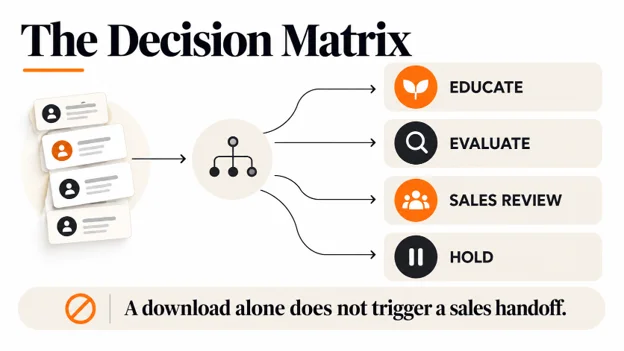
Segmentation only matters if each segment triggers something different. Use this matrix as a starting point and adjust it to your own sales cycle.
| Asset intent | Role | Owned-channel behaviour | ICP / TAL fit | Action |
| Learn or plan | Any | None | Fit | Educate: topic-matched content series, low frequency |
| Learn or plan | Practitioner | Repeat clicks | Fit | Equip: give them material to take to their team |
| Compare | Evaluator or decision maker | Some clicks | Fit | Evaluate: comparison content, proof, a soft offer |
| Compare or prove | Evaluator or decision maker | Pricing, case study, or reply | Fit | Sales review: hand off with full context |
| Any | Any | Any | No fit | Hold: newsletter-level contact only |
| Any | Any | None for a long stretch | Fit | Re-engage once, then move to hold |
TAL stands for target account list, the named set of companies your sales and marketing teams have agreed to prioritise. A lead from a TAL account who shows active intent should reach sales faster than the same lead from an account outside it.
A simple example
Two leads download the same “Intent Data Buyer’s Guide” in the same week. One is a marketing manager at a mid-sized software company in your TAL. The other is a consultant at a company outside your ICP.
The first enters the evaluate track with a comparison-focused email. The second goes to hold. Same asset, different outcome, and no one filled in another form.
Two weeks later, the marketing manager visits your case studies and replies to the second email. That is exclusive intent. She moves to sales review, and sales receives the asset, the emails she clicked, and the pages she visited.
Segmentation checklist
Before you launch nurture on a new batch, check that:
- Every lead has asset title, topic, format, and channel recorded
- Titles are normalised into function and seniority
- Each lead is matched against your ICP and TAL
- Consent and opt-in status are recorded for the region of the lead
- Leads are labelled by intake month so batches can be compared
- Each segment has one named action and one owner
- The handoff rule is written down and agreed with sales
- Reporting is set up by segment, not only in aggregate
If you want a quality gate to run before any of this, use our content syndication lead quality checklist.
Common segmentation mistakes and how to fix them
| Mistake | Why it hurts | Fix |
| Segmenting only by job title | Title says who they are, not what they need | Start with asset, then role |
| Treating every lead as a prospect | Burns trust, drives unsubscribes and rejections | Default to an education track |
| Handing off on download alone | Sales gets leads with no earned signal | Require owned-channel behaviour |
| Counting email opens as intent | Opens are an unreliable signal | Weight clicks, visits, replies |
| Asking for another form in email one | Adds friction to a thin relationship | Enrich and infer instead |
| Merging all batches into one list | You cannot see which sources convert | Label by intake month and source |
| Over-segmenting | More tracks than your team can write for | Cap segments at what you can feed |
More patterns that quietly lower quality are in content syndication mistakes that hurt lead quality.
How to tell whether your segmentation is working
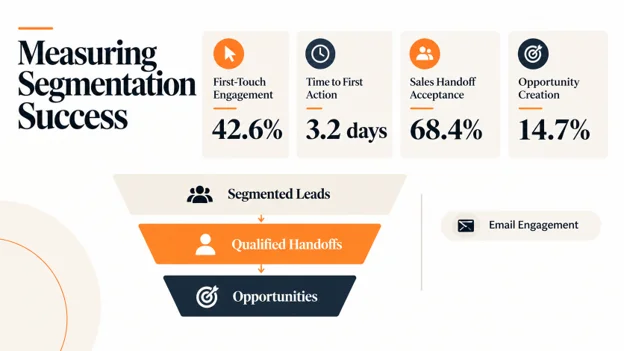
Segment-level reporting is what separates a working model from a tidy one. Track:
- First-touch engagement by asset topic: which topics earn follow-up clicks
- Time to first owned-channel action: how fast leads start behaving
- Handoff acceptance rate by segment: which segments sales actually values
- Opportunity creation by segment: the number that matters most
- Rejection reasons by segment: patterns tell you where your rules are wrong
When a segment produces plenty of engagement but few accepted handoffs, your intent threshold is too low. When a segment produces few handoffs but strong conversion, your threshold may be too tight.
This is also the honest answer to the volume-versus-quality debate. Better segmentation can make a smaller pool of syndicated leads more productive. For the wider trade-off, read lead volume vs lead quality in content syndication.
Where segmentation fits in the bigger picture
Segmentation is the bridge between capture and sales. Good segmentation starts earlier, when you set goals for leads, pipeline, or awareness, because the goal decides which assets you syndicate and therefore which segments you will have. It ends in a clean handoff that supports content syndication for B2B sales.
The wider programme logic lives in our B2B content syndication strategy.
segment content syndication leads before you nurture them
Syndicated leads are not weak. They are early. Treating them as early, and sorting them by asset, role, intent, and stage, is what turns a download into a conversation sales actually wants.
To segment content syndication leads well, start with what the asset implies, wait for what the lead does, and never promote a lead on a download alone. Fewer, sharper segments with a clear action each will outperform one long sequence every time.
If you would like segmentation designed into your syndication programme from the first brief, talk to Valasys Media about building nurture-ready lead segments with your next campaign.
Frequently asked questions
-
What does it mean to segment content syndication leads?
It means grouping leads from syndicated content into categories, such as asset topic, role, intent level, and buying stage, so each group gets relevant follow-up. The goal is to match the message to what the lead actually needs and to decide which leads are ready for sales and which still need education.
-
Should I segment by asset or by job title first?
Start with the asset. It is the only signal the lead chose themselves, and it tells you the problem they were researching. Then use role to adjust the angle and depth. Job titles vary too much between companies to be a reliable starting point on their own.
-
How many segments should I create?
Create as many as your team can write distinct content for, and no more. For most teams that is three to five tracks organised by topic cluster, each with role variants. Over-segmenting leaves thin, repetitive tracks, which defeats the purpose of segmenting.
-
What tools do I need to segment syndication leads?
A CRM with custom fields for asset, channel, and source, a marketing automation platform for scoring and behaviour tracking, and a way to enrich missing firmographic data. Spreadsheets can work for the first batch, but dynamic segments are easier to maintain in automation tools.
-
What is the biggest mistake teams make with syndicated lead nurture?
Treating all leads the same, or promoting them to sales on a download alone. Both come from ignoring that syndicated leads begin at the top of the funnel with weak signals. Separate implicit intent from behaviour you observe in your own channels before you hand anything to sales.
-
When is a syndicated lead ready for sales?
When the account fits your ICP or TAL and the lead has done something meaningful with you, such as visiting pricing or case study pages, replying to an email, or requesting contact. A download alone is not enough. Agree the exact rule with sales in advance so handoffs are accepted.