

SDR Follow-Up Scripts for Content Syndication Leads
Discover effective SDR follow-up scripts to engage content syndication leads, improve response rates, and convert prospects into lead


What Makes SDR Follow-Up Scripts Work for Content Syndication Leads?
Effective SDR follow-up scripts for content syndication leads reference the exact asset downloaded, name the business problem behind it, and offer something useful before asking for a meeting. Send the first touch within 48 hours, mix email, phone and LinkedIn across 10-14 days, and tailor scripts to lead tier rather than sending one template to everyone.
Why Most Follow-Up on Syndicated Leads Falls Flat
Picture a Monday morning. An SDR opens a CSV of 300 new leads from a syndication campaign. The first email template says, “Thanks for your interest in our solution.” The prospect never expressed interest in a solution. They downloaded a benchmark report three weeks ago, on a Thursday, between meetings.
That gap is the whole problem. A syndicated lead raised their hand for a topic, not for you.
Treat them like a demo request and you sound presumptuous. Ignore the context and you sound like every other cold email in their inbox.
This is also why many teams quietly decide the leads are poor quality, when the real issue is the follow-up. If that debate sounds familiar, why sales rejects content syndication leads explains how much of it traces back to handoff and messaging rather than the list itself.
The fix is not a clever subject line. It is a better system for deciding what to say, to whom, and when.
Key Takeaways
- A syndicated lead is a topic-level signal. Scripts should lead with the topic and the asset, not your product.
- Tier leads before writing a word. A VP who downloaded three assets deserves a different message than an analyst who downloaded one.
- Always have a ready answer for “I don’t remember downloading that.” It is the most common reply and the most mishandled.
- Use 10-14 days and 6-8 touches across email, phone and LinkedIn, then stop and recycle the lead into nurture.
- Track rejection reasons. Follow-up is also your best source of lead quality data.
How Is a Syndicated Lead Different From a Demo Request?
A demo request is a purchase-stage signal. A syndicated lead is an education-stage signal, collected on a third-party platform, often weeks before the SDR calls. Different intent means different scripts.
| Factor | Demo request | Syndicated lead |
| Who initiated contact | The buyer, on your site | The buyer, on a partner’s platform |
| Stated intent | Evaluate your product | Learn about a topic |
| Memory of the interaction | Fresh | Often faint |
| Right opening move | Book the demo | Add context, ask about the challenge |
| Right first CTA | Calendar link | A question or a useful resource |
| Typical objection | Pricing, timing | “Who are you? Why are you contacting me?” |
If your team is still deciding what content syndication should deliver for sales, content syndication for B2B sales is a useful starting point, and setting goals for leads, pipeline or awareness will keep expectations realistic before any script is written.
What Should SDRs Do Before Sending a Single Script?
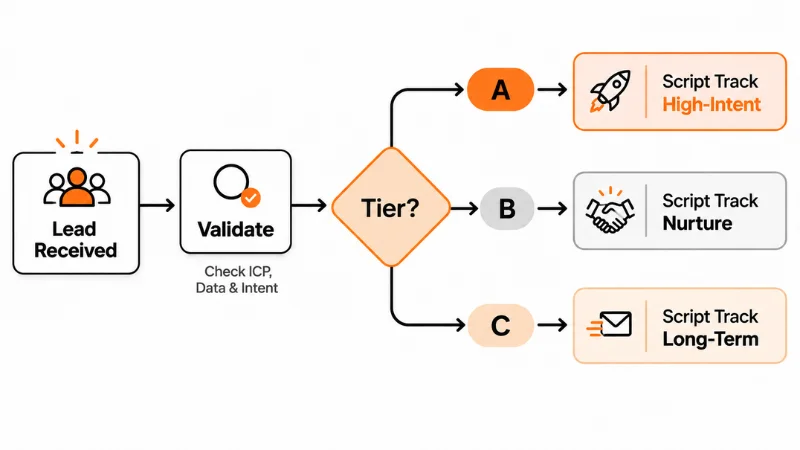
Check the lead first, then write. Scripts cannot rescue a lead who is outside your ICP, uses a personal email, or whose job title does not match what the form says.
A two-minute pre-flight check saves hours of wasted outreach. Confirm the title and company on LinkedIn, check the account against your target list, and note which asset was downloaded and when. Our guides on how to validate content syndication leads and the content syndication lead quality checklist cover this in depth.
The pre-flight also gives you the personalisation of raw material. The asset title, the persona, and the likely pain point are all you need for a message that feels written for one person.
The Valasys 5-Layer Follow-Up Framework
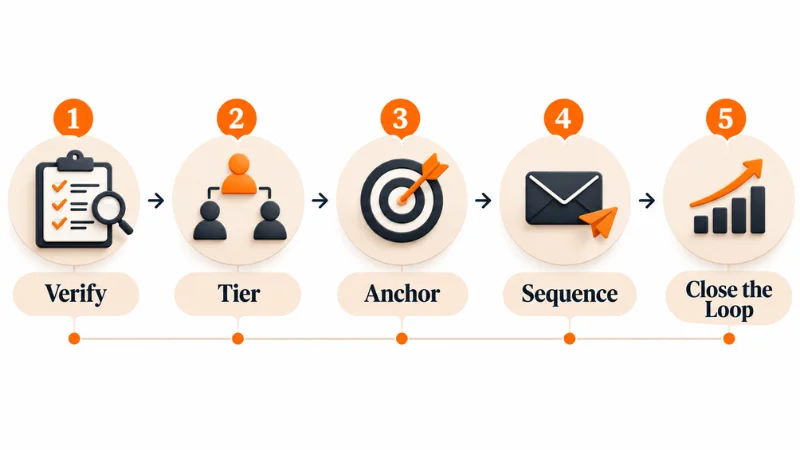
This is the framework we recommend teams save and reuse. Each layer answers one question SDRs usually skip.
Layer 1: Verify
What to do: Confirm the lead is real, relevant and reachable.
Why it matters: Bad data produces bounces, wrong-person replies and false conclusions about campaign quality.
How to execute: Check title, company size, industry and email validity. Flag anyone outside ICP for nurture only.
Common mistake: Sequencing every lead because the CRM says “new.”
Measure: Percentage of leads removed at pre-flight and why.
Layer 2: Tier
What to do: Sort leads into three tiers using fit and engagement.
Why it matters: One template for everyone guarantees mediocre results for everyone.
How to execute:
- Tier A: ICP account, decision-maker or influencer title, multiple assets or high-intent topic.
- Tier B: ICP account, relevant title, single asset.
- Tier C: Partial fit or early-stage researcher.
Common mistake: Tiering on title alone and ignoring what they actually downloaded. Measure: Reply rate by tier. If Tier A does not outperform Tier C, your tiering rules need work.
Layer 3: Anchor
What to do: Tie the message to the asset and the pain behind it.
Why it matters: The asset is the only shared context you have with the prospect.
How to execute: Map each asset to one business problem. A report on attribution maps to “proving marketing’s contribution to the pipeline.” A checklist on data hygiene maps to “wasted SDR hours on bad records.”
Common mistake: Naming the asset, then pivoting straight to a product pitch.
Measure: Positive reply rate on Email 1.
Layer 4: Sequence
What to do: Run a multichannel cadence with a clear end.
Why it matters: Single-channel follow-up leaves reachable prospects untouched.
How to execute: Use the cadence below. Each touch should add something new: an insight, a resource, a question.
Common mistake: Sending “just checking in” emails.
Measure: Touches per conversation and connect rate by channel.
Layer 5: Close the Loop
What to do: Record outcomes and send patterns back to marketing.
Why it matters: Follow-up is the fastest quality test your campaign will ever get.
How to execute: Log standard reasons (wrong persona, no recall, no budget, not now, competitor). Review weekly.
Common mistake: Letting reps write free-text notes nobody reads.
Measure: Lead-to-conversation and conversation-to-SQL rate, by campaign and asset.
Want to see how your current follow-up process compares with this framework? Explore our approach to content syndication lead nurturing.
What Does a Good Follow-Up Cadence Look Like?
A workable cadence for Tier A and B leads spans 10-14 days. The goal is a conversation, not a meeting on the first touch.
| Day | Channel | Purpose |
| 1-2 | Context + question | |
| 3 | Light connection, no pitch | |
| 4-5 | Add a resource | |
| 6 | Phone | Human conversation (Tier A first) |
| 8 | Short peer insight | |
| 10 | Phone + voicemail | Second attempt |
| 12-14 | Breakup note, recycle to nurture |
For a longer 30-day structure including scoring and metrics, see our content syndication follow-up plan. Tier C leads skip the calls and go straight into nurture, which you can design with a segmentation approach.
SDR Scripts You Can Copy and Adapt
Every script below follows one rule: give before you ask. A content download is a conversation starter, not proof that someone is ready to buy. Lead with context, offer something useful and give the prospect room to respond honestly.
Replace the brackets with verified details. If you cannot substantiate a claim or personalize a line, remove it.
Email 1 (Tier A): Lead with context
Subject: [Topic] at [Company]
Hi [First Name],
I noticed you recently downloaded [Asset Title] through [Partner Name]. The section on [specific topic] made me think it might be relevant to what your team is working on at [Company].
I’m curious, is [specific challenge] something you’re currently trying to solve, or are you looking into the broader [topic]?
Either way, I can share a useful example of how [relevant company type] is approaching it.
Worth sending over?
Best,
[Name]
Email 1 (Tier B): Keep it light
Subject: Was [Topic] on your radar?
Hi [First Name],
I wanted to reach out after you accessed [Asset Title].
Was [topic] something you were actively looking into, or did the resource simply catch your interest?
No assumptions either way. If it’s something you’re exploring, I have a quick checklist that might be useful.
Happy to share it.
Best,
[Name]
Email 2: Bring something useful to the table
Subject: Thought you’d find this useful
Hi [First Name],
Came across this [case study / checklist / benchmark] on [topic] and thought you might find it useful after reading [Asset Title].

I particularly liked its take on [specific insight or takeaway]. It offers a practical perspective on [business challenge].
Here’s the link: [Link]
Curious if this lines up with what you’re seeing at [Company].
Best,
[Name]
Reply to “I don’t remember downloading that”
The best response here is to make the prospect comfortable, not convince them that they should remember.
Totally understandable! It was through [Partner Name] on [date], so it may not be something you remember offhand.
I just wanted to follow up because the resource covered [topic]. If that’s relevant to your work, happy to share something more specific. And if it’s not something you’re interested in, no worries at all. I can make sure you don’t receive further outreach from us.
This acknowledges their response, explains the source and gives them control over what happens next. Always honour opt-out requests promptly.
Call opener: Make it a conversation
“Hi [First Name], this is [Name] from [Company]. Have I caught you at an okay time?
I’m calling because you recently accessed [Asset Title] through [Partner Name]. I wanted to understand whether [topic] is something you’re looking into at the moment, or if you were just exploring the subject.”
If they show interest:
“Got it. What’s driving that interest? Is there a particular challenge your team is trying to address?”
If it’s not a priority:
“That makes sense. I won’t take up more of your time. Would it be okay if I shared a useful resource for whenever this comes up?”
The goal is to earn the next question, not rush into a pitch.
Voicemail: Give them a reason to call back
“Hi [First Name], this is [Name] from [Company].
I’m reaching out about [topic] and wanted to share a resource that might be useful, particularly around [specific challenge].
I’ll drop you a quick email with the details. If it’s relevant, feel free to get back to me at [number].
Thanks!”
LinkedIn note: Start with a genuine connection
Hi [First Name], I work with [role] teams on [topic] and thought it would be great to connect. I’m particularly interested in how teams are approaching [specific challenge]. Would love to hear your perspective!
Use only where the connection and outreach are appropriate under applicable permissions and platform rules.
Gatekeeper or colleague redirect: Be respectful
“Hi, I’m trying to reach the person who looks after [topic] at [Company]. Would [First Name] be the right person to speak with, or is there someone else who handles this?”
Keep it simple. You’re looking for the right contact, not trying to get around the person answering the call.
Breakup email (Day 12–14): Leave the door open
Subject: Should I close the loop?
Hi [First Name],
I’ve reached out a couple of times, so I’ll leave it here rather than keep filling your inbox.
If [topic] comes back onto your team’s radar, here’s the resource I thought might be useful: [Link].
And if there’s someone else I should be speaking with, I’m happy to connect with them instead.
Wishing you a great week!
Best,
[Name]
Handoff note to the Account Executive: Pass the context, not just the contact
A positive reply is an opportunity to continue a conversation. Don’t make the prospect start from scratch with another person.
Include:
- What brought them in: Asset, source partner and download date.
- What they actually said: Their response, questions or expressed interest.
- What’s happening at their end: Any challenge, initiative or business priority they’ve shared.
- Where to take the conversation: A suggested next step based on what you know.
Example handoff:
VP, Revenue Operations at [Company] downloaded the MQL-to-SQL Handoff Playbook through [Partner]. They mentioned that lead routing consistency is a current challenge. Suggested next step: explore their existing routing process and share relevant examples.
A good handoff gives the AE a head start and makes the conversation feel continuous rather than like another cold introduction.
Which Mistakes Hurt Follow-Up Most?
| Mistake | Why it hurts | Fix |
| Pitching in Email 1 | The lead asked for learning, not selling | Lead with the asset and a question |
| Waiting two weeks to reach out | The download is forgotten | First touch within 48 hours |
| One script for every persona | Pain points differ by role | Write persona variants |
| “Just checking in” emails | Adds nothing | Every touch gives a new insight |
| Ignoring non-replies as a signal | Missed lead quality data | Log reasons weekly |
| Never telling marketing what you hear | Same bad leads keep arriving | Feed patterns back each week |
Several of these start upstream, in how the campaign was set up. See content syndication mistakes that hurt lead quality and how to improve lead quality in content syndication.
SDR Follow-Up Checklist
- Lead validated and tiered
- Asset title and download date noted
- One-line pain point written for this persona
- First touch scheduled within 48 hours
- Calls prioritised for Tier A
- Opt-out line included where required
- Outcome logged with a standard reason code
- Non-responders moved to nurture after Day 14
Struggling to tell which leads deserve a call? See how Valasys helps teams build cleaner, better-matched lead lists before the first script is sent.
How Do You Know If Your Follow-Up Is Working?
Track outcomes by tier and by asset, not as one blended number. Blended numbers hide the leads that work.
- Time to first touch: Hours between lead delivery and first outreach.
- Connect rate and reply rate: By channel and by tier.
- Positive reply rate: Replies that show interest, separate from opt-outs.
- Lead-to-conversation and conversation-to-SQL: The funnel that matters.
- Rejection reasons: The campaign quality signal.
If volume is rising while conversations are flat, you may be trading quality for quantity. Lead volume vs lead quality walks through that trade-off. And if you are building the programme from the beginning, start with a B2B content syndication strategy and a clear campaign brief.
Final Thoughts
Follow-up on syndicated leads is not about better templates. It is about respect for context: the asset they read, the problem behind it, and the fact that they never asked to be sold to.
Verify, tier, anchor, sequence, close the loop. Do those five things and the same leads your sales team once dismissed start producing conversations.
Ready to turn syndicated leads into sales conversations? Talk to Valasys about a lead programme built for follow-up from day one.
Frequently Asked Questions
- Should SDRs name the syndication partner when following up?
Yes. Naming the partner and the asset reminds the prospect where they saw your content and shows you are not hiding the source. It also reduces “how did you get my details” replies. Keep it brief and factual, and offer an easy opt-out in the same message. - Is it acceptable to call a syndicated lead by phone?
Often yes, but it depends on the consent wording of the original form and local regulations. Confirm with your syndication provider what the lead agreed to, and follow your legal team’s guidance. If phone permission is unclear, start with email and LinkedIn. This is not legal advice. - How many follow-up touches are enough before stopping?
Six to eight touches over 10-14 days across email, phone and LinkedIn is a practical range for most B2B teams. After that, move the lead into nurture rather than continuing the sequence. Persistence has a limit, and extra touches mostly raise unsubscribes. - What should an SDR do if a lead downloaded several assets?
Treat it as a stronger signal. Reference the theme across the assets rather than listing each one, and prioritise a call over an email. Multiple downloads on one topic usually indicate active research, which makes a direct question about their current project appropriate. - How can SDRs personalise follow-up at scale for large lists?
Build a short library: one pain point per asset, one variant per persona, and one proof point per industry. Merge these into templates, then spend manual effort only on Tier A. This keeps messages specific without requiring 300 hand-written emails. - Who should own the follow-up: marketing or sales? SDRs should run first-touch outreach, but marketing should own the nurture track and the lead quality feedback loop. Agree on service levels in advance: how quickly leads are contacted, what counts as accepted, and how rejection reasons are shared.