
Decision-Maker vs Influencer vs User in BANT Qualification
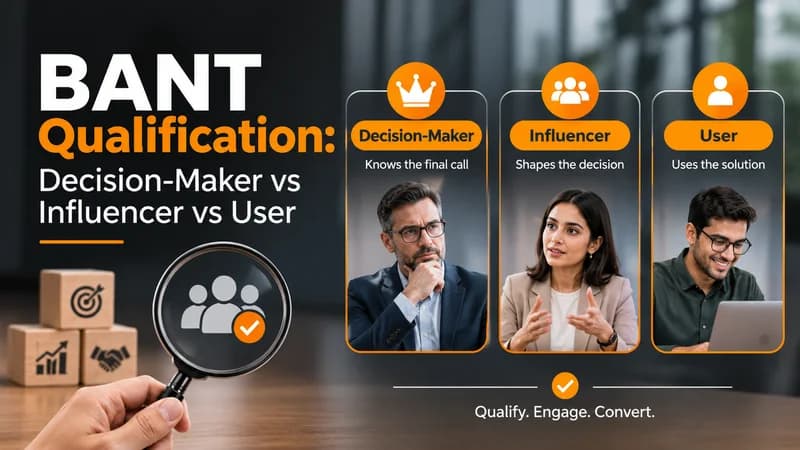
What is the difference between a decision-maker, influencer, and user? A decision-maker has authority to approve the purchase or a defined part of it. An influencer shapes the choice through advice, evaluation, or credibility but may not approve it. A user works with the solution day to day. One person can hold several roles, so responsibilities must be checked for each purchase. Key Takeaways Roles describe what someone does in one specific purchase, not what their title suggests. Approval can be split. Choosing the solution, releasing the funding, and signing the contract may sit with different people. Influencers and users often cannot approve anything, but they shape the evaluation. Keep them involved. Record who told you what, when, and whether the responsible person confirmed it. A confirmed role is not a confirmed purchase. Budget, need, and timeline still need their own evidence. How the three roles compare in BANT qualification BANT stands for Budget, Authority, Need, and Timeline. This blog stays on the Authority part, and on who sits behind it. Role Main contribution What the role does not establish by itself Useful verification question Decision-maker Approves the solution choice, the spend, or both, within a defined scope That every needed approval is covered. Finance, IT, or procurement may still weigh in “Once your team picks a supplier, which approvals are still needed?” Influencer Shapes the decision through evaluation, expertise, or advice Formal approval rights, or that their preference will win “How will your recommendation be weighed, and who receives it?” User Works with the solution daily and knows what must function in practice Budget control, or a view on cost, security, or contract terms “What would have to work in your daily workflow for you to support this?” These roles overlap. A manager can evaluate a tool, use it daily, and also approve it. In a larger purchase, those jobs may land on three different people. So assess the roles for the purchase you are discussing, not for the person in general. The same contact can be the approver on a small tool purchase and only an influencer on a platform that touches finance and IT. Assess these roles within the wider BANT qualification framework, because authority alone does not establish budget, need, or timing. Why a job title does not confirm purchase authority A VP title suggests seniority. It does not tell you whether that person signs off on this purchase, this budget, or this contract. A director at a small company may control a software budget outright, while a senior executive elsewhere may never see the request. BANT can oversimplify complex purchases when it turns into a hunt for one decision-maker. Asking “Are you the decision-maker?” invites a quick yes or no, and a quick yes can hide what is still unresolved. Enthusiasm and product knowledge are not authority either. A contact who knows your category well and argues for the purchase may be an internal champion, meaning someone who advocates for it inside the company. That is useful. It is not the same as approval. Instead of asking who “the” decision-maker is, separate four responsibilities: Solution approval: who agrees this is the right option. Funding approval: who confirms the money can be spent. Procurement: who handles vendor checks and commercial terms, where that step exists. Implementation: who judges whether it can be set up and run. Not every purchase has all four. One person may cover several. Ask about each instead of assuming. This matters most when a contact says “I’m the one who decides.” They may well be. But they may mean they decide which option the team prefers, while the budget sits with someone else. Both statements can be sincere. Only one of them gets a contract signed. Prefer purchase-specific wording. “Who approves this reporting platform, at this scope?” gets a better answer than “Who’s in charge?” The first points to a decision. The second invites an organisational chart. Questions that reveal each stakeholder’s role The aim is to learn how the purchase can be approved, not to interrogate your contact. Keep the questions conversational, and treat “I’m not sure” as useful information. It tells you which part of the approval path is still a gap, and a gap you can name is one you can close. A practical order: start with the user or influencer you already have, then ask them to describe how the decision usually moves. People often explain the process more freely than they claim the authority. Ask decision-makers about the scope of their approval Try these: “What can you approve on your own?” “Who approves or releases the funding for this?” “After your team recommends a supplier, what happens next?” The first question shows the limits of their authority. The second separates choosing a solution from paying for it. The third surfaces steps people forget to mention, such as legal review or a procurement check. If the answer is “I’d need to check with finance,” that is not a failure. Finance becomes a stakeholder to record. Follow up by asking who should confirm the process, and whether they can be included in the next conversation. Ask influencers how recommendations are evaluated Try these: “How will your team compare the options?” “Who receives your recommendation?” “Which technical, procurement, or other reviews remain?” These reveal the evaluation criteria and the route a recommendation travels. Follow up by asking whether a recommendation usually goes forward as is, or gets reviewed again. If it gets reviewed, find out by whom. Do not dismiss someone because they lack sign-off. They may be the person who decides whether you reach the shortlist. If an influencer offers to introduce you to the approver, take the introduction and keep the influencer in the loop. Going around them can cost you the relationship that got you this far. Ask users what must work in practice Try these: “What has to work in your daily workflow?” “What would make you reject a tool like this?” “Will you take